
 100% FREE ACCESS
6th Standard CBSE Syllabus & Materials
6th Standard CBSE
CBSE 6th Social Science The Value of Work - New Sample Question Papers Study Material - QB365 Set A
NEW6th Standard CBSE
CBSE 6th Social Science Family and Community - New Sample Question Papers Study Material - QB365 Set A
NEW6th Standard CBSE
CBSE 6th Social Science India's Cultural Roots - New Sample Question Papers Study Material - QB365 Set A
NEW6th Standard CBSE
CBSE 6th Social Science India,That is Bharat - New Sample Question Papers Study Material - QB365 Set A
NEW6th Standard CBSE
CBSE 6th Social Science Timeline and sources of history - New Sample Question Papers Study Material - QB365 Set A
NEW6th Standard CBSE
CBSE 6th Social Science Oceans and Continents - New Sample Question Papers Study Material - QB365 Set A

Published on: 26/09/2019
Separation of Substances
Download CBSE Class 6th Standard CBSE Science question papers, sample papers, important questions, and previous year solved papers in PDF format. Get free study materials, NCERT solutions, and exam preparation resources for Class 6th Standard CBSE Science
Questions + Answers key
Take MCQ Science Test
1.
A mixture of iron nails, salt, oil and water is provided to you. Give step wise method to separate each component from this mixture?
2.
You are provided with a mixture of salt, sand, oil and water. Write the steps involved for the separation of salt, sand and oil from the mixture by giving an activity along with the diagram
3.
Rohit and Raman are best friends. They study in different class but in the same standard, Class VI. One day, they were playing in the school. They were throwing sand on each other. Suddenly Raman asked to Rohit if we mix salt in sand, then how will you separate the mixture of sand and salt?
Rohit was quite intelligent, his science teacher had completed the chapter separation of substances last week. So, he immediately explained the method of separation. Rohit told him that his teacher had shown this activity in the class and same method is applicable for the separation of mixture of sugar and sand.
Read the passage carefully and answer the following questions:
(a) How a mixture of sand and salt is separated?
(b) Name the method(s) which are applicable in the separation of this mixture.
(c) What values are shown by Rohit?
4.
Read the story titled 'Wise Farmer' and tick the correct option to complete the story.
A farmer was sad/happy to see his healthy wheat crops ready for harvest. He harvested the crops and left it under the sun/rain to dry the stalks. To separate the seeds from the bundles of the stalk, he handpicked/threshed them.
After gathering the seed grains, he wanted to separate the stones and husk from it. His wife winnowed/ threshed them to separate the husk and later sieved/ handpicked to remove stones from it. She ground the wheat grains and sieved/filtered the flour. The wise farmer and his wife got a good price for the flour. Can you tell why?
5.
Both Sarika and Mohan were asked to make salt solution. Sarika was given a teaspoonful of salt and half a glass of water whereas, Mohan was given twenty teaspoonful of salt and half a glass of water.
(a) How would they make salt solutions?
(b) Who would be able to prepare saturated solution?
1.
The method to separate each component from the mixture is given below:
(i) Hand picking: It is used to separate iron nails from the mixture.
(ii) Decantation: The mixture is allowed to stand for some time. The clear liquid is poured to another container to separate oil from the mixture.
(iii) Evaporation: The remaining liquid is allowed to evaporate till residue is obtained. This residue is salt.
2.
A mixture of salt, sand, oil and water can be separated by following steps:
Step I : First of all, the clear liquid is poured into another container by the process of decantation. By this process, oil is separated from the mixture.
Step II : Now filter the mixture by using filter paper, funnel and container by the process of filtration. By this process, sand is separated from the mixture
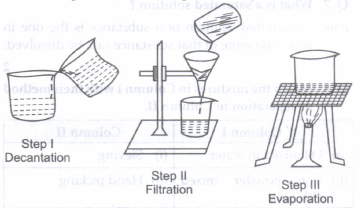
Step III : Finally, the remaining liquid evaporates till the residue in obtained by the process of evaporation. By this process, salt is separated from the mixture.
3.
(a) This is done as follows:
(i) Some water is added to the mixture of sand and salt in a beaker and stirred. Salt dissolves in water to form salt solution, whereas sand remains undissolved. It is then filtered.
(ii) On filtering, sand is obtained as a residue on the filter paper and salt solution is obtained as a filtrate. (iii) The filtrate is evaporated and pure salt is left behind.
(b) The mixture of sand and salt has been separated into its components, i.e sand and salt by doing two methods.
(i) Filtration
(ii) Evaporation
(c) Rohit is knowledgeable and intelligent boy.
4.
(i) happy
(ii) sun
(iii) threshed
(iv) winnowed
(v) handpicked
(vi) sieved
They got a good price as they used appropriate methods of separation to get good quality of flour (atta).
5.
(a) They will mix salt with water within a certain amount to make salt solution. Hence, Sarika will make a better salt solution.
(b) Saturation is the point at which a solution of a substance can dissolve no more of that substance and additional amount of that substance will appear as a precipitate, Mohan's solution would be saturated because in Mohan's case, some salt would remain undissolved and settled at the bottom of the glass.

6th Standard CBSE Syllabus & Materials
6th Standard CBSE
CBSE 6th Social Science Locating Places on the Earth - New Sample Question Papers Study Material - QB365 Set A
NEW6th Standard CBSE
CBSE 6th Science A Journey Through States of Water - New Sample Question Papers Study Material - QB365 Set A
NEW6th Standard CBSE
CBSE 6th Science Temperature and its Measurement - New Sample Question Papers Study Material - QB365 Set A
NEW6th Standard CBSE
CBSE 6th Science Materials Around Us - New Sample Question Papers Study Material - QB365 Set A



CBSE 6th Standard CBSE Subjects
CBSE Standards




