
 100% FREE ACCESS
6th Standard CBSE Syllabus & Materials
6th Standard CBSE
CBSE 6th Social Science The Value of Work - New Sample Question Papers Study Material - QB365 Set A
NEW6th Standard CBSE
CBSE 6th Social Science Family and Community - New Sample Question Papers Study Material - QB365 Set A
NEW6th Standard CBSE
CBSE 6th Social Science India's Cultural Roots - New Sample Question Papers Study Material - QB365 Set A
NEW6th Standard CBSE
CBSE 6th Social Science India,That is Bharat - New Sample Question Papers Study Material - QB365 Set A
NEW6th Standard CBSE
CBSE 6th Social Science Timeline and sources of history - New Sample Question Papers Study Material - QB365 Set A
NEW6th Standard CBSE
CBSE 6th Social Science Oceans and Continents - New Sample Question Papers Study Material - QB365 Set A

Published on: 13/08/2019
The Living Organisms and their Surroundings
Download CBSE Class 6th Standard CBSE Science question papers, sample papers, important questions, and previous year solved papers in PDF format. Get free study materials, NCERT solutions, and exam preparation resources for Class 6th Standard CBSE Science
Questions + Answers key
Take MCQ Science Test
1.
Differentiate between excretion and secretion in plants and animals.
2.
List the types of movements seen in plants.
3.
List the common characteristics of the living things.
4.
Define the following:
(i) Prey
(ii) Predators
(iii) Acclimatization
(iv) Adaptation
(v) Stimuli
5.
List the important characteristics of living things which differentiate them from non-living things.
6.
Camels live in desert habitat. How do they adapt to such harsh climate?
7.
Animals like mountain goat and snow leopard do not slip or fall. Why?
8.
State an example of animals showing response to a stimuli.
9.
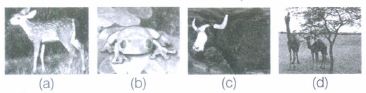
Using the following words, write the habitat of each animal given in figures (a to d). Grassland, mountain, desert, pond, river
10.
Name one characteristic which identify seeds as living beings.
11.
What is the function of gills ?
12.
Camel is called of ___________ desert.
13.
Forest and trees act as _____________ .
14.
Soil, water and air are__________ components of habitat.
15.
Soil, water and air are the ______________ factors of a habitat.
16.
The biggest animal living on the earth is
Whale
Zebra
Elephant
Camel
17.
Fishes move about in water with the help of their
mouth and gills
legs and seales
wings and tails
fins and tails
18.
Respiration in aquatic animals occurs by
lungs
gills
nostrils
legs
19.
Carbon dioxide in air is used by plants to
breathe
make food
remove waste
trap energy of the sun for photosynthesis
20.
Boojho comes across an animal having a streamlined and slippery body. What is the habitat of the animal?
Water
Desert
Grassland
Mountain
21.
Which of the following cannot be called a habitat?
A desert with camels
A pond with fishes
A jungle with wild animals
Cultivated land with gratr'ng cattle
22.
All animals can live in isolation and are independent.
23.
All plants and animals cannot survive without air.
24.
All living beings need water.
25.
Almost all types of plants are found in sea.
26.
Non-living objects carry out respiration.
27.
Aeroplane
28.
Bird
29.
Whale
30.
Snow bear
31.
Cockroach
1.
Differentiate between excretion and secretion in plants and animals
| Excretion | Secretion |
| The removal of waste substances from the body of a living being is called excretion. | The process of removal of wastes in plants is referred to as secretion. |
| e.g. formation of urine excrete urea from the animals, body. | e.g. latex, resin and gum are waste for the ptant but useful for us. |
2.
We see the following movements in plants
(i) Opening and closing of flower.
(ii) Growth of stem and leaves.
(iii) Growth of stem and twigs towards light and roots towards soil and water.
3.
Living things have following common characteristics:
(i) Growth
(ii) Movement
(iii) Reproduction
(iv) Respiration
(v) Adaptation
(vi) Excretion
4.
(i) Prey: An animal hunted or caught for food.
(ii) Predator: An organism that lives by preying on other organisms is called a predator.
(iii) Acclimatization: It is the process in which an individual organism adjusts to a gradual change in its environment (such as a change in temperature, humidity, photoperiod, or pH) allowing it to maintain performance across a range of environmental conditions. Acclimation occurs in a short period of time (days to weeks), and within the organism's lifetime
(iv) Adaptation: In biology, an adaptation, also called an adaptive trait, is a trait with a current functional role in the life history of an organism that is maintained or developed by means of natural selection. Adaptation refers to both the current state of being adapted and to be in the dynamic evolutionary process that leads to the adaptation.
(v) Stimuli: An agent, action, or condition that elicits or accelerates a physiological or psychological activity response.
5.
Differences between living and non-living things:
| Living things | Non-living things |
| Living things are grow. | Non-living things do not Grow. |
| They can move on their own | They cannot move |
| They can reproduce | They cannot reproduce |
| They have different life span. | They might exist forever. |
| Living things are made up of cells | They do not have cell-like structures. |
6.
Camels have long legs, a hump and padded feet. All of these are adaptive features which help camel to survive in desert habitat.
7.
These animals have big and padded feet and strong hooves to spread their weight preventing slip or fall.
8.
On sudden appearance of bright lights animals run-off like cats, rats, etc.
9.
(a) The diagram is of a deer which lives in grassland.
(b) The diagram is of a frog which lives in pond.
(c) The diagram is of a yak which lives in mountain.
(d) The diagram is of a camel which lives in desert.
10.
Seeds respire so, it can be identified as living beings.
11.
()
To absorb oxygen dissolved in water.
12.
()
ship
13.
()
wind brakes
14.
()
abiotic
15.
()
abiotic
16.
17.
(d)
fins and tails
18.
(b)
gills
19.
(b)
make food
20.
(a)
Water
21.
(d)
Cultivated land with gratr'ng cattle
22.
(b)
23.
(a)
24.
(a)
25.
(b)
26.
(b)
27.
()
Non-living thing
28.
()
Flight adaptation
29.
()
Aquatic animal
30.
()
Found on mountain
31.
()
Nocturnal

6th Standard CBSE Syllabus & Materials
6th Standard CBSE
CBSE 6th Social Science Locating Places on the Earth - New Sample Question Papers Study Material - QB365 Set A
NEW6th Standard CBSE
CBSE 6th Science A Journey Through States of Water - New Sample Question Papers Study Material - QB365 Set A
NEW6th Standard CBSE
CBSE 6th Science Temperature and its Measurement - New Sample Question Papers Study Material - QB365 Set A
NEW6th Standard CBSE
CBSE 6th Science Materials Around Us - New Sample Question Papers Study Material - QB365 Set A



CBSE 6th Standard CBSE Subjects
CBSE Standards




