
 100% FREE ACCESS
6th Standard CBSE Syllabus & Materials
6th Standard CBSE
CBSE 6th Social Science The Value of Work - New Sample Question Papers Study Material - QB365 Set A
NEW6th Standard CBSE
CBSE 6th Social Science Family and Community - New Sample Question Papers Study Material - QB365 Set A
NEW6th Standard CBSE
CBSE 6th Social Science India's Cultural Roots - New Sample Question Papers Study Material - QB365 Set A
NEW6th Standard CBSE
CBSE 6th Social Science India,That is Bharat - New Sample Question Papers Study Material - QB365 Set A
NEW6th Standard CBSE
CBSE 6th Social Science Timeline and sources of history - New Sample Question Papers Study Material - QB365 Set A
NEW6th Standard CBSE
CBSE 6th Social Science Oceans and Continents - New Sample Question Papers Study Material - QB365 Set A

Published on: 25/10/2019
CIV - Key Elements of a Democratic Government
Download CBSE Class 6th Standard CBSE Social Science question papers, sample papers, important questions, and previous year solved papers in PDF format. Get free study materials, NCERT solutions, and exam preparation resources for Class 6th Standard CBSE Social Science
Questions + Answers key
Take MCQ Social Science Test
1.
What do you understand by the term 'participation'? Why do conflicts arise? Give an example of conflict in India.
2.
How are the members of the Lok Sabha elected?
3.
What features of the Indian Constitution are mentioned in the Preamble?
4.
What is the structure of the judiciary in India?
5.
What is the importance of public opinion? Name the agencies which are helpful in the formation of public opinion.
6.
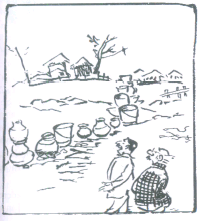
Look at the cartoon carefully and answer the question.
(i) What approval or disapproval is being expressed here?
7.
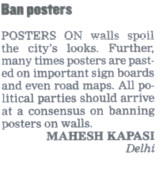
Look at the newspapers and discuss some elections that you may have read about. Why do you think elections are required after a fixed period?
8.
Write a short note on the Cauvery water dispute between Karnataka and Tamil
Nadu.
1.
(i) People's participation can be understood as the participation of people in governance through elections and other means such as rallies, processions, signature campaigns, etc.
(ii) People participate by taking an interest in the working of the government and criticising it as and when required.
(iii) By participating, people express their opinions and public opinion thus created is very essential in a democracy.'
(iv) Conflicts arise when the interest of the people of different cultures, religions, regions or economic background contradict.
(v) For example, river can be a source of conflict, like the Cauvery River Dispute between Karnataka and Tamil Nadu.
2.
(i) The members of the Lok Sabha are elected directly by the people.
(ii) Territorial areas called Parliamentary Constituencies are set up in each State and Union territory for the purpose of elections.
(iii) Seats are allotted to various States on the basis of their respective population.
(iv) Any number of candidates may contest an election from the same constituency.
(v) The candidate who secures majority of vote is declared elected to the Lok Sabha.
3.
(i) The objectives of the country as mentioned in the Preamble of the Constitution of India are Justice, Equality, Fraternity and Liberty.
(ii) In the Constitution of India, justice means justice for all.
(iii) Social justice means justice for the whole society and no discrimination on the basis of caste or colour.
(iv) Economic justice implies equal distribution of wealth and political justice means equal participation of every individual in the government.
(v) Liberty: Indian citizens are given freedom of thought, expression, belief, faith and worship.
(vi) Equality: Liberty without equality is meaningless. Every citizen of India is treated equally before the law and is ensured equal protection.
(vii) Fraternity : It means brotherhood among the people of India.
4.
(i) There are three different levels of courts in India. There are several courts at the lower level and only one court at the apex level.
(ii) The courts that most people interact with called as District Courts. These are at the district or Tehsil or towns and they hear all kinds of cases.
(iii) Every State has a High Court which is the highest court of appeal of that State.
(iv) At the top is the Supreme Court which is presided over by the Chief Justice of India.
(v) The decisions made by the Supreme Court are binding on all the other courts in India.
5.
(i) Public opinion contributes a lot to the development of social life. It does not allow the government to be absolute.
(ii) The views, interests and aspirations of the people constitute the core of a democratic system.
(iii) Public opinion ensures democratic communications.
(iv) The following agencies are helpful in the formation of public opinion press, radio, television, cinema, political parties and elections.
(v) Mass media plays a crucial role in reflecting public opinion.
(vi) Freedom of expression can be exerted by all classes of people, whether rich or poor through these agencies.
6.
Approval and disapproval are being expressed here as:
Approval The two persons express approval for presence of water in a tap.
Disapproval The condition of distribution of drinking water is not good. It should be condemned as it may give rise to aversion to the system and governance.
7.
We have read about recent elections held in the country for State Legislatures in Maharashtra, Jharkhand, Haryana and jammu and Kashmir (2014).
(i) Congress led government in Haryana defeated and BJP formed the government.
(ii) In Jammu and Kashmir, PDP won majoriry seas followed by BJP.
(iii) In Maharashtra, BJP formed the government.
(iv) In Jharkhand, BJP emerged as the single majority party and formed the government with its alliances.
I think elections are required after afixed period because:
(i) People's voice gets heard.
(ii) The power of the government gets limited
8.
Cauvery Water Dispute
• River Cauvery flows through Karnataka and Tamil Nadu.
Two dams have been constructed on this river:
(i) Krishnasagar dam has been constructed on Cauvery in Karnataka.
(a) It stores water which is used in irrigation in several districts of Karnataka.
(b) It also meets the water needs of Bangalore city.
(ii) Mettur dam has been constructed in Tamil Nadu.
(a) Its water is used in crop irrigation in the delta regions of Tamil Nadu.
(iii) Downstream dam of Mettur can be filled up only if water from upstream dam Krishnasagar is released.
(iv) Neither of the two states gets as much water as per their requirement.
(v) Due to these two dams being on the same river, a conflict has arisen.

6th Standard CBSE Syllabus & Materials
6th Standard CBSE
CBSE 6th Social Science Locating Places on the Earth - New Sample Question Papers Study Material - QB365 Set A
NEW6th Standard CBSE
CBSE 6th Science A Journey Through States of Water - New Sample Question Papers Study Material - QB365 Set A
NEW6th Standard CBSE
CBSE 6th Science Temperature and its Measurement - New Sample Question Papers Study Material - QB365 Set A
NEW6th Standard CBSE
CBSE 6th Science Materials Around Us - New Sample Question Papers Study Material - QB365 Set A



CBSE 6th Standard CBSE Subjects
CBSE Standards




