
 100% FREE ACCESS
6th Standard CBSE Syllabus & Materials
6th Standard CBSE
CBSE 6th Social Science The Value of Work - New Sample Question Papers Study Material - QB365 Set A
NEW6th Standard CBSE
CBSE 6th Social Science Family and Community - New Sample Question Papers Study Material - QB365 Set A
NEW6th Standard CBSE
CBSE 6th Social Science India's Cultural Roots - New Sample Question Papers Study Material - QB365 Set A
NEW6th Standard CBSE
CBSE 6th Social Science India,That is Bharat - New Sample Question Papers Study Material - QB365 Set A
NEW6th Standard CBSE
CBSE 6th Social Science Timeline and sources of history - New Sample Question Papers Study Material - QB365 Set A
NEW6th Standard CBSE
CBSE 6th Social Science Oceans and Continents - New Sample Question Papers Study Material - QB365 Set A

Published on: 24/09/2019
HIS - In the Earliest Cities
Download CBSE Class 6th Standard CBSE Social Science question papers, sample papers, important questions, and previous year solved papers in PDF format. Get free study materials, NCERT solutions, and exam preparation resources for Class 6th Standard CBSE Social Science
Questions + Answers key
Take MCQ Social Science Test
1.
What symbolises the end of the civilisation?
2.
Explain the features of seals.
3.
What was special about the cities of Harappa?
4.
You are travelling with your parents about 4000 years ago, from Lethal to Mohanjodaro. Describe how you would travel, what your parents might carry with them and what would you see in Mohanjodaro.
5.
Look at the picture and answer the questions based on this:
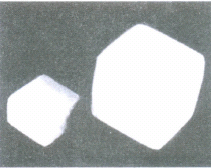
(i) Which type of weights are shown in the picture?
(ii) It was made from which type of stone?
(iii) Mention its use in the past?
6.
Answer the questions based on the given picture:
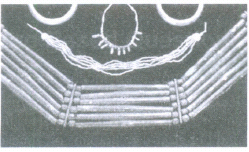
(i) What does above picture refer to?
(ii) Picture shown above is made up of which material?
(iii) Why there were holes in the middle of each?
7.
What could be the probable reasons as suggested by the archaeologists for the end of Harappa?
8.
Describe the drainage system of the Harappan cities.
9.
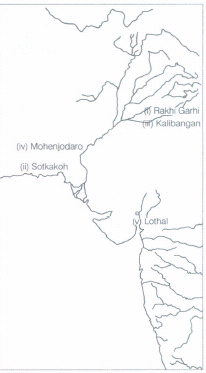
Show the following cities on the outline map of India
(i) Rakhi Garhi
(ii) Sotkakoh
(iii) Kalibangan
(iv) Mohenjodaro
(v) Lothal
10.
Discuss the evidence of food-production in the Harappan civilisation.
1.
(i) Around 3900 years ago, we find the beginning of a major change. People stopped living in many of the cities.
(ii) Writing, seals and weights were no longer used.
(iii) Raw materials brought from distant places became rare.
(iv) In Mohenjodaro, we find that garbage was piled up on the streets, the drainage system broke down, and new, less impressive houses were built, even over the streets.
2.
(i) Seals are clay tablets have been found from various Harappan sites. They have figures of animals, trees and various letters carved on them.
(ii) Seals may have been used to stamp bags or packets containing goods that were sent from one place to another.
(iii) After a bag was closed or tied, a layer of wet clay was applied on the knot and seal was pressed on it
(iv) The impression of the seal is known as sealing. If the sealing was intact, one could be sure that the goods cased arrived safely.
3.
(i) The Harappan cities developed about 4700 years ago. Many of these cities were divided into two or more parts. Usually, the part to the West was smaller but higher. Archaeologists describe it as the citadel. Generally, the part to the East was larger but lower and it is called the lower town,
(ii) In some cities, special buildings were constructed on the citadel. For example, in Mohenjodoro, a very special tank, which archeologists call the Great Bath, was built It was lined with bricks and coated with plaster, Perhaps, important people took a dip in this tank on special occasions,
(iii) Other cities, such as Kaibangan and Lothal had fire altars where sacrifices may have been performed. And some cities like Mohenjadaro, Harappa and Lothal had elaborate storehouses. These cities were found in Punjab and Sindh in Pakistan and in Gujarat, Haryana, Rajasthan and Punjab in India.
(iv) There were people who planned the construction of special buildings in the city. They were probably the rulers.
(v) It is likely that the rulers sent people to distant lands to get metals, precious stones and other things that they wanted. They may have kept the most valuable objects, such as ornaments of gold and silver or beautiful beads for themselves.
4.
Lothal to Mohanjodaro's journey will be done on bullock carts along the dusty roads. My parents will carry food, water and clothes. In Mohanjodaro, I would see:
(i) Citadels
(ii) Big storehouses
(iii)A great tank i.e., the Great Bath
(iv) Wells
(v) Streets with covered drains
(vi) Houses of one or two storeys.
5.
(i) The picture shows stone weights.
(ii) They were made of chert stone.
(iii) They were used to weigh precious stones or metals.
6.
(i) Above picture refers to beads.
(ii) Many of these were made out of carnelian, a beautiful red stone.
(iii) A hole was bored through centre so that a string could be passed through it.
7.
Reasons for the fall of the Harappan cities were:
(i) Till date, no concrete reason has been found out by the scholars, but some of the scholars suggested that the rivers dried up.
(ii) While other scholars have suggested that there was deforestation because large quantity of fuel was required for baking bricks and for smelting copper ores.
(iii) Besides, grazing by large herds of cattle, sheep and goat may have destroyed the green cover. In some areas there were floods.
(iv) But none of these reasons can explain the end of all the cities since the flooding, or a river drying up would have had an effect in only some areas.
(v) Some sites in Sind and West Punjab (present-day Pakistan) were abandoned, while many people moved into newer, smaller settlements to the East and the South, it seems as if the rulers lost control over their subjects.
8.
Many of the Harappan cities had covered drains. These are as follow:
(i) We can notice how carefully these were laid out, in straight lines. However, each drain had a gentle slope so that water could flow through it.
(ii) The drains in houses were connected to those on the streets and smaller drains led into bigger ones.
(iii) As the drains were covered, inspection holes were provided at intervals to clean them. All three - houses, drains and streets - were probably planned and built at the same time.
9.
10.
(i) We know from the remains of plants that the Harappans grew wheat, barley, pulses, peas rice, sesame, linseed and mustard.
(ii) A new tool, the plough, was used to dig the earth for turning the soil and planting seeds.
(iii)As this region did not receive heavy rainfall, some form of irrigation may have been used. It means that water was stored and supplied to the fields when the plants were growing.

6th Standard CBSE Syllabus & Materials
6th Standard CBSE
CBSE 6th Social Science Locating Places on the Earth - New Sample Question Papers Study Material - QB365 Set A
NEW6th Standard CBSE
CBSE 6th Science A Journey Through States of Water - New Sample Question Papers Study Material - QB365 Set A
NEW6th Standard CBSE
CBSE 6th Science Temperature and its Measurement - New Sample Question Papers Study Material - QB365 Set A
NEW6th Standard CBSE
CBSE 6th Science Materials Around Us - New Sample Question Papers Study Material - QB365 Set A



CBSE 6th Standard CBSE Subjects
CBSE Standards




