
 100% FREE ACCESS
6th Standard CBSE Syllabus & Materials
6th Standard CBSE
CBSE 6th Social Science The Value of Work - New Sample Question Papers Study Material - QB365 Set A
NEW6th Standard CBSE
CBSE 6th Social Science Family and Community - New Sample Question Papers Study Material - QB365 Set A
NEW6th Standard CBSE
CBSE 6th Social Science India's Cultural Roots - New Sample Question Papers Study Material - QB365 Set A
NEW6th Standard CBSE
CBSE 6th Social Science India,That is Bharat - New Sample Question Papers Study Material - QB365 Set A
NEW6th Standard CBSE
CBSE 6th Social Science Timeline and sources of history - New Sample Question Papers Study Material - QB365 Set A
NEW6th Standard CBSE
CBSE 6th Social Science Oceans and Continents - New Sample Question Papers Study Material - QB365 Set A

Published on: 03/10/2019
HIS - Traders, Kings and Pilgrims
Download CBSE Class 6th Standard CBSE Social Science question papers, sample papers, important questions, and previous year solved papers in PDF format. Get free study materials, NCERT solutions, and exam preparation resources for Class 6th Standard CBSE Social Science
Questions + Answers key
Take MCQ Social Science Test
1.
Explain the ways through which the Chiefs use to rule South India.
2.
Name the Chinese visitors who came to India. What was their aim of visit?
3.
Answer the following questions based on the picture given below:
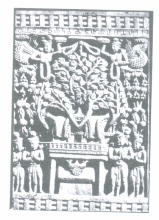
(i) What does the empty seat below tree represent?
(ii)Where the above sculpture belongs to?
4.
Give an account of the beginning of Bhakti.
5.
'Each of these pilgrims left an account of his journey'. Discuss.
6.
'Dozens of caves were hollowed out of hills for monks to live in'. Discuss.
1.
(i) The Cholas, Cheras and Pandyas were the three ruling families who became powerful in South India around 2300 years ago.
(ii) Each of the three Chiefs had two centres of power: one on land, and one on the coast.
(iii) The Chiefs did not collect regular taxes. Instead, they demanded and received gifts from the people.
(iv) They also went on military expeditions and collected tributes from neighbouring areas.
(v) They kept some of the wealth and distributed the rest amongst their supporters including members of their family, soldiers and poets.
(vi) Many poets whose compositions are found in the Sangam collection are poems in praise of the chiefs who often rewarded them with precious stones, gold, horses, elephants, chariots and fine cloth.
2.
The Chinese Buddhist pilgrims who visited India were:
(i) Fa Xian, who Came to the sub-continent about 1600years ago,
(ii) Xuan Zang who came around 1400 years ago, and
(iii) I-Qing, who came about 50 years after Xuan Zang.
Their aim was to visit places associated with the life of Buddha as well as the famous monasteries.
3.
(i)It indicates that the Buddha had attained enlightenment while meditating under the tree
(ii)The sculpture belongs to the Stupa at Sanchi
4.
The starting of the Bhakti became Central feature of later Hinduism. It was the time when certain deities were worshipped such as Shiva, Vishnu and Goddesses as Durga. Bhakti refers to a persons's devotion to his or her chosen deity. Anybody could follow the path of Bhakti, be it rich or poor, people belonging to 'high' or 'low' caste, man or woman. The concept of Bhakti is also present in sacred book of the Hindus i.e. 'Bhagavad Gita', included in the Mahabharata. This type of worship spread to various parts of the country. The people who followed Bhakti focused on devotion and individual worship of a God or Goddess and not on the performance of elaborate sacrifices.
5.
Each pilgrim left experiences of their journies
• They wrote about the dangers they faced and experiences during their travels to the
countries and the monasteries.
• They wrote about the books they carried back with them
• Xuan Zang went back China through the land route. He carried statues of Buddha made of
gold, silver and sandalwood
• He also took about 600 manuscripts loaded on about 20 horses He spent his life converting the manuscripts from Sanskrit to Chinese.
• Fa Xian also took many manuscripts with him He also gave us detailed description of his journey and contemporary Indian society.
6.
Buddhism spread to Western and Southern India and caves were made out of hills for monks to live in. The caves were made on the order of kings and queens and also some of the caves are made by farmers and merchants.
Location of the caves were near passes through the Western Ghats. There were roads connecting these ports with cities in the Deccan ran through these passes. The traders used to stop in these caves while they were travelling. Buddhism also spread South Eastwards to Sri Lanka, Myanmar, Thailand and other parts of South-East Asia including Indonesia. But Theravada Buddhism, the older form of Buddhism was more popular in these areas.

6th Standard CBSE Syllabus & Materials
6th Standard CBSE
CBSE 6th Social Science Locating Places on the Earth - New Sample Question Papers Study Material - QB365 Set A
NEW6th Standard CBSE
CBSE 6th Science A Journey Through States of Water - New Sample Question Papers Study Material - QB365 Set A
NEW6th Standard CBSE
CBSE 6th Science Temperature and its Measurement - New Sample Question Papers Study Material - QB365 Set A
NEW6th Standard CBSE
CBSE 6th Science Materials Around Us - New Sample Question Papers Study Material - QB365 Set A



CBSE 6th Standard CBSE Subjects
CBSE Standards




