
 100% FREE ACCESS
6th Standard CBSE Syllabus & Materials
6th Standard CBSE
CBSE 6th Social Science The Value of Work - New Sample Question Papers Study Material - QB365 Set A
NEW6th Standard CBSE
CBSE 6th Social Science Family and Community - New Sample Question Papers Study Material - QB365 Set A
NEW6th Standard CBSE
CBSE 6th Social Science India's Cultural Roots - New Sample Question Papers Study Material - QB365 Set A
NEW6th Standard CBSE
CBSE 6th Social Science India,That is Bharat - New Sample Question Papers Study Material - QB365 Set A
NEW6th Standard CBSE
CBSE 6th Social Science Timeline and sources of history - New Sample Question Papers Study Material - QB365 Set A
NEW6th Standard CBSE
CBSE 6th Social Science Oceans and Continents - New Sample Question Papers Study Material - QB365 Set A

Published on: 26/09/2019
HIS - What Books and Burials Tell Us
Download CBSE Class 6th Standard CBSE Social Science question papers, sample papers, important questions, and previous year solved papers in PDF format. Get free study materials, NCERT solutions, and exam preparation resources for Class 6th Standard CBSE Social Science
Questions + Answers key
Take MCQ Social Science Test
1.
How did skeletal studies reveal whether a skeleton was of a man or a woman?
2.
Were some burial spots meant for certain families? Give examples
3.
Describe the archaeological evidences of the materials used in the Stone Age
4.
In the Rigveda people were described in terms of the work they did and the language they spoke.Fill the names of six people you know, three men and three women. For each of them, mention the work they do and the language they speak. Would you like to add anything else to the description.
5.
Answer the questions based on the picture given below:
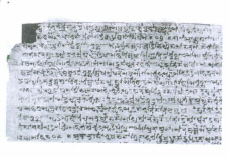

(i) Above manuscript belongs to which Vedic period?
(ii) Name the place where this manuscript was found?
(iii) At present time where it is preserved?
6.
How are people described in the Rigveda?
7.
What were the silent sentinels behind the story of the megaliths?
8.
What does the Rigveda tell about battles?
1.
(i) It is easy to make out the skeleton of a child from its small size. However, there are no major differences in the bones of a girl and a boy.
(ii) Sometimes, people decide on the basis of what is found with the skeleton. For instance, if a skeleton is found with jewellery, it is generally thought to be that of a woman.
(iii) However, there are problems with this. Often, men also wore ornaments.
(iv) A better way of figuring out the sex of a skeleton is to look at the bone structure. The hip or the pelvic area of women is generally larger to enable child bearing. These distinctions are based on modern skeletal studies.
2.
(i) Sometimes, megaliths contained more than one skeleton
(ii) These indicate that people, perhaps belonging to the same family were buried at the same place though not at the same time
(iii) The bodies of those who died later were brought into graves through the Pot-holes.
(iv) Stone circles or boulders placed on the surface probably served as signposts to find the burial sites, so that people could return to the same place whenever they wanted to.
3.
(i) The oldest trace of human civilisation in India discovered by archaeologists belong to the Stone Age. The Stone Age had been identified by locating microliths. Some of the stone sites unearthed are Baluchistan in North-West. India, Bengal, Assam in North-East and Tamil Nadu.
(ii) Crops: The crops cultivated were rabi, wheat, rice, horse grain, cotton, etc. South of the Godavari river has shown traces of cultivation of cereals and Allahabad sites have shown cultivation of rice.
(iii) Animals: Large number of animal remains were excavated from Mehrgarh near Baluchistan.The prevalence of domestication of animals in that period was evident from excavations near Bulrzahom and Gufkral. Skeletons of dogs have also been found with human bones near the graves.
(iv) Houses: A row of mud houses, in dilapidated shapes were found in Baluchistan sites. Lake side pits, mud houses and caves with human settlements were located in Burzahom and Gufkral sites. Rows of circular and rectangular houses made of mud and bricks were also found near Piklihal in Karnataka.
(v) Tools: Bagor of Rajasthan and Langhnaj excavations have showed that they used a proto-type of bow and arrow using stone microliths. Stone blades and stone axes have also been found in the South of the Godavari river.
(vi) Pottery: The biggest collection of potteries in various sizes used both in cooking and grain storage were found in Baluchistan and Amri. The sites had remains of black pots as well as painted and decorated potteries.
(vii) Burials:Excavations in Kashmir have proved that they buried dogs and other stone tools along with the dead people. The early man's burial ground has also been excavated in Baluchistan.
4.
| Name | Work | Language | Anything else |
|---|---|---|---|
| i. Soniya (Sales girl in the shop) | Displays the goods in the shops and shows them to customers | Hindi, English | Tries to sell the goods as quickly as possible |
| ii.Dr. Mayank (Doctors,Male) | Give medical treatment and advice | Hindi, English | Give medicines and injections |
| iii. Shiv Charan (Vegetable sellers, Male) | Sells vegetables | Hindi | Used to haggling and tries to give less weight. |
| iv. Asha (Maid Servant,Female) | Does household work. | Hindi or Mother tongue | Cooks food |
| v. Rajeev (Driver, Male) | Drives our cars. | Hindi | Drops us to our school and home |
| vi. Aradhana (Teachers,Female) | Teaches us. | English, Hindi | Sometimes they act the scene with the help of the children |
5.
(i) Rigveda
(ii) Kashmir
(iii) Pune, Maharashtra
6.
In the Rigveda, there are two groups who are described in terms of their work - the priests, sometimes called brahmins, who performed various rituals, and the rajas.
(i) At that time, rajas did not have capital cities, palaces or armies, nor did they collect taxes. Generally, sons did not automatically succeed fathers as rajas.
(ii) In the Rigveda, to describe the people or the community as a whole, the words - 'jana' and 'vish' were used.
(iii) Several vish or jana are mentioned, for example, the Puru jana or vish, the Bharata jana or vish, the Yadu jana or vish, and so on.
(iv) The people who composed the hymns described themselves as Aryas and called their opponents as Dasas or Dasyus.
7.
The silent sentinels behind the story of the megaliths were as follow:
(i) The big stones or the stone boulders are known as megaliths which were carefully arranged by people, and were used to mark burial sites.
(ii)The practice of erecting'megaliths began about 3000 years ago, and was prevalent throughout the Deccan, South India, in the North-East and Kashmir.
(iii) Some of the megaliths can be seen on the surface, other megalithic burials are often underground.
(iv) Archaeologists often find that a circle of stone boulders or a single large stone standing on the ground, are the only indications of burials.
(v) The burials have some common features as the dead were buried with distinctive pots, which are' called Black and Red Ware. Tools and weapons of iron and sometimes, skeletons of horses, horse equipment and ornaments of stone and gold are also found.
8.
From the Rigveda we know that there was no regular army at that time. There were assemblies where people met and discussed matters of war and peace. Most men took part in the battle. They chose leader who were brave and skilful warriors. Leaders used horse chariot in the battlefield. Battles were usually fought for land and water. Sometimes battles were also fought for cattle and people Capturing people the rajas made them as dasas (slaves). The power and strength of the Raja depend on land and cattle they had. Initially the struggle was between the Arya tribes and non-Arya tribes As the domination of Arya tribes increased, the power struggle between the Arya tribes seem to have begun.

6th Standard CBSE Syllabus & Materials
6th Standard CBSE
CBSE 6th Social Science Locating Places on the Earth - New Sample Question Papers Study Material - QB365 Set A
NEW6th Standard CBSE
CBSE 6th Science A Journey Through States of Water - New Sample Question Papers Study Material - QB365 Set A
NEW6th Standard CBSE
CBSE 6th Science Temperature and its Measurement - New Sample Question Papers Study Material - QB365 Set A
NEW6th Standard CBSE
CBSE 6th Science Materials Around Us - New Sample Question Papers Study Material - QB365 Set A



CBSE 6th Standard CBSE Subjects
CBSE Standards




