
 100% FREE ACCESS
6th Standard CBSE Syllabus & Materials
6th Standard CBSE
CBSE 6th Social Science The Value of Work - New Sample Question Papers Study Material - QB365 Set A
NEW6th Standard CBSE
CBSE 6th Social Science Family and Community - New Sample Question Papers Study Material - QB365 Set A
NEW6th Standard CBSE
CBSE 6th Social Science India's Cultural Roots - New Sample Question Papers Study Material - QB365 Set A
NEW6th Standard CBSE
CBSE 6th Social Science India,That is Bharat - New Sample Question Papers Study Material - QB365 Set A
NEW6th Standard CBSE
CBSE 6th Social Science Timeline and sources of history - New Sample Question Papers Study Material - QB365 Set A
NEW6th Standard CBSE
CBSE 6th Social Science Oceans and Continents - New Sample Question Papers Study Material - QB365 Set A

Published on: 31/07/2019
What Books and Burials Tell Us
Download CBSE Class 6th Standard CBSE Social Science question papers, sample papers, important questions, and previous year solved papers in PDF format. Get free study materials, NCERT solutions, and exam preparation resources for Class 6th Standard CBSE Social Science
Questions + Answers key
Take MCQ Social Science Test
1.
How was wealth distributed in Vedic India?
2.
What is the importance of cattle, horses and chariots in the Rigveda?
3.
How do historians study the literary sources?
4.
List the languages you have heard about, and try and identify the families to which they belong.
5.
Do you notice any similarities between Indo-European languages?
6.
People who composed hymns were called
Dasyus
Aryas
Jana
Vish
7.
Vishvamitra was
A Sage
A god
A king
A soldier
8.
What were used for entering the burial places?
Surface-holes
Burial-holes
Port-holes
Stone-holes
9.
Stone circles or boulders on the surface were used to cover the
house
burial places
port-holes
All of these
10.
______ were used for various kind of work.
Carpenters
Farmers
Slaves
Labour
11.
How was the information written in the Rigveda passed on?
12.
What is the language of the Rigveda?
13.
Who were slaves?
14.
Where was the manuscript of Rigveda found?
15.
What is cist?
16.
The Rigveda includes more than a thousand hymns, called Sukta or______
17.
There are four Vedas_____,______,______
18.
Battles were also_____ for land, which was important for________ and for growing hardy crops that ripened quickly, such as barley
19.
The people who composed the hymns described themselves as _______ .
20.
In a hymn in the Rigveda, speaks to two rivers, _________ and _______ who were worshipped as Goddesses.
21.
Sanskrit
22.
Ghoda
23.
Opponents of Aryas
24.
Dasa
25.
Ghod
26.
Megaliths were used to mark burial sites
27.
Battles were fought for land, water and to capture people
28.
Soma was the warrior god
29.
The practice of erecting megaliths began about 3000 years ago.
30.
Yajnas were for kings and rulers.
31.
How did skeletal studies reveal whether a skeleton was of a man or a woman?
32.
Answer the questions based on the picture given below:
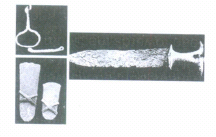
(i) Which metal was used for the preparation of the above equipments?
(ii) These equipments were found from which burials?
1.
(i) Some of the wealth that obtained was kept by the leaders, while some was given to the priests and the rest was distributed amongst the people.
(ii) Some of the wealth was used for the performance of yajnas or sacrifices in which offerings were made into the fire.
2.
(i) There are many prayers in the Rigveda for cattle, children (especially sons) and horses
(ii) Horses were yoked to chariots which were used in battles, fought to capture cattle.
(iii) Battles were also fought for land, which was an important form of pasture and for growing hardy crops that ripened quickly, such as barley.
3.
Historians read the literary sources carefully and take clues from them. On the basis of such information, they try to create an understanding of the socio-cultural political set- up and place it in the right context and time.
4.
Other languages used in the sub-continent belong to different families. For instance, those used in the North-East belong to the Tibero-Burrnan family. South Indian languages like, Tamil, Telugu, Kannada and Malayalam belong to the Dravidian family. The languages spoken in Jharkhand and parts of Central India belong to the Ausrro-Asiatic family.
5.
Sanskrit is part of a family of languages known as Indo-European. Some Indian languages such as Assamese, Gujarati, Hindi, Kashmiri and Sindhi, and many European languages such as English, French, German, Greek, Italian and Spanish belong to this family. They are called a family, because they originally had words in common.
For example, the words 'matr' (Sanskrit), 'rna' (Hindi) and 'mother' (English).
6.
(b)
Aryas
7.
(a)
A Sage
8.
(c)
Port-holes
9.
(b)
burial places
10.
(c)
Slaves
11.
()
The Rigveda was recited and heard rather than read. It was written down several centuries after it was first composed and it was printed less than 200 years ago.
12.
()
The Rigveda is in old or Vedic Sanskrit
13.
()
Slaves were those persons who were treated as the property of their owners.
14.
()
The manuscript of the Rigveda was found in Kashmir.
15.
()
A type of megalith is known as a cist. Some cists have port-holes which could be used as an entrance.
16.
()
Well-said
17.
()
Rigveda, Samaveda, Yajurveda and Atharvaveda
18.
()
Fought, pasture
19.
()
Aryas
20.
()
Vishvamitra, Beas, Sutlej.
21.
()
A language of Indo European family
22.
()
Atributary of Bhima
23.
()
Dasas
24.
()
Slave
25.
()
Tributary of river Bhima
26.
(a)
27.
(a)
28.
(b)
29.
(a)
30.
(b)
31.
(i) It is easy to make out the skeleton of a child from its small size. However, there are no major differences in the bones of a girl and a boy.
(ii) Sometimes, people decide on the basis of what is found with the skeleton. For instance, if a skeleton is found with jewellery, it is generally thought to be that of a woman.
(iii) However, there are problems with this. Often, men also wore ornaments.
(iv) A better way of figuring out the sex of a skeleton is to look at the bone structure. The hip or the pelvic area of women is generally larger to enable child bearing. These distinctions are based on modern skeletal studies.
32.
(i) Iron metal was used for the preparation of the above equipments.
(ii) Megalithic equipments were found from burials

6th Standard CBSE Syllabus & Materials
6th Standard CBSE
CBSE 6th Social Science Locating Places on the Earth - New Sample Question Papers Study Material - QB365 Set A
NEW6th Standard CBSE
CBSE 6th Science A Journey Through States of Water - New Sample Question Papers Study Material - QB365 Set A
NEW6th Standard CBSE
CBSE 6th Science Temperature and its Measurement - New Sample Question Papers Study Material - QB365 Set A
NEW6th Standard CBSE
CBSE 6th Science Materials Around Us - New Sample Question Papers Study Material - QB365 Set A



CBSE 6th Standard CBSE Subjects
CBSE Standards




