
 100% FREE ACCESS
6th Standard CBSE Syllabus & Materials
6th Standard CBSE
CBSE 6th Social Science The Value of Work - New Sample Question Papers Study Material - QB365 Set A
NEW6th Standard CBSE
CBSE 6th Social Science Family and Community - New Sample Question Papers Study Material - QB365 Set A
NEW6th Standard CBSE
CBSE 6th Social Science India's Cultural Roots - New Sample Question Papers Study Material - QB365 Set A
NEW6th Standard CBSE
CBSE 6th Social Science India,That is Bharat - New Sample Question Papers Study Material - QB365 Set A
NEW6th Standard CBSE
CBSE 6th Social Science Timeline and sources of history - New Sample Question Papers Study Material - QB365 Set A
NEW6th Standard CBSE
CBSE 6th Social Science Oceans and Continents - New Sample Question Papers Study Material - QB365 Set A

Published on: 31/12/2018
6th Class Test
Download CBSE Class 6th Standard CBSE Science question papers, sample papers, important questions, and previous year solved papers in PDF format. Get free study materials, NCERT solutions, and exam preparation resources for Class 6th Standard CBSE Science
Questions + Answers key
Take MCQ Science Test
1.
Why is food present in the roots of some plants, although it is made in the leaves?
2.
Leaves of mountain trees prevent damage by snow or rain. How?
3.
Write any two activities which require more than one bucket of water.
4.
Why a shopkeeper prefers to keep biscuits and sweets in a glass or plastic container?
5.
It is given that a plant is very tall and have hard, thick stem with branching on the upper part of the plants. On the basis of the given characteristics, categorise the plant.
6.
Recently, a ban on plastic bags has been imposed in many places. Is the ban justified? Give reasons in three sentences.
7.
Sita is operating an base electric wire so that its electric iron can be used safely. Her friend Vimlesh advised her not to do so without plastic gloves.
(a) Mention the values that Vimlesh shows here.
(b) A plastic glove is an insulator or conductor.
8.
What are the specific features present in a deer that help it to detect the presence of predators like lion?
9.
Select those objects from the following which shine:
Glass bowl, plastic toy, steel spoon, cotton shirt
10.
Can the stem of a plant be compared with a street with two ways traffic? Give reason.
11.
Bud is non bloomed flower.
12.
A bar magnet has three poles.
13.
Rubber is a translucent object.
14.
The fruits of cotton plant are as big as apple.
15.
The boiling of rice is a physical change.
16.
Chalk, iron nail, wood, aluminium, candle, cotton usually look different from each other. Give some properties by which we can prove that these materials are different.
17.
A bar magnet is cut into two pieces A and B from the middle as shown in figure.

Will the two pieces act as individual magnets? Mark the poles of these two pieces. Suggest an activity to verify your answer.
18.
Air present in atmosphere will be defined as what? Name the major constituents of air. Give their volume proportions in air.
19.
Explain with the help of a diagram that how can we see an image behind wall using a periscope.
20.
Sarita was interested in knowing more about plants and its parts. She started exploring and collecting plants. She wanted to preserve them, so that she can have a good collection of plants.
(a) Suggest the steps to help her in identifying plants.
(b) Is there any other method to identify plants Explain.
(c) What are the values shown by Sarita?
21.
Objects lighter than a liquid _____ in that liquid.
22.
The vitamin that gets easily destroyed by heating during cooking is __________.
23.
Saline water, hot air and sand are __________components of a habitat.
24.
A device which makes or breaks the circuit is called _________________
25.
In rectilinear motion, object moves _________________a______________ line.
26.
Fixed joint
27.
Joint
28.
Snake
29.
Snail
30.
Fish
31.
What kind of change occurs in the eruption of a volcano
Physical change
Sudden change
Irreversible chang
All of these
32.
The habitat of living organisms that live in water is called
Terrestrial habitat
Aquatic habitat
Both (a) and (b)
None of the above
33.
Colour of water is
Sky blue
White
Green
Colourless
34.
Which of the following activities does not reflect responsible behaviour with regard to waste disposal?
Goods carried in paper bags or cloth bags
Waste collected in polythene bags for disposal
Waste separated into those that degrade and those that do not
Making handicrafts with used up notebooks
35.
Two students while sitting across a table looked down onto its top surface. They noticed that they could see their own and each other's image. The table top is likely to be made of
unpolished wood
red stone
glass sheet
wood top covered with cloth
36.
Which country first invented silk?
37.
Why is our backbone not fixed?
38.
A cement bag left open gets hard after some time, what type of change it is ?
39.
What is reflection?
40.
Are there any food materials that have sources other than plants and animals? Name them, if any.
1.
Food is present in the roots of some plants, although it is made in the leaves because root system also provides support for plants in the form of an anchor in the soil. e.g., carrots store food in their roots and live on it all winter and in summers, a new plant grows from these roots.
2.
The needle-like leaves of these trees have a thick waxy layer called cuticle which protects the leaves from any kind of damage.
3.
Two activities which require use of more than one bucket of water is washing more than 10 clothes and irrigating a crop field.
4.
Due to transparent nature of glass or plastic container, biscuits, sweets, etc., can be seen easily by buyers, so shopkeepers do like this.
5.
From the given characteristics, it can be concluded that the given plant is a tree.
6.
The recent ban on plastic bags is justified as due to this
(i) Local people had started taking proper care of plastic disposal.
(ii) Ban on plastic bags had made people shift to paper bags for their day-to-day routine use.
(iii) Disposal of plastic bags had come under control due to this ban.
7.
(a) Vimlesh is intelligent and has good knowledge of current and its hazard.
(b) A plastic glove is an insulator. It does not conduct electricity.
8.
Deer have following specific features that help it to detect the presence of predators like lion
(i) Long ears to hear movement of predators.
(ii) Eyes on the sides of its head which allow it to look in all directions.
9.
From the given Objects, glass bowl and steel spoon are shiny objects which also called lustrous materials.
10.
Yes, the stem of a plant can be compared with a street with two ways traffic because
(i) It carries water and minerals from the roots to the leaves and other parts of plant in upward direction.
(ii) It takes the prepared food by the leaves to other parts of the plant.
11.
(a)
12.
(b)
13.
(b)
14.
(b)
15.
(b)
16.
There are following properties by which we can prove that these materials are different:
| Material | Lustre | Hardness/softness | Roughness/smoothness |
|---|---|---|---|
| Chalk | - | Soft | Rough |
| Iron nail | Lustrous | Hard | Rough |
| Wood | - | Hard | Rough |
| Aluminium | Lustrous | Hard | Smooth |
| Candle | Candle | Soft | Smooth |
| Cotton | - | Soft | Smooth |
17.

Yes, two pieces will work as an individual magnet because a monopole (single pole) of magnet never exists
18.
Air is a mixture of gases. The major composition of air are oxygen, nitrogen, carbon dioxide, etc. The percentage composition of These dust particles are produced due to constituents of air are given below:
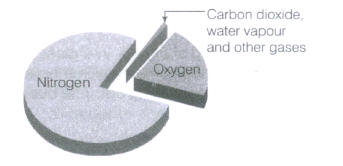
Nitrogen - 78%, oxygen - 20.9%, argon - 0.9%, carbon dioxide - 0.035 - 0.0,45%, water vapour - 0.03%, dust, etc.
19.
The image can be observed behind wall using a periscope with the help of plane mirror by reflection of light.
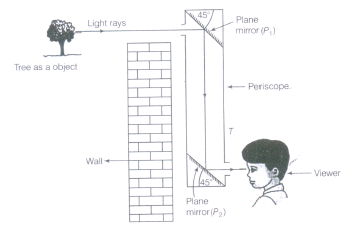
So, when rays of light coming from tree behind the wall fall on plane mirror (P1), then after reflection, it goes to the plane mirror (P2), which again reflects the light rays towards viewer. Therefore, we can see the tree which is behind wall.
20.
(a) Sarita can follow the following steps:
(i) Collect plant twig with flowers.
(ii) Press the8m in papers/magazines.
(iii) Change the paper/magazine every day for 5-6 days.
(iv) When plants are well pressed and dried place them on white plane paper sheet.
(v) Stick the plants to sheet with cello tape.
(vi) Try to identify the plant.
(vii) Take help of teachers/seniors for plant identification.
(b) Yes, plants can also be identified on the basis of the nature of their stem and size.
(c) Inquisitive, scientific attitude and love for nature.
21.
float
22.
()
vitamin C
23.
()
abiotic
24.
()
switch
25.
()
in, straight
26.
()
Skull joints
27.
()
A place where two bones meet together.
28.
()
Whole body
29.
()
shows very slow movement or has an outer skeleton
30.
()
have fins on the body or have a streamlined body
31.
(d)
All of these
32.
(b)
Aquatic habitat
33.
(d)
Colourless
34.
(b)
Waste collected in polythene bags for disposal
35.
(c)
glass sheet
36.
()
China
37.
()
Backbone is not fixed so that we can bend it.
38.
()
Chemical change.
39.
()
The bouncing off and change in direction of light on striking a plane mirror is called reflection
40.
()
Yes, salt and water are obtained from sources other than plants and animals.

6th Standard CBSE Syllabus & Materials
6th Standard CBSE
CBSE 6th Social Science Locating Places on the Earth - New Sample Question Papers Study Material - QB365 Set A
NEW6th Standard CBSE
CBSE 6th Science A Journey Through States of Water - New Sample Question Papers Study Material - QB365 Set A
NEW6th Standard CBSE
CBSE 6th Science Temperature and its Measurement - New Sample Question Papers Study Material - QB365 Set A
NEW6th Standard CBSE
CBSE 6th Science Materials Around Us - New Sample Question Papers Study Material - QB365 Set A



CBSE 6th Standard CBSE Subjects
CBSE Standards




