
 100% FREE ACCESS
6th Standard CBSE Syllabus & Materials
6th Standard CBSE
CBSE 6th Social Science The Value of Work - New Sample Question Papers Study Material - QB365 Set A
NEW6th Standard CBSE
CBSE 6th Social Science Family and Community - New Sample Question Papers Study Material - QB365 Set A
NEW6th Standard CBSE
CBSE 6th Social Science India's Cultural Roots - New Sample Question Papers Study Material - QB365 Set A
NEW6th Standard CBSE
CBSE 6th Social Science India,That is Bharat - New Sample Question Papers Study Material - QB365 Set A
NEW6th Standard CBSE
CBSE 6th Social Science Timeline and sources of history - New Sample Question Papers Study Material - QB365 Set A
NEW6th Standard CBSE
CBSE 6th Social Science Oceans and Continents - New Sample Question Papers Study Material - QB365 Set A

Published on: 24/10/2025
Download CBSE Class 6th Standard CBSE Mathematics question papers, sample papers, important questions, and previous year solved papers in PDF format. Get free study materials, NCERT solutions, and exam preparation resources for Class 6th Standard CBSE Mathematics
Questions + Answers key
Take MCQ Mathematics Test
1.
Using only letters and sign, write the expression for the statements given below:
product of 6 and x divided by 2
2.
Name the properties, where x, y and z are variable and can takeany numerical values.
x\(\times\)(y + z) = x\(\times\)y + x\(\times\)z
3.
Leela is Radha's younger sister. Leela is 4 years younger than Radha. Can you write Leela's agein terms of Radius's age? Take Radha's age to be x years.
4.
The teacher distributes 10 pencils per student. Can you tell how many pencils are needed, given the number of students? (use x for the number of students).
5.
Find the rule, which gives the number of matchsticks required to make the following matchsticks patterns. Use a variable to write the rule.
A pattern of letter H as 
6.
Write down the operations which are used in forming the following expressions 2x-3.
7.
To find sum of three numbers 14, 27 and 13,we can have two ways
(a) We may first add 14 and 27 to get 41 and thenode 13 to it to get the total sum 54 or
(b) We may add 27 and 13 to get 40 and then add14 III get the sum 54. Thus, (14+ 27)+ 13= 14+ (27+ 13) This can be done for any three numbers. This property is known as the associativity of addition 01 numbers. Express this property which we have already studied in the chapter on whole numbers in, a general way, by using variables a, band c.
8.
If there are 25 pictures in an album, then find the rule which gives total number of pictures in 'x' albums.
9.
If there are 50 mangoes in a box, how will you write the total number of mangoes in terms of the number of boxes? (Use bfor the number of boxes).
10.
We already know the rule for the pattern of letters L, C and F Some of the letters from question 1 (given above) give us the same rule as that given by L. Which are these? Why does this happen?
11.
If 3a + 2b = 12 and 2 a + 4b = 10, then find the values of a and b.
12.
The internal angles of a triangle are 2 x ,3 x and 5x. What is the difference between the largest and smallest angle?
13.
Translate each of the following statements into an equation, using x as the variable.
(a) 13 subtracted from twice a number gives 3.
(b) One-fifth of a number is 5 less than that number.
(c) Two-third of a number is 12.
(d) 9 added to twice a number gives 13.
(e) 1 subtracted from one-third of a number gives 1.
14.
Meena, Beena and Leena are climbing the steps to the hill top. Meena is at step s, Beena is 8 steps ahead and Leena 7 steps behind. Where are Beena and Meena? The total number of stepsto the hill top is 10 less than 4 times what Meena has reached. Express the total number of steps using s.
15.
Solve: k - 3 = 3
3
-3
0
6
16.
Solve:\(\frac { y }{ 3 } \)=5
3
5
2
15
17.
The side of a square is I. Its perimeter is
3l
2l
4l
6l.
18.
The rule, which gives the number of matchsticks required to make the matchstick pattern ◻️ is
2n
3n
4n
5 n.
19.
The rule, which gives the number of matchsticks required to make the matchstick pattern L, is
2n
3n
4 n
5 n.
20.
If x takes the value 3, then x + 12 is
16
10
14
15
21.
Given, expression for P divided by 15 is
P-15
P+15
P÷15
\(p\times 15\)
22.
m exceeds n by 10 can be expressed as ________
23.
If 7x + 6 = 48, then the value of x is ___________
24.
The LHS of an ________ is equal to its RHS only for a definite value of the variable in the equation.
25.
The variable can take _________ values.
26.
3x - 6 > 15 is an equation.
27.
The distance between New Delhi and Bhopal is not a variable
28.
In the equation 7k - 7 = 7, the variable is 7.
29.
The total distance travelled by a car in x h at a constant speed of y km/h, is xy km.
30.
State which of the following are equations (with a variable). Give reason for your answer. Identify the variable from the equations with a variable.
7-x=5
31.
State which of the following are equations (with a variable). Give reason for your answer. Identify the variable from the equations with a variable.
20 = 5y
32.
State which of the following are equations (with a variable). Give reason for your answer. Identify the variable from the equations with a variable
2m < 30
33.
Can you make some more expressions?
34.
Can you now write the rule for making patterns of F?
1.
product of 6 and x divided by 2=\(\frac{6x}{2}\)or 6x÷2
2.
Distributivity of numbers
3.
Let Radha's age be x yr.
Given, the Leela is 4 yr younger than Radha So, age of Leela = (Age of Radha) - 4 yr
⇒ Age of Leela = (x - 4) yr
Thus, we can write Leela's age in terms of Radha's age
4.
Let number of students be x
Given, Number of pencils distributed per student = 10
Now, number of pencils, when x = 1 is 10 or \(10 \times 1=10 \times x \Rightarrow \)x=2 is 20 or\(10\times 2=10\times x \Rightarrow x=3\)is 30 or \(10\times 3=10\times x\)
∴ Number of pencils for x students are 10 x.
5.
From the figure, it can be observed that it will require five matchsticks.
∴ The number of matchsticks required is 5n.
6.
Multiplication and subtraction
7.
According to the question,
Sum of three numbers 14,27 and 13 can be found in two ways,
(a) (14 + 27) + 13 = 41 + 13 = 54
(b) (27+13)+14=40+14=54 or 14+(27+13)=54
Thus, (14 + 27) + 13 = 14 + (27 + 13) = 54
By using variables, we can write this property of numbers also in general way. Let a, b and c be three numbers each of which can take any numerical value. Then, (a+b)+c=a+(b+c)
This property is called an associativity of addition of numbers.
8.
25x
9.
Given, b is the number of boxes and the number of mangoes in a box = 50
When there is one box, i.e. b = 1,then the number of mangoes = 50 \(\times\) 1 i.e. 50.
When there are two boxes i.e. b = 2, then the number of mangoes = 50 \(\times\) 2 i.e. 100
When there are three boxes i.e. b = 3, then the number of mangoes = 50 \(\times\) 3 i.e. 150
When there are b boxes i.e. b = b, then the number of mangoes = 50 \(\times\) b = 50b
Hence, total number of mangoes in terms of number of boxes can be written as 50 b.
10.
Rules for the pattern of letters L, C and F are as follow:
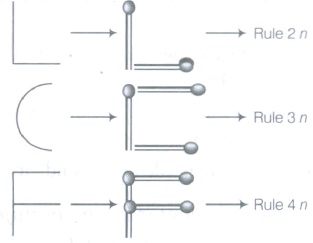
In question 1, letter T and V havesame rule as that givenbyL. This happens because the number of matchsticks required in each of them is 2.
11.
\(a=\frac{7}{2}\)and \(b=\frac{3}{4}\)
12.
540
13.
a) Let number be x.
Twice the number = 2x Then,2x-13=3
(b) Let the number be x.
One-fifth of this number =\(\frac{x}{5}\)
Then,\(\frac{x}{5}\)=x-5
(c) Let the number be x.
Two-third of this number =\(\frac{2}{3}x\)
∴ \(\frac{2x}{3}=12\)
(d) Let the number be x.
Twice of this number = 2x
Then, 2x + 9 =13
(e) Let the number be x.
One-third of this number =\(\frac{x}{3}\)
Then, \(\frac{x}{3}\)-1=1
14.
Given, the Meena is at step = 5
Also, Beena is 8 steps ahead.
∴ Beena is at step = 5 + 8 and Leena is 7 steps behind
∴ Leena is at step = 5 - 7
Now, total number of steps = 10 less than 4 times Meena's steps = 4\(\times\)Meena's steps - 10 = 45 -10
Hence, total number of steps using 5 can be expressed as (45 - 10).
15.
(d)
6
16.
(d)
15
17.
(c)
4l
18.
(c)
4n
19.
(a)
2n
20.
(d)
15
21.
(c)
P÷15
22.
()
m=n+10
23.
()
x=6
24.
()
equation
25.
()
different
26.
(b)
27.
(a)
28.
(b)
29.
(a)
30.
()
Is an equation LHS =RHS : Related variable = x
31.
()
Is an equation LHS =RHS : Related variable = y
32.
()
Is not an equation LHS ≠ RHS : It has no sign of equality (=)
33.
()
Yes! for example:
y - 8,\(\frac { y }{ 5 } \)-3,\(\frac { y }{ 5 } \)+3,\(\frac { y }{ 3 } \)+8,\(\frac { y }{ 3 } \)-8,etc
34.
()
Yes! the required rule is as follows:
Number of matchsticks required = 4n where n is a variable which can take any value 1,2, 3, 4, ..., etc.

6th Standard CBSE Syllabus & Materials
6th Standard CBSE
CBSE 6th Social Science Locating Places on the Earth - New Sample Question Papers Study Material - QB365 Set A
NEW6th Standard CBSE
CBSE 6th Science A Journey Through States of Water - New Sample Question Papers Study Material - QB365 Set A
NEW6th Standard CBSE
CBSE 6th Science Temperature and its Measurement - New Sample Question Papers Study Material - QB365 Set A
NEW6th Standard CBSE
CBSE 6th Science Materials Around Us - New Sample Question Papers Study Material - QB365 Set A



NCERT Books

Syllabus

Exam Pattern

Sample Question Papers

Previous year Question Papers

Important Notes

MCQ Practice test

NCERT Exemplers

Case study Questions

Image Based Questions

Passage based Questions

HOT Questions

Value Based Questions

Model Questions Papers
NCERT ( Book Back ) Questions

Assertion and Reason
Important Questions And Answers

CBSE 6th Standard CBSE Subjects
CBSE Standards


