
 100% FREE ACCESS
6th Standard CBSE Syllabus & Materials
6th Standard CBSE
CBSE 6th Social Science The Value of Work - New Sample Question Papers Study Material - QB365 Set A
NEW6th Standard CBSE
CBSE 6th Social Science Family and Community - New Sample Question Papers Study Material - QB365 Set A
NEW6th Standard CBSE
CBSE 6th Social Science India's Cultural Roots - New Sample Question Papers Study Material - QB365 Set A
NEW6th Standard CBSE
CBSE 6th Social Science India,That is Bharat - New Sample Question Papers Study Material - QB365 Set A
NEW6th Standard CBSE
CBSE 6th Social Science Timeline and sources of history - New Sample Question Papers Study Material - QB365 Set A
NEW6th Standard CBSE
CBSE 6th Social Science Oceans and Continents - New Sample Question Papers Study Material - QB365 Set A

Published on: 24/10/2025
Download CBSE Class 6th Standard CBSE Mathematics question papers, sample papers, important questions, and previous year solved papers in PDF format. Get free study materials, NCERT solutions, and exam preparation resources for Class 6th Standard CBSE Mathematics
Questions + Answers key
Take MCQ Mathematics Test
1.
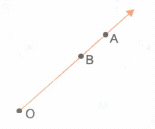
Here is a ray \(\vec {OA}\) It starts at 0 and passes through the point A. It also passes through the point B. Can you also name it as \(\vec {OB}\)?Why? \(\vec {OA}\) and \(\vec {OB}\) are same here.
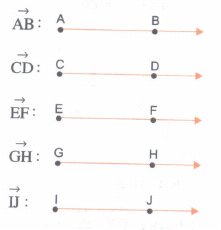
Can we write \(\vec {OA}\) as \(\vec {AO}?\) Why or why not? Draw five rays and write appropriate names for them. What do the arrows on each of these rays show?
2.
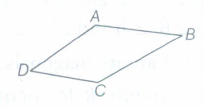
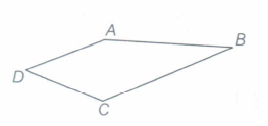
Draw a rough sketch of a quadrilateral ABCD Write
(i) two pairs of opposite sides.
(ii) two pairs of adjacent angles.
3.
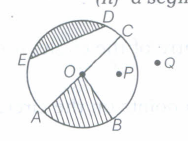
From the figure, identify
(a) the centre of circle
(b) three radii
(c) a diameter
(d) a chord
(e) two points in the interior
(f) point in the exterior
(g) a sector
(h) a segment
4.
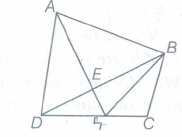
In the given figure, write the name of triangles.
5.
(a) Identify three triangles in the figure.
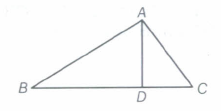
(b) Write the names of seven angles.
(c) Write the names of six line segments.
(d) Which two triangles have \(\angle B\) as common?
6.
Draw rough diagrams of two angles such that they have
(a) one point in common.
(b) two points in common.
(c) three points in common.
(d) four points in common.
(e) one ray in common.
7.
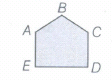
Draw a five sided polygon and shade its interior.
8.
Illustrate, if possible, each one of the following with a rough diagram:
(a) A closed curve that is not a polygon.
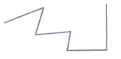
(b) An open curve made up entirely of line segments.
(c) A polygon with two sides.
9.
Draw a rough figure and label suitably in each of the following cases.
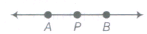
(a) Point P lies on \(\bar {AB}\).
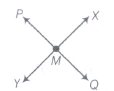
(b)\(\overleftrightarrow {XY}\) and\(\overleftrightarrow {PO}\) intersect at M.
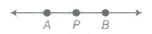
(c) Line I contains E and F but not D.
(d)\(\overleftrightarrow {OP}\) and \(\overleftrightarrow {OQ}\) meet at O.
10.
In the following figure, write angles of the quadrilateral ABCD.
1.
Yes! We can name it as \(\vec {OB}\) as \(\vec {OA}\) and \(\vec {OB}\) represent the same ray. We cannot write the ray \(\vec {OA}\) as ray \(\vec {AO}\) because the starting point of ray \(\vec {OA}\) is O whereas the starting point of ray \(\vec {AO}\) is A.
Five rays have been drawn below:
2.
(i) AB and CD, BC and AD,
(ii) \(\angle A\ and\ \angle B,\angle B\ and\ \angle C,\angle C\ and\ \angle D,\angle D\ and\ \angle A\)
3.
(a) In the given figure, point O is the centre of the circle.
(b) Three radii of circle in the given figure are OA, OB and OC.
(c) Here, OA and OC are radii such that OA and OC are in a line. So, AC is the diameter i.e. diameter = 2 X radius.
(d) In the given figure, ED is a chord of circle.
(e) Points P and O are in the interior of circle.
(f) Point Q is in the exterior of circle.
(g) A region in the interior of a circle enclosed by an arc on one side and a pair of radii on the other two sides is called a sector. In given figure, OAB is a sector.
(h) A region in the interior of a circle enclosed by a chord and an arc is called a segment of the circle. In given figure, region enclosed by ED is a segment.
4.
\(\triangle EFB,\triangle AFB,\triangle DBC,\triangle FBC,\triangle ADE,\triangle ADB,\triangle DFE,\triangle AEB,\triangle AFD.\)
5.
(a) We know that, a triangle is a three sided polygon. So, three triangles in the given figure are as follow:
(i)\(\triangle ABD\) (ii) \(\triangle ADC\) (iii) \(\triangle ABC\)
(b) An angle is made up of two rays starting from a common end point, here the names of seven angles are as follow:
(i) \(\angle BAD\) (ii) \(\angle BAC\) (iii) \(\angle CAD\) (iv) \(\angle ABD\) (v) \(\angle ACD\) (vi) \(\angle ADC\) (vii) \(\angle ADB\)
(c) The names of six line segments are as follow:
(i) AB (ii) BD (iii) DC (iv) CA (v) AD (vi) BC
(d) From the given figure, it is clear that \(\angle B\) is common of \(\triangle ABD\ and \triangle ABC\).
6.
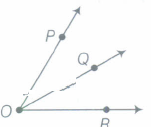
(a) The diagram is shown as below:
Here, \(\angle ROQ\ and\angle QOP\) have one point O In common.
(b) The diagram is shown as below:
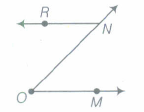
Here,\(\angle MON\ and \angle ONR\) have two points O and N in common.
(c) Drawing a diagram of two angles, such that they have three points in common, is not possible.
(d) Drawing a diagram of two angles, such that they have four points in common, is not possible.
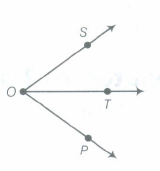
(e) In the figure given below, \(\angle SOT\ and\angle POT\) have one ray \(\vec {OT}\) in common.
7.
8.
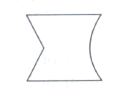
(a) The following figure shows a closed curve, but not a polygon, because a polygon is made by line segments only.
(b) The following figure shows an open curve made up entirely of line segments.
(c) It is not possible, because a polygon of two sides cannot be drawn.
9.
A rough figure in each of the cases is given below:
(a) Point P lies on \(\bar {AB}\).
(b)\(\overleftrightarrow {XY}\) and \(\overleftrightarrow {PO}\) intersect at M.
(c) Line I contains E and F but not D.
(d) \(\overleftrightarrow {OP}\) and \(\overleftrightarrow {OQ}\) meet at O.
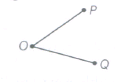
10.
\(\angle A\ or\angle DAB,\angle B\ or\angle ABC,\angle C\ or\angle BCD,\angle D\ or\angle CDA\)

6th Standard CBSE Syllabus & Materials
6th Standard CBSE
CBSE 6th Social Science Locating Places on the Earth - New Sample Question Papers Study Material - QB365 Set A
NEW6th Standard CBSE
CBSE 6th Science A Journey Through States of Water - New Sample Question Papers Study Material - QB365 Set A
NEW6th Standard CBSE
CBSE 6th Science Temperature and its Measurement - New Sample Question Papers Study Material - QB365 Set A
NEW6th Standard CBSE
CBSE 6th Science Materials Around Us - New Sample Question Papers Study Material - QB365 Set A



NCERT Books

Syllabus

Exam Pattern

Sample Question Papers

Previous year Question Papers

Important Notes

MCQ Practice test

NCERT Exemplers

Case study Questions

Image Based Questions

Passage based Questions

HOT Questions

Value Based Questions

Model Questions Papers
NCERT ( Book Back ) Questions

Assertion and Reason
Important Questions And Answers

CBSE 6th Standard CBSE Subjects
CBSE Standards


