
 100% FREE ACCESS
6th Standard CBSE Syllabus & Materials
6th Standard CBSE
CBSE 6th Social Science The Value of Work - New Sample Question Papers Study Material - QB365 Set A
NEW6th Standard CBSE
CBSE 6th Social Science Family and Community - New Sample Question Papers Study Material - QB365 Set A
NEW6th Standard CBSE
CBSE 6th Social Science India's Cultural Roots - New Sample Question Papers Study Material - QB365 Set A
NEW6th Standard CBSE
CBSE 6th Social Science India,That is Bharat - New Sample Question Papers Study Material - QB365 Set A
NEW6th Standard CBSE
CBSE 6th Social Science Timeline and sources of history - New Sample Question Papers Study Material - QB365 Set A
NEW6th Standard CBSE
CBSE 6th Social Science Oceans and Continents - New Sample Question Papers Study Material - QB365 Set A

Published on: 24/10/2025
Download CBSE Class 6th Standard CBSE Mathematics question papers, sample papers, important questions, and previous year solved papers in PDF format. Get free study materials, NCERT solutions, and exam preparation resources for Class 6th Standard CBSE Mathematics
Questions + Answers key
Take MCQ Mathematics Test
1.
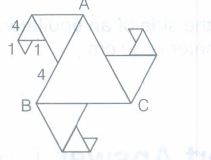
ln the given figure, all triangles are equilateral and AB = 8 units. Other triangles have been formed by taking the mid-points of the sides. What is the perimeter of the figure?
2.
Can you now write the following as decimals?
| Hundreds (100) |
Tens (10) |
Ones (1) |
Tenths (1/10) |
|---|---|---|---|
| 2 | 1 | 6 | 3 |
| 4 | 5 | 4 | 2 |
| 7 | 3 | 2 | 1 |
3.
Length of a rectangle is three times its breadth. Perimeter of the rectangle is 40 cm. Find its length and width.
4.
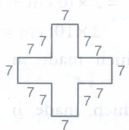
Split the following shapes into rectangles and find their areas (The measures are given in centimetres)
5.
What does represent in tally marks?
6.
A bird flies 1kilometer in one minute. Can you express the distance covered by the bird in terms of its flying time in minutes? (Use t for flying time in minutes).
7.
Express the following as cm using decimals. 30 mm
8.
How will you write \(19\frac { 3 }{ 100 } \) as decimal?
9.
The blood groups of 25 students are recorded as follows:
A, B, 0, A, AB, 0, A, 0, B, A, O, B, A, AB, AB, A, A, B, B, O, B, AB, O, A, B.
Arrange the information in a table using tally marks.
10.
Complete the table and by inspection of the table, find the solution to the equation 5t = 35.
| t | 3 | 4 | 5 | 6 | 7 | 8 | 9 | 10 | 11 | __ | __ | __ | __ |
| 5t | __ | __ | __ | __ | __ | __ | __ | __ | __ | __ | __ | __ | __ |
11.
This bar graph shows the number of gold medals won by 4 countries in an event.
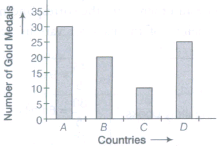
Use the graph to answer the following questions.
(a) How many gold medals did D win?
(b) How many gold medals did B win?
(c) How many more gold medals did Dwin than C?
(d) Which country won the most gold medals?
(e) How many gold medals did A and D win altogether?
12.
The radius of a circle is\(\frac{r}{2}\).Find its diameter in terms of r.
13.
Measure and write the lengths of the four sides of a page of your notebook. The sum of the lengths of the four sides.
= AB + BC + CD + DA
=__cm+__cm+__cm+__cm=__cm
What is the perimeter of the page?
14.
Is\(\left( \frac { y }{ 3 } +5 \right) \)allowed? Is (y + 8) allowed? Is 15y allowed?
15.
Can you now write the rule for making patterns of F?
1.
Given, ΔABC is an equilateral triangle.
Here, AB = 8 units
∴ AB = BC = CA = 8 units
Thus,ΔADE is an equilateral triangle.
Here, E is the mid-point of AB
\(\therefore AE=BE=\frac { AB }{ 2 } =\frac { 8 }{ 2 } =4units\)
Now, in ΔADE, AD = DE = EA = 4 units
Similarly, equilateral triangles are ΔBOT and ΔUPC
having each sides equal i.e.
BO = OT = BT = UC = PC = PU = 4 units
It is also clear that, OC = PA = 4 units
Also, ΔDIF is an equilateral triangle.
Here, F is the mid-point of DE.
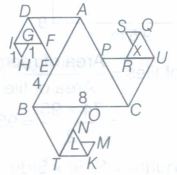
\(\therefore DF=FE=\frac { DE }{ 2 } =\frac { 4 }{ 2 } =2units\)
In ΔDIF, DI = IF = DF = 2 units
Similarly, in ΔTKN and ΔRQU,
TK = KN = TN = RQ = UQ = UR = 2 units
It is also clear that NO = RP = 2 units
Also, ΔHIG is an equilateral triangle.
Here, G is the mid-point of IF
\(\therefore IG=GF=\frac { IF }{ 2 } =\frac { 2 }{ 2 } =1\)
Now, in ΔHIG, HG = HI = GI = 1 unit
Similarly, in ΔMLK and ΔXQS,
ML = MK = LK = SQ = XS = QX = 1unit
It is also clear that, LN = XR = 1 unit
Now, perimeter of the given figure
= Sum of all outer sides of the given figure
= AD + DI + IH + HG + GF + FE + EB + BT +TK + KM + LM + LN+NO+OC +CU+UO + OS + XS + XR + PR +PA
=[4+ 2+1 +1 +1 + 2+ 4+ 4+ 2+1 +1+1+2 + 4 + 4 + 2 + 1 + 1 + 1 + 2 + 4] cm
=45cm
Hence, the perimeter of the given figure is 45 cm.
2.
Given numbers can be represented in decimals as follows:
(i) 2 \(\times\) hundreds + 1 \(\times\) ten + 6 \(\times\) ones + 3 \(\times\) tenths
= 2 \(\times\) 100 + 1 \(\times\) 10 + 6 \(\times\) 1+ 3 \(\times\) \(\frac { 1 }{ 10 } \)
= 200 + 10 + 6 + \(\frac { 3 }{ 10 } \) = 216 + 0.3 = 216.3
(ii) 4 \(\times\) hundreds + 5 \(\times\) tens + 4 \(\times\) ones + 2 \(\times\) tenths
= 4 \(\times\) 100 + 5 \(\times\) 10 + 4 \(\times\) 1+ 2 \(\times\) \(\frac { 1 }{ 10 } \)
= 400 + 50 + 4 + \(\frac { 2 }{ 10 } \) = 454+0.2= 454.2
(iii) 7 \(\times\)hundreds + 3 \(\times\) tens + 2 \(\times\) ones + 1 \(\times\) tenth
= 7 \(\times\) 100 + 3 \(\times\) 10 + 2 \(\times\) 1+ 1 \(\times\) \(\frac { 1 }{ 10 } \)
= 700 + 30 + 2 + \(\frac { 1 }{ 10 } \) = 732 + 0.1 = 732.1
3.
Let width of rectangle (b)= x cm
Then, length of rectangle (I) = 3x cm
∴ Perimeter = 2 (l + b)
⇒ 40 =2 (3x + x)
⇒ 8x =40
⇒ x=\(\frac{40}{8}\)=5cm
Hence, length is 15 cm and width is 5 cm.
4.
Required area is 245 sq cm
5.
It represents 5 (frequency).
6.
Let flying time of bird be t min.
Then, bird flies in one min = 1 km
∴ Bird flies in t min = t\(\times\)t km = t km
Hence, the distance covered by the bird in its flying time i.e. in t min is t km.
7.
We know that, 10 mm = 1 cm \(\Rightarrow\) 1 mm = \(\frac {1}{10}\) cm
\(\therefore \quad 30\quad mm=30\times \frac { 1 }{ 10 } cm=\frac { 30 }{ 10 } cm=3\quad cm\)
8.
\(19\frac { 3 }{ 100 } =19+\frac { 3 }{ 100 } \)= 19 + 0.03 = 19.03
9.
| Blood group | Tally marks | Number of students |
| A | .png) |
8 |
| B | .png) |
7 |
| O | .png) |
6 |
| AB | I I I I | 4 |
10.
By inspection of the above table, we find that t =7
satisfies the equation 5t = 35. [∵ at = 7, LHS = RHS]
Hence, t = 7 is its solution.
11.
(a) 25
(b) 20
(c) 15
(d) A
(e) 55.
12.
r
13.
Let ABCD be the page of a notebook.
On measuring, AB = CD = 15 cm and BC = DA = 20 cm
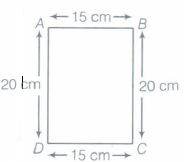
Then, the sum of the lengths of four sides
= AB + BC + CD + DA
= 15 cm + 20 cm + 15 cm + 20 cm
= (I5 + 20 + 15 + 20) cm = 70 cm
Hence, the sum of the four sides is 70 em.
Now, perimeter of the page = Sum of the lengths of four sides
=70 cm
14.
()
No, Yes, Yes.
15.
()
Yes! the required rule is as follows:
Number of matchsticks required = 4n where n is a variable which can take any value 1,2, 3, 4, ..., etc.

6th Standard CBSE Syllabus & Materials
6th Standard CBSE
CBSE 6th Social Science Locating Places on the Earth - New Sample Question Papers Study Material - QB365 Set A
NEW6th Standard CBSE
CBSE 6th Science A Journey Through States of Water - New Sample Question Papers Study Material - QB365 Set A
NEW6th Standard CBSE
CBSE 6th Science Temperature and its Measurement - New Sample Question Papers Study Material - QB365 Set A
NEW6th Standard CBSE
CBSE 6th Science Materials Around Us - New Sample Question Papers Study Material - QB365 Set A



NCERT Books

Syllabus

Exam Pattern

Sample Question Papers

Previous year Question Papers

Important Notes

MCQ Practice test

NCERT Exemplers

Case study Questions

Image Based Questions

Passage based Questions

HOT Questions

Value Based Questions

Model Questions Papers
NCERT ( Book Back ) Questions

Assertion and Reason
Important Questions And Answers

CBSE 6th Standard CBSE Subjects
CBSE Standards


