
 100% FREE ACCESS
6th Standard CBSE Syllabus & Materials
6th Standard CBSE
CBSE 6th Social Science The Value of Work - New Sample Question Papers Study Material - QB365 Set A
NEW6th Standard CBSE
CBSE 6th Social Science Family and Community - New Sample Question Papers Study Material - QB365 Set A
NEW6th Standard CBSE
CBSE 6th Social Science India's Cultural Roots - New Sample Question Papers Study Material - QB365 Set A
NEW6th Standard CBSE
CBSE 6th Social Science India,That is Bharat - New Sample Question Papers Study Material - QB365 Set A
NEW6th Standard CBSE
CBSE 6th Social Science Timeline and sources of history - New Sample Question Papers Study Material - QB365 Set A
NEW6th Standard CBSE
CBSE 6th Social Science Oceans and Continents - New Sample Question Papers Study Material - QB365 Set A

Published on: 24/10/2025
Download CBSE Class 6th Standard CBSE Mathematics question papers, sample papers, important questions, and previous year solved papers in PDF format. Get free study materials, NCERT solutions, and exam preparation resources for Class 6th Standard CBSE Mathematics
Questions + Answers key
Take MCQ Mathematics Test
1.
Observe the following table and answer the related questions.
| Blood group | Number of students |
|---|---|
| A | 10 |
| B | 8 |
| O | 12 |
| AB | 15 |
(a) Which blood group is the most common?
(b) Which blood group is the rarest?
(c) What is the total number of students?
2.
Solve \(\frac { 5 }{ 6 } -\frac { 1 }{ 3 } \)
3.
Express as kg using decimals.
5 kg 8 g
4.
Compare the fractions and put an appropriate sign.\(\frac { 1 }{ 7 } \Box { } \frac { 1 }{ 4 } \)
5.
Which is greater? 0.5 or 0.05
6.
Write each of the following as decimals. 200 + 60 + 5 + \(\frac { 1 }{ 10 } \)
7.
What fraction of a day is 15 hours?
8.
Simpify. \(4\frac{3}{5}+2+3\frac{1}{10}\)
9.
Anil got Rs 1000 as pocket money. He spent Rs 439.74 in playing games and Rs 246.40 in food. How mush did he save?
10.
The blood groups of 25 students are recorded as follows:
A, B, 0, A, AB, 0, A, 0, B, A, O, B, A, AB, AB, A, A, B, B, O, B, AB, O, A, B.
Arrange the information in a table using tally marks.
11.
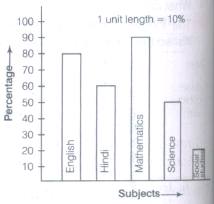
The percentage of marks secured by Karan in an examination are given below:
| Subject | English | Hindi | Maths | Science | Social Science |
| Percentage | 80 | 60 | 90 | 50 | 20 |
Draw the bar graph to represents the above information.
12.
Find the equivalent fraction of 3 /5 having numerator 9
13.
Jack has painted \(1\frac{2}{5}\) part of a wall and Mike has \(\frac{3}{4}\) painted part of the same wall. How much did they paint together?
14.
Ravi purchased 5 kg 400 g rice, 2 kg 20 g sugar and 10 kg 850 g flour. Find the total weight of his purchases.
15.
Name the numerator of \(\frac { 3 }{ 7 } \)and the denominator of \(\frac { 4 }{ 15 } \)
1.
(a) AB (b) b (c) 45
2.
\(\frac { 5 }{ 6 } -\frac { 1 }{ 3 } =\frac { 1 }{ 2 } \)
3.
We know that, 1 g \(={1\over 1000}\) kg
\(\therefore\) 5 kg 8 g = 5 kg + 8 g = 5 kg \(+8\times{1\over 1000}\) kg
= 5 kg \(+{8\over1000}\) kg = (5+0.008) kg = 5.008 kg.
4.
We have\(\frac { 1 }{ 7 } \Box { } \frac { 1 }{ 4 } \)
Here,numerators are same of both fractions. So, fraction having smaller denominator will be greater.
∴ \(\frac { 1 }{ 7 } \boxed { < } \frac { 1 }{ 4 } \)
5.
0.5 or 0.05
Whole part for both is 0.
Tenth part for 0.5 is 5 and for 0.05 is 0.
\(\therefore \) 5 >0
\(\therefore \) 0.5> 0.05
6.
\(200+60+5+\frac { 1 }{ 10 } =265.1\)
7.
We know that, one day = 24 h
\(\therefore\) The required fraction = \(\frac { 15\ h }{ 24\ h } =\frac { 15 }{ 14 } =\frac { 5 }{ 8 } \)
8.
\(12\frac{4}{5}\)
9.
Rs 313.86
10.
| Blood group | Tally marks | Number of students |
| A | .png) |
8 |
| B | .png) |
7 |
| O | .png) |
6 |
| AB | I I I I | 4 |
11.
First of all, we draw a horizontal and a vertical line. On the horizontal line, mark points at equal distance. Write the subject on these points whose percentage is to be plotted. Now, choose a suitable scale, such as
1 unit = 10 small squares = 10%.
For the given table, bar graph is shown alongside:
12.
Given, numerator of an equivalent fraction = 9
∴ \(\frac { 9 }{ D } =\frac { 3 }{ 5 } \) ⇒ D\(\times\)3 = 9\(\times\)5
So, D\(\times\)3 = 3\(\times\)3\(\times\)5 [∵ 9=3\(\times\)3]
⇒ D\(\times\)3 =15\(\times\)3
On comparing, we get D = 15
∴ Required equivalent fraction of \(\frac { 3 }{ 5 } =\frac { N }{ D } =\frac { 9 }{ 15 } \)
13.
\(2\frac{3}{20}\)
14.
Weight of rice purchased by Ravi
= 5 kg 400 g = 5 kg + 400 g
\(= 5 kg+ 400\times{1\over 1000}kg\) \(\begin{bmatrix} \because 1\ g={1\over 1000} kg\end{bmatrix}\)
\(=5\ kg+{400\over1000}\)kg = (5+ 0.400) kg = 5.400 kg
Weight of sugar purchased by Ravi
= 2 kg 20 g = 2 kg+ 20 g
\(= 2 kg+ 20\times{1\over1000}kg\) \(\begin{bmatrix} \because 1\ g={1\over 1000} kg\end{bmatrix}\)
\(=2\ kg+{20\over1000}kg\) = (2+ 0.020) kg = 2.020 kg
Weight of flour purchased by Ravi
= 10 kg 850 g = 10 kg + 850 g
\(=10\ kg+850\times{1\over 1000}kg\) \(\begin{bmatrix} \because 1\ g={1\over 1000} kg\end{bmatrix}\)
\(=10\ kg+{850\over1000}kg\) (10 + 0.850) kg = 10.850 kg
\(\therefore\) Total weight of his purchases
\(\quad5.400\\\quad2.020\\+10.850\\\_\_\_\_\_\_\_\_\\\ \ 18.270\\\_\_\_\_\_\_\_\_\)
Hence, the total weight of all his purchases is 18.270 kg.
15.
()
The numerator of\(\frac { 3 }{ 7 } \) is 3 and the denominator of \(\frac { 4 }{ 15 } \)is 15

6th Standard CBSE Syllabus & Materials
6th Standard CBSE
CBSE 6th Social Science Locating Places on the Earth - New Sample Question Papers Study Material - QB365 Set A
NEW6th Standard CBSE
CBSE 6th Science A Journey Through States of Water - New Sample Question Papers Study Material - QB365 Set A
NEW6th Standard CBSE
CBSE 6th Science Temperature and its Measurement - New Sample Question Papers Study Material - QB365 Set A
NEW6th Standard CBSE
CBSE 6th Science Materials Around Us - New Sample Question Papers Study Material - QB365 Set A



NCERT Books

Syllabus

Exam Pattern

Sample Question Papers

Previous year Question Papers

Important Notes

MCQ Practice test

NCERT Exemplers

Case study Questions

Image Based Questions

Passage based Questions

HOT Questions

Value Based Questions

Model Questions Papers
NCERT ( Book Back ) Questions

Assertion and Reason
Important Questions And Answers

CBSE 6th Standard CBSE Subjects
CBSE Standards


