
 100% FREE ACCESS
6th Standard CBSE Syllabus & Materials
6th Standard CBSE
CBSE 6th Social Science The Value of Work - New Sample Question Papers Study Material - QB365 Set A
NEW6th Standard CBSE
CBSE 6th Social Science Family and Community - New Sample Question Papers Study Material - QB365 Set A
NEW6th Standard CBSE
CBSE 6th Social Science India's Cultural Roots - New Sample Question Papers Study Material - QB365 Set A
NEW6th Standard CBSE
CBSE 6th Social Science India,That is Bharat - New Sample Question Papers Study Material - QB365 Set A
NEW6th Standard CBSE
CBSE 6th Social Science Timeline and sources of history - New Sample Question Papers Study Material - QB365 Set A
NEW6th Standard CBSE
CBSE 6th Social Science Oceans and Continents - New Sample Question Papers Study Material - QB365 Set A

Published on: 24/10/2025
Download CBSE Class 6th Standard CBSE Mathematics question papers, sample papers, important questions, and previous year solved papers in PDF format. Get free study materials, NCERT solutions, and exam preparation resources for Class 6th Standard CBSE Mathematics
Questions + Answers key
Take MCQ Mathematics Test
1.
A survey of 100 school students was done to find which activity they prefer to do in their free time.
| Preferred activity | Number of students |
|---|---|
| Playing | 35 |
| Reading story books | 20 |
| Watching TV | 30 |
| Listening to music | 10 |
| Painting | 5 |
Draw a bar graph to illustrate the above data taking scale of 1 unit length=5 students. Which activity is preferred by most of the students other than playing?
2.
Draw a line segment \(\bar{AB}\) = 12 cm. Using compasses, divided it into four equal parts. Verify by actual measurement.
3.
Construct with ruler and compasses, angle of the following measures 45o.
4.
The perimeter of a squared garden is 48 m. A small flower bed covers 18 sq m area inside this garden. What is the area of the garden that is not covered by the flower bed? What fractional part of the garden is covered by flower bed? Find the ratio of the area covered by the flower bed and the remaining area.
5.
The length and breadth of three rectangles are as given below.
(a)9 m and 6 m (b) 17 m and 3 m (c)4 m and 14 m
Which one has the largest area and which one has the smallest?
6.
Write the decimal number represented by the points A, B, C and D on the given number line.

7.
Can you now write the following as decimals?
| Hundreds (100) |
Tens (10) |
Ones (1) |
Tenths \(\left( \frac { 1 }{ 10 } \right) \) |
|---|---|---|---|
| 5 | 3 | 8 | 1 |
| 2 | 7 | 3 | 4 |
| 3 | 5 | 4 | 6 |
8.
Observe the following table and answer the related questions.
| Blood group | Number of students |
|---|---|
| A | 10 |
| B | 8 |
| O | 12 |
| AB | 15 |
(a) Which blood group is the most common?
(b) Which blood group is the rarest?
(c) What is the total number of students?
9.
Draw a circle of radius 4.5 cm. Draw a line passing through the centre and meeting the circumference at two different points. Name the line, so formed.
10.
Find the sum of the following:
15 + 0.632 + 13.8
11.
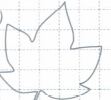
Find the areas of the following figures by counting square.
12.
Find the perimeter of a rectangle, whose length is 40 cm and width is 30 cm.
13.
Give expressions in the following cases.
Y is multiplied by -5 and the result is added to 16.
14.
Rohan walks 12 km in an hour while Rakesh walks 8 km in an hour. What is the ratio of the distance covered by Rohan to the distance covered by Rakesh?
15.
Find the rule, which gives the number of matchsticks required to make the following matchsticks patterns. Use a variable to write the rule.
A pattern of letter H as 
16.
Find the distance travelled by Soniya, if she takes three rounds of a squared park of side 60 m.
17.
Write each of the following as decimals. 200 + 60 + 5 + \(\frac { 1 }{ 10 } \)
18.
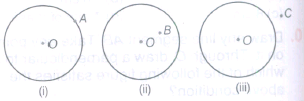
Given, a circle of radius 3.1 cm, mark points A Band C such that
(i) A is on the circle.
(ii) B is in the interior of the circle.
(iii) C is in the exterior of the circle.
19.
Draw a line AB to 6.5 cm length. At the end points A B draw two perpendiculars. Are these lines perpendicular to each other?
20.
The pocket money of A B and C are Rs 600, Rs 500 and Rs 550, respectively. Find the
(a) ratio of pocket money of A to that of B.
(b) ratio of pocket money of A to that of C.
21.
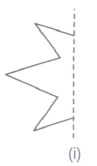
Complete the figure, given its line of symmetry.
22.
Simplify 53.5 - 34.68 + 64.75 - 28.9.
23.
Raju purchases 10 pens for Rs.150 and Manish buys 7 pens for Rs.84. Can you say who got the pens cheaper?
24.
If 14: x:: 7 : 25, then find the value of x.
25.
What is the cost of tiling a rectangular plot of land 500 m long and 200 m wide at the rate of Rs.8 per hundred sq m?
26.
The following table shows the ages of 5 people. Illustrate this date using a bar graph and answer the following questions.
| Name of the person | A | B | C | D | E |
| Ages (in years) | 35 | 25 | 40 | 30 | 50 |
(a) Who is twice as old as B?
(b) Who is the youngest of all?
(c) By how many years, is A older than D?
27.
Find the side of the square whose perimeter is 32 m.
28.
The cost of 5 kg of tomatoes is Rs 100. The cost of 2 kg of tomatoes is
Rs. 20
Rs. 40
Rs. 30
Rs. 50
29.
There are 25 boys and 25 girls in a class. The ratio of the number of boys to the total number of students is
1:2
1:3
2:3
3:2
30.
12 kg 20 g =
12.02 kg
12.2 kg
12.002 kg
12.0002 kg.
31.
111mm=
11.1 cm
1.11cm
0.111 cm
0.0111 cm.
32.
The expression for '2 times x from which 1 is subtracted' is
2x-1
2x+1
x-2
x+2
33.
Which of the following letters has vertical line of symmetry?
R
C
B
T
34.
Two sides of a triangle are 5 cm and 4 cm. The perimeter of the triangle is 12 cm. The third side has length
1 cm
2 cm
3 cm
6 cm
35.
The perimeter of a square is 8 m. Find the length of the side.
1 m
2 m
4 m
8 m
36.
Perimeter of an equilateral triangle =
2 x Length of a side
3 x Length of a side
4 x Length of a side
6 x Length of a side.
37.
If 66: 72 :: x: 96, then x is equal to
108
78
88
48
38.
Perpendicular bisector of a line segment
is perpendicular to it
divides it into two equal parts
Both (a) and (b) are true
None of the above
39.
The perimeter of a triangle whose sides are 1.2cm, 3.4 cm and 1.7 cm, is
6.3 cm
6.2 m
6.5 cm
6.4 cm
40.
Take Meena's present age to be y yr, what is his father's age if he is double of her age?
y + 2
Y - 2
y/2
2y
41.
The marks (out of 10) obtained by 28 students in a Mathematics test are listed as given below:
8, 1, 2, 6, 5, 5, 5, 0, 1, 9, 7, 8, 0, 5, 8, 3, 0, 8, 10, 10, 3, 4, 8, 7, 8, 9, 2, 0
, the number of students who scored marks less than 4 is
15
13
12
10
42.
A ratio expressed in lowest form has no common factor other than ______________ in its terms.
43.
The line of symmetry of a line segment is the __________ bisector of the line segment.
44.
3 part out of 100 = ___________
45.
4.56 + 9.25 = _______________
46.
A scalene triangle has _____ line of symmetry.
47.
An equilateral triangle has _____ lines of symmetry.
48.
m exceeds n by 10 can be expressed as ________
49.
If 7x + 6 = 48, then the value of x is ___________
50.
The data can be arranged in a tabular form using _________ marks.
1.
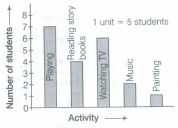
Watching TV is preferred by most of the studentsother than playing.
2.
First of all, we construct \(\bar{AB}\) of length 12 cm.
Now, steps of construction are as follows:
Step I Draw a line segment \(\bar{AB}\) = 12 cm.
Step II Draw perpendicular bisector of AB, which meets \(\bar{AB}\) at O. (i.e. O is the mid-point of \(\bar{AB}\)) i.e. AO = OB.
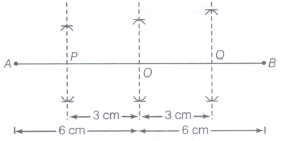
Step III Now, draw perpendicular bisector of \(\bar{AO}\) , which meet \(\bar{AB}\) at P such that AP = PO.
Step IV Then, draw perpendicular bisector of BO, which meet \(\bar{AB}\) at Q such that BQ = OQ.
Step V The line segment AB is divided into 4 equal parts at P, O, and Q.
Step VI By actual measurement, we have \(\bar{AP}=\bar{PO}=\bar{OQ}=\bar{QB}\) = 3 cm.
3.
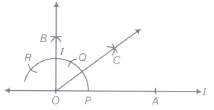
On measuring, \(\angle\)COA = 45o.
4.
Let side of squared garden be x m.
Given that, perimeter of a squared garden = 48 m
∴ 4 x Side of a square = 48
⇒ 4x=48⇒x=\(\frac{48}{4}=12m\)
Now, area of the squared garden = (X)2
=(12)2=144m2
Also given, area of small flower bed cover inside the garden = 18 m2
∴ Area of the 9B.rden not covered by flower bed
= Area of squared garden - Area of flower bed
=144 m2 -18 m2 = 126 m2
The fractional part of the garden covered by flower bed=\(\frac { Area\quad covered\quad by\quad the\quad flower }{ Remaming\quad Area\quad of\quad the\quad squared\quad garden } \)
\(=\frac { 18 }{ 126 } =\frac { 2 }{ 14 } =\frac { 1 }{ 7 } \)
Hence, ratio of the area covered by the flower bed and the remaining area is 1 : 7.
5.
(a) Here, length of the rectangle = 9 m
and breadth of the rectangle = 6 m
∴ Area of the rectangle = Length \(\times\) Breadth = 54 sq m
Hence, the area of the rectangle is 54 sq m.
(b) Here, length of the rectangle = 17 m
and breadth of the rectangle = 3 m
∴ Area of the rectangle = Length \(\times\) Breadth
= 17m \(\times\) 3m = 51 sq m
Hence, the area of the rectangle is 51 sq m.
(c) Here, length of the rectangle = 14 m
and breadth of the rectangle = 4 m
∴ Area of the rectangle = Length \(\times\) Breadth
= 14 m \(\times\) 4 m = 56 sq m
Hence, the area of the rectangle is 56 sq m.
Now, we have 56> 54> 51
Hence, the rectangle having sides 4 m and 14 m has the largest area and the rectangle having sides 17m and 3 m has the smallest area.
6.
Given number line is a follows:

(i) From the figure, it is clear that A = 0.8 as the unit length between 0 and 1 has been divided into 10 equal parts and 8 parts from 0 have been taken.
(ii) From the figure, it is clear that B = 1.3 as the unit length between 1 and 2 has been divided into 10 equal parts and unit length between 0 to 1 and then 3 parts have been taken.
(iii) From the figure, it is clear that C = 2.2 as the unit length between 2 and 3 has been divided into 10 equal parts and unit length between 0 to 1, 1 to 2 and then 2 parts have been taken.
(iv) From the figure, it is clear that D = 2.9 as the unit length between 2 and 3 has been divided into 10 equal parts and unit length between 0 to 1, 1 to 2 and then 9 parts have been taken.
7.
Given numbers can be written in decimals as follows:
(i) 5 hundreds + 3 tens + 8 ones + 1 tenth
= 5 \(\times\) 100 + 3 \(\times\) 10 + 8 \(\times\) 1+ 1 \(\times\) \(\frac { 1 }{ 10 } \)
= 500 + 30 + 8 + \(\frac { 1 }{ 10 } \) = 538 + 0.1 = 538.1
(ii) 2 hundreds + 7 tens + 3 ones + 4 tenths
= 2 \(\times\) 100 + 7 \(\times\) 10 + 3 \(\times\) 1+ 4 \(\times\) \(\frac { 1 }{ 10 } \)
= 200 + 70 + 3 + \(\frac { 4 }{ 10 } \) = 273 + 0.4 = 273.4
(iii) 3 hundreds + 5 tens + 4 ones + 6 tenths
= 3 \(\times\) 100 + 5 \(\times\) 10 + 4 \(\times\) 1+ 6 \(\times\) \(\frac { 1 }{ 10 } \)
= 300 + 50 + 4 + \(\frac { 6 }{ 10 } \) = 354 + 0.6 = 354.6
8.
(a) AB (b) b (c) 45
9.
Diameter
10.
We have, 15 + 0.632 + 13.8
\(\quad Tens\quad Ones \quad Tenths \quad Hundreaths \quad Thousandhs\\ \quad1\quad\quad\quad\quad5\quad\quad\quad0\quad\quad\quad\quad\quad0\quad\quad\quad\quad\quad\quad0\\ \quad0\quad\quad\quad\quad0\quad\quad\quad6\quad\quad\quad\quad\quad3\quad\quad\quad\quad\quad\quad2\\+1\quad\quad\quad\quad3\quad\quad\quad8\quad\quad\quad\quad\quad0\quad\quad \quad \quad \quad\quad 0\\ \_\_\_\_\_\_\_\_\_\_\_\_\_\_\_\_\_\_\_\_\_\_\_\_\_\_\_\_\_\_\_\_\_\_\_\_\_\_\_\_\_\_\_\_\_\_\_\\\quad 2\quad\quad\quad\quad9\quad\quad\quad4\quad\quad\quad\quad\quad3\quad\quad\quad\quad\quad\quad2\\\_\_\_\_\_\_\_\_\_\_\_\_\_\_\_\_\_\_\_\_\_\_\_\_\_\_\_\_\_\_\_\_\_\_\_\_\_\_\_\_\_\_\_\_\_\_\_\)
\(\therefore\) 15+0.632+13.8=29.432
11.
Given, figure is covered by 7 full squares, 8 half squares, 3 more than half squares and 3 less than half squares.
∴ Area = \(\left( 7\times 1+8\times \frac { 1 }{ 2 } +3\times 1+3\times 0 \right) sq\quad units\)
=(7 +4 +3 +0)sq unit
= 14 sq units
12.
140 cm
13.
When y is multiplied by -5, then result is -5 y and then this result is added to 16, then expression will be -5y+16.
14.
\(\because\) Distance covered by Rohan in 1 h = 12 km and distance covered by Rakesh in 1 h = 8 km
\(The\ required\ ratio=\frac{Distance\ covered\ by\ Rohan}{Distance\ covered\ by\ Rakesh}=\frac{12}{8}\)
Now, divide numerator and denominator both by the HCF of 12 and 8 i.e. 4, \(\frac{12\div4}{8\div4}\ \ [\because HCF\ of\ 12\ and\ 8\ is\ 4]\)
\(=\frac{3}{2}=3:2\)
15.
From the figure, it can be observed that it will require five matchsticks.
∴ The number of matchsticks required is 5n.
16.
Perimeter of a squared park = 4 \(\times\) Length of a side = 4 \(\times\) 60 = 240 m
Distance covered in one round = 240 m
Distance covered in three rounds = 3 \(\times\) 240 m = 720 m
17.
\(200+60+5+\frac { 1 }{ 10 } =265.1\)
18.
The required circles, are given below.
19.
No, they are parallel to each other.
20.
(a) 6 : 5
(b) 12 : 11
21.
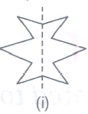
22.
Converting the given decimals into like decimals
we get
53.5 - 34.68 + 64.75 - 28.9
= (53.50 + 64.75)-(34.68 + 28.90)
= 118.25 - 63.58
= 54.67
23.
For Raju, cost of 10 pens = Rs.150
\(\therefore\) Cost of 1 pen \(=Rs.\frac{150}{10}=Rs.15\)
For Manish, cost of 7 pens = Rs.84
\(\therefore\) Cost of 1 pen \(=Rs.\frac{84}{7}=Rs.12\)
Here, Rs.12 < Rs.15
Hence, Manish got the pens cheaper.
24.
50
25.
Given, length of a rectangular plot = 500 m
and breadth of a rectangular plot = 200 m
∴ Area of the rectangular plot = Length \(\times\) Breadth
= 500 m\(\times\) 200 m
= 100000 sq m
∴ Cost of tiling per hundred square metres = Rs. 8
∴ Cost of 1 sq m = Rs.\(\frac { 8 }{ 100 } \)
Now, cost of 100000 sq metre =Rs.100000\(\times\frac { 8 }{ 100 } \)
=Rs. 8000
Hence, the cost of tiling rectangular plot is Rs. 8000
26.
.png)
(a) E
(b) B
(c) 5 yr.
27.
8
28.
\(\frac { 100 }{ 5 } \times 2\) = 40
29.
\(\frac { 25 }{ 25+25 } =\frac { 25 }{ 30 } =\frac { 1 }{ 2 } \)=1:2
30.
(a)
12.02 kg
31.
(a)
11.1 cm
32.
(a)
2x-1
33.
(d)
T
34.
Third side = 12 - (5 + 4) = 3 cm
35.
Length of side =\(\frac{8}{4}\)=2 m
36.
(b)
3 x Length of a side
37.
(c)
88
38.
(c)
Both (a) and (b) are true
39.
(a)
6.3 cm
40.
(d)
2y
41.
(d)
10
42.
()
1
43.
()
perpendicular
44.
()
0.03
45.
()
13.81
46.
()
zero
47.
()
three
48.
()
m=n+10
49.
()
x=6
50.
()
tally

6th Standard CBSE Syllabus & Materials
6th Standard CBSE
CBSE 6th Social Science Locating Places on the Earth - New Sample Question Papers Study Material - QB365 Set A
NEW6th Standard CBSE
CBSE 6th Science A Journey Through States of Water - New Sample Question Papers Study Material - QB365 Set A
NEW6th Standard CBSE
CBSE 6th Science Temperature and its Measurement - New Sample Question Papers Study Material - QB365 Set A
NEW6th Standard CBSE
CBSE 6th Science Materials Around Us - New Sample Question Papers Study Material - QB365 Set A



NCERT Books

Syllabus

Exam Pattern

Sample Question Papers

Previous year Question Papers

Important Notes

MCQ Practice test

NCERT Exemplers

Case study Questions

Image Based Questions

Passage based Questions

HOT Questions

Value Based Questions

Model Questions Papers
NCERT ( Book Back ) Questions

Assertion and Reason
Important Questions And Answers

CBSE 6th Standard CBSE Subjects
CBSE Standards


