
 100% FREE ACCESS
6th Standard CBSE Syllabus & Materials
6th Standard CBSE
CBSE 6th Social Science The Value of Work - New Sample Question Papers Study Material - QB365 Set A
NEW6th Standard CBSE
CBSE 6th Social Science Family and Community - New Sample Question Papers Study Material - QB365 Set A
NEW6th Standard CBSE
CBSE 6th Social Science India's Cultural Roots - New Sample Question Papers Study Material - QB365 Set A
NEW6th Standard CBSE
CBSE 6th Social Science India,That is Bharat - New Sample Question Papers Study Material - QB365 Set A
NEW6th Standard CBSE
CBSE 6th Social Science Timeline and sources of history - New Sample Question Papers Study Material - QB365 Set A
NEW6th Standard CBSE
CBSE 6th Social Science Oceans and Continents - New Sample Question Papers Study Material - QB365 Set A

Published on: 24/10/2025
Download CBSE Class 6th Standard CBSE Mathematics question papers, sample papers, important questions, and previous year solved papers in PDF format. Get free study materials, NCERT solutions, and exam preparation resources for Class 6th Standard CBSE Mathematics
Questions + Answers key
Take MCQ Mathematics Test
1.
Express the following as em using decimals:11 cm52 mm
2.
Make three more examples similar to the one given in question 1 and solve them.
Three more examples similar to the one given in question 1 are as follows:
Can you write the following numbers as decimals?
| S.No. | Hundreds(100) | Tens(10) | Ones(1) | Tenths\(\left( \cfrac { 1 }{ 10 } \right) \) |
| 1 | 6 | 4 | 9 | 2 |
| 2 | 3 | 8 | 4 | 5 |
| 3 | 4 | 6 | 5 | 7 |
3.
Arrange 12.142, 12.124, 12.104, 12.401 and 12.214 in ascending order
4.
The place value of a digit at the tenths place is 10times the same digit at the ones place. State whether the statement is true or false?
5.
Between which two numbers in tenths place on the number line does each of the given number lie?
(a) 0.06 (b) 0.45 (c) 0.19 (d) 0.66 (e) 0.92 (f) 0.57
6.
Write the following decimals in the place value table.
(a) 0.29 (b) 2.08 (c) 19.60 (d) 148.32 (e) 200.812
7.
What part of the whole square is the shaded portion, if we shade 8 squares, 15 squares, 50 squares, 92 squares of the whole square?
8.
(a) The length of Ramesh's notebook is 9 cm 5 mm. What will be its length in cm?
(b) The length at a young gram plant is 65 mm. Express its length in cm.
9.
Can you now represent 2.3 on a number line? Check, how many ones and tenths are there in 2.3. Where will it lie on the number line?
10.
Write five numbers between 0 and 1 and show them on the number line.
1.
11 cm 52 rnm = 11 cm + 52 rnm
= 11 cm+ \(\cfrac { 52 }{ 10 } \)cm
I·: 1 rnm= \(\cfrac { 1 }{ 10 } \)cm
= 11 cm+ \(\cfrac { 50+2 }{ 10 } cm\)
=11 cm+\(\left( \cfrac { 50 }{ 10 } +\cfrac { 2 }{ 10 } \right) \)
= 11 cm+ \(\left( 5+\cfrac { 2 }{ 10 } \right) \)
= \(\left( 11+5+\cfrac { 2 }{ 10 } \right) cm\)
=\(\left( 16+\cfrac { 2 }{ 10 } \right) \)cm = 16.2 cm
2.
1.Required number
=600+40+9+ \(\cfrac { 2 }{ 10 } \) =649.2
2.Required number
= 300 + 80 + 4 + \(\cfrac { 5 }{ 10 } \) = 384.5
3.Required number
=400+60+5+ \(\cfrac { 7 }{ 10 } \) =465.7
3.
Given numbers are 12.142, 12.124, 12.104, 12.401 and 12..214.
\(\therefore\) \(12.142=10+2+\frac { 1 }{ 10 } +\frac { 4 }{ 100 } +\frac { 2 }{ 1000 } \)
\(12.124=10+2+\frac { 1 }{ 10 } +\frac { 2 }{ 100 } +\frac { 4 }{ 1000 } \)
\(12.104=10+2+\frac { 1 }{ 10 } +\frac { 0 }{ 100 } +\frac { 4 }{ 1000 } \)
\(12.401=10+2+\frac { 4 }{ 10 } +\frac { 0 }{ 100 } +\frac { 1 }{ 1000 } \)
\(12.214=10+2+\frac { 2 }{ 10 } +\frac { 1 }{ 100 } +\frac { 4 }{ 1000 } \)
Here, whole part of all numbers are same and tenths part of 12.142, 12.124 and 12.104 are same.
Now, tenths part of 12.401 = \(\frac { 4 }{ 10 } \)
and tenths part of 12.214 = \(\frac { 2 }{ 10 } \)
\(\because \quad \frac { 4 }{ 10 } >\frac { 2 }{ 10 } \)
\(\therefore\) 12.401 > 12.214
Again, hundredths part of 12.142 = \(\frac { 4 }{ 100 } \)
\(\therefore\) Hundredths part of 12.104 = \(\frac { 0 }{ 100 } \)
\(\therefore \quad \frac { 4 }{ 100 } >\frac { 2 }{ 100 } >\frac { 0 }{ 100 } \)
\(\therefore\) 12.142 > 12.124 > 12.104
Hence, the ascending order of given number are 12.104 < 12.124 < 12.142 < 12.214 < 12.401.
4.
False, because the place value of a digit at the tenths place is 1/10 times the same digit at the ones place,
e.g. Let a number be 23.37.
Here, place value of 3 at ones place = 3
and place value of 3 at tenths place
\(=\frac { 3 }{ 10 } =3\times \frac { 1 }{ 10 } =\frac { 1 }{ 10 } \times \) Place value of 3 at ones place
5.

Given, numbers can be represented on the number line as given below:
(a) Here, 0.06 is more than 0 but less than 0.1. So, it lies between 0 and 0.1.
(b) Here, 0.45 is more than 0.4 but less than 0.5. So, it lies between 0.4 and 0.5.
(c) Here, 0.19 is more than 0.1 but less than 0.2. So, it lies between 0.1 and 0.2.
(d) Here, 0.66 is more than 0.6 but less than 0.7. So, it lies between 0.6 and 0.7.
(e) Here, 0.92 is more than 0.9 but less than 1. So, it lies between 0.9 and 1.
(f) Here, 0.57 is more than 0.5 but less than 0.6. So, it lies between 0.5 and 0.6.
6.
The given decimals can be written as
(a) 0.29=\(0+\frac { 2 }{ 10 } +\frac { 9 }{ 100 } \)
(b) 2.08=\(2+\frac { 0 }{ 10 } +\frac { 8 }{ 100 } \)
(c) 19.60=10+9+\(\frac { 6 }{ 10 } +\frac { 0 }{ 100 } \)
(d) 14832=100+40+8+\(\frac { 3 }{ 10 } +\frac { 2 }{ 100 } \)
(e) 200.812=200+00+0+\(\frac { 8 }{ 10 } +\frac { 1 }{ 100 } +\frac { 2 }{ 1000 } \)
Now, the place value table is given below:
| Decimal number | Hundreds (100) |
Tens (10) |
Ones (1) |
Tenths (1/10) |
Hundredths (1/100) |
Thousandths (1/1000) |
|
|---|---|---|---|---|---|---|---|
| (a) | 0.29 | 0 | 0 | 0 | 2 | 9 | 0 |
| (b) | 2.08 | 0 | 0 | 2 | 0 | 8 | 0 |
| (c) | 19.60 | 0 | 1 | 9 | 6 | 0 | 0 |
| (d) | 148.32 | 1 | 4 | 8 | 3 | 2 | 0 |
| (e) | 200.812 | 2 | 0 | 0 | 8 | 1 | 2 |
7.
(i) If we shade 8 squares, then whole square with shaded portion is given.
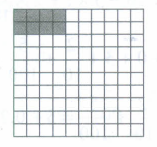
Here, total number of squares = 100 and number of shaded squares = 8
\(\therefore
\) Ordinary fraction = \(\frac { Shaded\quad squares }{ Total\quad squares } =\frac { 8 }{ 100 } \)
and decimal number = \(\frac { 8 }{ 100 } =0.08\)
(ii) If we shade 15 squares, then whole square with shaded portion is given
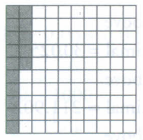
Here, total number of squares = 100 and number of shaded squares = 15
\(\therefore
\) Ordinary fraction=\(\frac { Shaded\quad squares }{ Total\quad squares } =\frac { 15 }{ 100 } \)
and decimal number = \(\frac { 15 }{ 100 } =0.15\)
(iii) If we shade 50 squares, then whole square with shaded portion is given
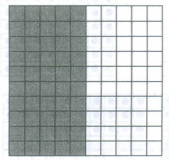
Here, total number of squares = 100 and number of shaded squares = 50
\(\therefore \quad Ordinary\quad fraction=\frac { Shaded\quad squares }{ Total\quad squares } =\frac { 50 }{ 100 } \)
and decimal number = \(\frac { 50 }{ 100 } =0.50\)
(iv) If we shade 92 squares, then whole square with shaded portion is given.
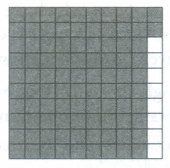
Here, total number of squares = 100 and number of shaded squares = 92
\(\therefore \quad Ordinary\quad fraction=\frac { Shaded\quad squares }{ Total\quad squares } =\frac { 92 }{ 100 } \)
\(and\quad decimal\quad number=\frac { 92 }{ 100 } \)
= 0.92
Now, we can write it in the form of table as shown below:
| Shaded portions | Ordinary fraction | Decimal number |
|---|---|---|
| 8 squares | \(\frac { 8 }{ 100 } \) | 0.08 |
| 15 squares | \(\frac { 15 }{ 100 } \) | 0.15 |
| 50 squares | \(\frac { 50 }{ 100 } \) | 0.50 |
| 92 squares | \(\frac { 92 }{ 100 } \) | 0.92 |
8.
(a) Given, length of Ramesh's notebook
= 9 cm 5 mm
We know that, 10 mm = 1 cm
\(\Rightarrow \quad 1\quad mm=\frac { 1 }{ 10 } cm\)
\(\therefore\) Length of Ramesh's notebook = 9 cm 5 mm
\(=9\quad cm+5\times \frac { 1 }{ 10 } cm\)
\(=9\quad cm+\frac { 5 }{ 10 } cm\)
= 9 cm + 0.5 cm
= (9 + 0.5) cm = 9.5 cm
(b) Given, length of young gram plant = 65 mm
We know that, 10 mm = 1 cm
\(\Rightarrow\) 1 mm = 1/10 cm
\(\therefore\) Length of young gram plant = \(65\times \frac { 1 }{ 10 } cm\)
\(=\frac { 65 }{ 10 } cm=6\frac { 5 }{ 10 } cm=\left( 6+\frac { 5 }{ 10 } \right) cm\)
= (6 + 0.5) cm = 6.5 cm
9.
Yes, we can represent all decimals on the number line.
We know that, 2.3 is greater than 2, but less than 3. So, divide the unit length between 2 and 3 into 10 equal parts and take 3 parts as shown below:

Thus, A represents 2.3 on the number line. There are 2 ones and 3 tenths in 2.3 and it will lie between 2 and 3 on the number line.
10.
Let five numbers between 0 and 1 be 0.1, 0.3, 0.5, 0.7 and 0.9. Now, we will represent them on the number line.
We know that, all these numbers are greater than 0, but less than 1. So, divide a unit length between 0 and 1 into 10 equal parts and each part represents 0.1 (one-tenth).
Now, take 1 part, 3 parts, 5 parts, 7 parts and 9 parts, respectively. Thus, 0.1, 0.3, 0.5, 0.7 and 0.9 are shown by A, B, C, D and E respectively on the number line.


6th Standard CBSE Syllabus & Materials
6th Standard CBSE
CBSE 6th Social Science Locating Places on the Earth - New Sample Question Papers Study Material - QB365 Set A
NEW6th Standard CBSE
CBSE 6th Science A Journey Through States of Water - New Sample Question Papers Study Material - QB365 Set A
NEW6th Standard CBSE
CBSE 6th Science Temperature and its Measurement - New Sample Question Papers Study Material - QB365 Set A
NEW6th Standard CBSE
CBSE 6th Science Materials Around Us - New Sample Question Papers Study Material - QB365 Set A



NCERT Books

Syllabus

Exam Pattern

Sample Question Papers

Previous year Question Papers

Important Notes

MCQ Practice test

NCERT Exemplers

Case study Questions

Image Based Questions

Passage based Questions

HOT Questions

Value Based Questions

Model Questions Papers
NCERT ( Book Back ) Questions

Assertion and Reason
Important Questions And Answers

CBSE 6th Standard CBSE Subjects
CBSE Standards


