
 100% FREE ACCESS
6th Standard CBSE Syllabus & Materials
6th Standard CBSE
CBSE 6th Social Science The Value of Work - New Sample Question Papers Study Material - QB365 Set A
NEW6th Standard CBSE
CBSE 6th Social Science Family and Community - New Sample Question Papers Study Material - QB365 Set A
NEW6th Standard CBSE
CBSE 6th Social Science India's Cultural Roots - New Sample Question Papers Study Material - QB365 Set A
NEW6th Standard CBSE
CBSE 6th Social Science India,That is Bharat - New Sample Question Papers Study Material - QB365 Set A
NEW6th Standard CBSE
CBSE 6th Social Science Timeline and sources of history - New Sample Question Papers Study Material - QB365 Set A
NEW6th Standard CBSE
CBSE 6th Social Science Oceans and Continents - New Sample Question Papers Study Material - QB365 Set A

Published on: 24/10/2025
Download CBSE Class 6th Standard CBSE Mathematics question papers, sample papers, important questions, and previous year solved papers in PDF format. Get free study materials, NCERT solutions, and exam preparation resources for Class 6th Standard CBSE Mathematics
Questions + Answers key
Take MCQ Mathematics Test
1.
Write five pairs of like fractions and five pairs of unlike fractions.
2.
How do you name the dotted line in the figure?
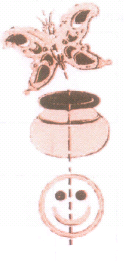
3.
Rani had Rs 18.50. She bought one ice-cream for Rs 11.75. How much money does she have now?
4.
Find the perimeter of a square whose side is 20 cm.
5.
7 times of y is subtracted from 40.
6.
Find the HCF of 12, 16 and 28 using the division method.
7.
Find additive inverse of the following numbers.
11
8.
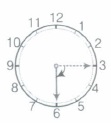
Find the number of right angles turned through by the hour hand of a clock, when it goes from 3 to 6
9.
Find the sum of the smallest whole number and the smallest natural number.
10.
Compare the following number: 67454 and 78465
11.
The ratio of 20 kg to 200 kg is 1 : 10.
12.
Using only the two set-squares of the geometry box, an angle of 40° can be drawn.
13.
Two co-primes numbers are always prime numbers.
14.
Sum of interior angles of scalene triangle and equilateral triangle are different.
15.
Zero is the smallest natural number.
16.
The smallest odd number is
1
2
3
4
17.
\(2\cfrac { 1 }{ 10 } \)=
2.1
2.01
2.001
2.0002.
18.
The rule, which gives the number of matchsticks required to make the matchstick pattern A, is
3 n
4n
5 n
6 n.
19.
The area of a square of side 1 cm is
1 cm2
4 cm2
9 cm2
16 cm2
20.
Apala bought \(2\frac { 1 }{ 2 } \) kg of potatoes whereas Meenu bought \(1\frac { 1 }{ 2 } \) kg of potatoes. Find the total amount of potatoes purchased by Apala and Meenu both.
1 Kg
2 Kg
3 Kg
4 Kg
21.
Which of the following is true?
0<-8
0>-8
4<-4
0>6
22.
Take two digits, 0 and 1. Make the smallest 4-digit number using both the digits equal number of times
1001
1010
1100
None of these
23.
What part of a revolution have you turned through if you stand facing east and turn clockwise to face west?
\(\frac{1}{4}\)
\(\frac{1}{2}\)
\(\frac{3}{4}\)
none of these
24.
The marks (out of 10) obtained by 28 students in a Mathematics test are listed as given below:
8, 1, 2, 6, 5, 5, 5, 0, 1, 9, 7, 8, 0, 5, 8, 3, 0, 8, 10, 10, 3, 4, 8, 7, 8, 9, 2, 0
The number of students who obtained marks more than or equal to 5 is
13
15
16
17
25.
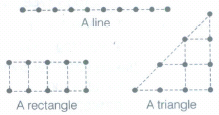
By using dot (\(\cdot\)) patterns, which of the following numbers can be arranged in all the three ways namely a line, a triangle and a rectangle?
9
10
11
12
26.
To find the ratio of two quantities, they must be expressed in ______________ unit.
27.
A radius of a circle is a line segment with one end at the ______ and the other end _________.
28.
\(\frac{5}{17}+\frac{11}{17}\)is equal to ______ .
29.
A scalene triangle has _____ line of symmetry.
30.
The smallest prime number between 80 and is __________
31.
An observation occurring seven times in a data is represented as ________ using tally marks.
32.
The angle formed in half-revolution is _______
33.
All the radii of a circle are____________.
34.
99 - ( ... ) = 105
35.
450 is the successor of __________.
36.
The pocket money of A B and C are Rs 600, Rs 500 and Rs 550, respectively. Find the
(a) ratio of pocket money of A to that of B.
(b) ratio of pocket money of A to that of C.
37.
Write the following statements, using numbers, literals and signs of basic operations, 8 times a number x is y less than a number z.
38.
A man saves Rs. 250 per month. How much money will save in 2 yr?
39.
1 obtuse angle
40.
Pyramid
41.
Cylinder
42.
1 obtuse angle
43.
2 sides of equal length
44.
The number of cars sold over a period of six months is represented in a pictograph given below
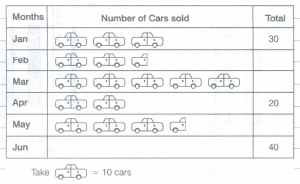
(b) Which month has the highest number of cars being sold?
(c) Find the ratio of the number of cars sold in April to the number of cars being sold in June.
45.
Find the greatest number that will divide 445, 572 and 699, leaving remainders 4, 5 and 6 respectively.
46.
Look at all these representations of fraction.
.png)
These fractions are \(\frac { 1 }{ 2 } ,\frac { 2 }{ 4 } ,\frac { 3 }{ 6 } \)representing the parts takenjrom the total numberofparts./fwe place the pictorial representation of one over the other they are found to be equal. Do you agree?
47.
State which of the following are equations (with a variable). Give reason for your answer. Identify the variable from the equations with a variable.
20-(10-5)=3x5
48.
Get 100 using four 9's and some of the symbols like +, ÷ x, etc.
49.
Are there angles smaller than a right angle?
50.
How much was the increase in population during 1991-2001? Try to find out.
1.
Five pairs of like fractions are as follows:
\(\frac { 1 }{ 8 } ,\frac { 3 }{ 8 } ;\frac { 2 }{ 9 } ,\frac { 7 }{ 9 } ;\frac { 3 }{ 11 } ,\frac { 9 }{ 11 } ;\frac { 4 }{ 13 } ,\frac { 5 }{ 13 } ;\frac { 7 }{ 17 } ,\frac { 11 }{ 17 } \)
Five pairs of unlike fractions are as follows:
\(\frac { 4 }{ 31 } ,\frac { 9 }{ 33 } ;\frac { 2 }{ 33 } ,\frac { 7 }{ 37 } ;\frac { 11 }{ 25 } ,\frac { 11 }{ 35 } ;\frac { 2 }{ 7 } ,\frac { 2 }{ 9 } ;\frac { 3 }{ 11 } ,\frac { 3 }{ 13 } \)
2.
We name the dotted line in the figure as the line of symmetry.
3.
\(\therefore\) Total money Rani had = Rs 18.50 and cost of ice-cream
= Rs 11.75
\(\therefore\) Remaining money = Rs ( 18.50- 11.75)= Rs 6.75
Hence, she have Rs 6.75.
4.
80 cm
5.
40-7y
6.
Firstly, find the HCF of 12 and 16.
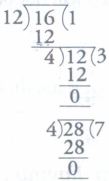
HCF of 12 and 16 is 4.
Now, find the HCF of 4 and 28.
HCF of 4 and 28 is 4.
Hence, HCF of 12, 16 and 28 is 4.
7.
-11
8.
Here, the hour hand moves from 3 to 6. It starts from 3 and covers digits 4, 5 and 6. So, hour hand turned by one right angle.
9.
1
10.
Both 67454 and 78465 are five-digit numbers. So, we compare them by comparing the digits at ten thousand places. Since, 7> 6. So, 78465> 67454.
11.
(a)
12.
(b)
13.
(b)
14.
(b)
15.
(b)
16.
(a)
1
17.
(a)
2.1
18.
(c)
5 n
19.
Area = 1 x 1 = 1 cm2
20.
(d)
4 Kg
21.
(b)
0>-8
22.
(a)
1001
23.
(b)
\(\frac{1}{2}\)
24.
(d)
17
25.
Number '10' can be arranged in all the three ways i.e as a line, a triangle and a rectangle.
26.
()
same
27.
()
centre, on the circle.
28.
()
We have, \(\frac{5}{17}+\frac{11}{17}=\frac{5+11}{17}=\frac{16}{17}\)
29.
()
zero
30.
()
83
31.
()
.png)
32.
()
1800
33.
()
equal
34.
()
-6
35.
Here, we will find predecessor of 450 = 450 - 1 = 449
So, 450 is the successor of 449.
36.
(a) 6 : 5
(b) 12 : 11
37.
It can be written as 8x - y = z.
38.
Monthly saving = Rs. 250
We know that, 1 yr = 12 months, 2 yr = 24 months
Total saving in 2 yr = 24 x 250 = Rs. 6000
39.
()
Obtuse angled
40.
()

41.
()

42.
()
Obtuse angled
43.
()
Isosceles
44.
(b) March (c) 1:2
45.
For the required number, we must find the HCF of (445 - 4), (572 - 5)and (699 - 6) i.e. 441, 567and 693
\(\therefore\)
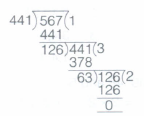
\(\therefore\) HCF of 441 and 567 is 63.
Now, we will find the HCF of 63 and 693
HCF of 63 and 693 is 63.
Hence, HCF of 441, 567 and 693 = 63
\(\therefore\) The required number = 63
46.
()
Yes.
47.
()
Is an equation LHS =RHS : It is an equation in numbers
48.
()
99+\(\frac{9}{9}\) =100
49.
()
Yes
50.
()
The increase during 1991-2001 in India's population was one hundred million.

6th Standard CBSE Syllabus & Materials
6th Standard CBSE
CBSE 6th Social Science Locating Places on the Earth - New Sample Question Papers Study Material - QB365 Set A
NEW6th Standard CBSE
CBSE 6th Science A Journey Through States of Water - New Sample Question Papers Study Material - QB365 Set A
NEW6th Standard CBSE
CBSE 6th Science Temperature and its Measurement - New Sample Question Papers Study Material - QB365 Set A
NEW6th Standard CBSE
CBSE 6th Science Materials Around Us - New Sample Question Papers Study Material - QB365 Set A



NCERT Books

Syllabus

Exam Pattern

Sample Question Papers

Previous year Question Papers

Important Notes

MCQ Practice test

NCERT Exemplers

Case study Questions

Image Based Questions

Passage based Questions

HOT Questions

Value Based Questions

Model Questions Papers
NCERT ( Book Back ) Questions

Assertion and Reason
Important Questions And Answers

CBSE 6th Standard CBSE Subjects
CBSE Standards


