
 100% FREE ACCESS
6th Standard CBSE Syllabus & Materials
6th Standard CBSE
CBSE 6th Social Science The Value of Work - New Sample Question Papers Study Material - QB365 Set A
NEW6th Standard CBSE
CBSE 6th Social Science Family and Community - New Sample Question Papers Study Material - QB365 Set A
NEW6th Standard CBSE
CBSE 6th Social Science India's Cultural Roots - New Sample Question Papers Study Material - QB365 Set A
NEW6th Standard CBSE
CBSE 6th Social Science India,That is Bharat - New Sample Question Papers Study Material - QB365 Set A
NEW6th Standard CBSE
CBSE 6th Social Science Timeline and sources of history - New Sample Question Papers Study Material - QB365 Set A
NEW6th Standard CBSE
CBSE 6th Social Science Oceans and Continents - New Sample Question Papers Study Material - QB365 Set A

Published on: 24/10/2025
Download CBSE Class 6th Standard CBSE Mathematics question papers, sample papers, important questions, and previous year solved papers in PDF format. Get free study materials, NCERT solutions, and exam preparation resources for Class 6th Standard CBSE Mathematics
Questions + Answers key
Take MCQ Mathematics Test
1.
Mr. Kumar spent \(\frac { 1 }{ 8 } \) of his salary on food,\(\frac { 3 }{ 8 } \) of his salary on house, \(\frac { 1 }{ 4 } \)of his salary on car. What fraction of his money was kept for savings?
2.
Add with the help of a diagram \(\frac { 1 }{ 8 } +\frac { 1 }{ 8 } \)
3.
Sohan was putting covers on his notebooks. He put one-fourth of the covers on Monday. He put another one-fourth on Tuesday and the remaining on Wednesday. What fraction of the covers did he put on Wednesday?
4.
Choose the greatest fraction \(\frac { 2 }{ 3 } ,\frac { 9 }{ 27 } ,\frac { 3 }{ 8 } ,\frac { 6 }{ 24 } \)
5.
Mehak used \(\frac { 3 }{ 6 } \)of a chalk.Dimple used \(\frac { 1 }{ 3 } \) of the chalk. Who used more of the chalk among both of them?
6.
Convert the following into like fractions \(\frac { 4 }{ 7 } ,\frac { 5 }{ 9 } ,\frac { 2 }{ 3 } \)
7.
Express the following as mixed fractions \(\frac { 20 }{ 3 } \)
8.
Determine \(\frac { 3 }{ 4 } \)of 20 pens
9.
Write the natural numbers from 2 to 12. What fraction of them are prime numbers?
10.
What fraction of a day is 8 hours?
11.
Write the fraction representing the shaded portion.
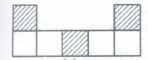
12.
Write the fraction representing the shaded portion.
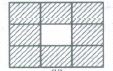
13.
Which of the following pairs of fractions are equivalent?
\(\frac { 1 }{ 2 } ,\frac { 2 }{ 4 } \)
\(\frac { 1 }{ 3 } ,\frac { 3 }{ 7 } \)
\(\frac { 2 }{ 5 } ,\frac { 4 }{ 9 } \)
\(\frac { 4 }{ 7 } ,\frac { 8 }{ 13 } \)
14.
Express the mixed fraction \(2\frac { 3 }{ 4 } \) as an improper fraction.
\(\frac { 11 }{ 4 } \)
\(\frac { 4 }{ 11 } \)
\(\frac { 9 }{ 11 } \)
\(\frac { 7 }{ 11 } \)
15.
Which of the following is an improper fraction?
\(\frac { 1 }{ 4 } \)
\(\frac { 3 }{ 8 } \)
\(\frac { 11 }{ 3 } \)
\(\frac { 2 }{ 5 } \)
16.
The fraction representing the shaded portion
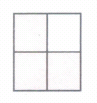
is
\(\frac { 1 }{ 4 } \)
\(\frac { 1 }{ 2 } \)
\(\frac { 3 }{ 4 } \)
none of these
17.
The fraction representing the shaded portion
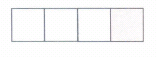
is
\(\frac { 1 }{ 4 } \)
\(\frac { 3 }{ 4 } \)
\(\frac { 1 }{ 2 } \)
\(\frac { 1 }{ 8 } \)
18.
When \(\frac{1}{4}\) is written with denominator as 12, its numerator is
3
8
24
12
19.
Which of the following fraction is smallest?
\(\frac{16}{23}\)
\(\frac{17}{23}\)
\(\frac{9}{23}\)
\(\frac{11}{23}\)
20.
On subtracting \(\frac{6}{13}\) from \(\frac{11}{13}\) the result is
5/13
2/13
3/13
8/13
21.
Sum of \(\frac{4}{17}\) and \(\frac{15}{17}\) is
\(2\frac{1}{17}\)
\(1\frac{2}{17}\)
\(3\frac{1}{17}\)
\(3\frac{2}{17}\)
22.
The fraction which is not equal to \(\frac{4}{5}\) is
\(\frac{40}{50}\)
\(\frac{12}{15}\)
\(\frac{16}{20}\)
\(\frac{9}{15}\)
23.
\(\frac{7}{9}\)and \(\frac{5}{9}\) are _______ proper fractions
24.
Fractions with the same denominators are called _____ fractions
25.
A fraction with numerator greater than the denominator is called an ______ fraction.
26.
Ali divided one fruit cake equally among six persons. The part of the cake he gave to each person is \(\frac{1}{6}\)
27.
The simplest form of \(\frac{24}{50}\) is \(\frac{12}{25}\)
28.
The value of \(\frac{19}{23}-\frac{7}{23} \) is \(\frac{12}{23}\)
29.
Sum of \(\frac{5}{12}\) and \(\frac{7}{12} \) is \(1\frac{7}{12}\)
30.
The fraction represented by the shaded portion in the following figure is \(\frac{3}{8}\)

31.
Sum of two fractions is always a fraction.
1.
\(\frac { 1 }{ 4 } \)
2.
Here, draw two rectangles and divide them into 8 equal parts out of which 1 part is shaded. On adding them, we get 2 parts shaded out of 8 equal parts. Thus,
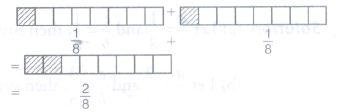
i.e \(\frac { 1 }{ 8 } +\frac { 1 }{ 8 } =\frac { 1+1 }{ 8 } =\frac { 2 }{ 8 } =\frac { 1 }{ 4 } \)
3.
Covers putting by Sohan on Monday = 1/ 4
Covers putting by him on Tuesday = 1/4
∴ Covers putting by him on Wednesday
=1-\(\frac { 1 }{ 4 } -\frac { 1 }{ 4 } =\frac { 4 }{ 4 } -\frac { 1 }{ 4 } -\frac { 1 }{ 4 } \) [∵ 1 and 4/4 are equivalent fractions]
= \(\frac { 4-1-1 }{ 4 } =\frac { 2 }{ 4 } =\frac { 1 }{ 4 } \)
Hence he put one-half of the covers on Wednesday
4.
\(\frac { 2 }{ 3 } \)
5.
Mehak
6.
\(\frac { 36 }{ 63 } ,\frac { 35 }{ 63 } ,\frac { 42 }{ 63 } \)
7.
We have, \({20\over 3}\)
On dividing 20 by 3, we get quotient = 6 remainder =2
∴ \(\frac { 20 }{ 3 } =6\frac { 2 }{ 3 } \) i.e 6 whole and\(\frac { 2 }{ 3 } \)more

8.
15
9.
Natural numbers from 2 to 12 = 2, 3, 4, 5, 6, 7, 8, 9, 10, 11, 12.
Total natural numbers - 11
Prime numbers from 2 to 12 = 2, 3, 5,7, 11
∴ Required fraction = \(\frac { Total\ prime\ numbers }{ Total\ natural\ numbers } =\frac { 5 }{ 11 } \)
10.
We know that, total hours in a day = 24 h
∴ Required field fraction = \(\frac { 8h }{ 24h } =\frac { 8 }{ 24 } \)
11.
Total number of equal parts = 7; Shaded parts = 3
∴ Fraction representing the shaded portion = \(\frac { 3 }{ 7 } \)
12.
Total number of equal parts = 9; Shaded parts = 8
∴ Fraction representing the shaded portion = \(\frac { 8 }{ 9 } \)
13.
(a)
\(\frac { 1 }{ 2 } ,\frac { 2 }{ 4 } \)
14.
(a)
\(\frac { 11 }{ 4 } \)
15.
(c)
\(\frac { 11 }{ 3 } \)
16.
(c)
\(\frac { 3 }{ 4 } \)
17.
(a)
\(\frac { 1 }{ 4 } \)
18.
(a)
3
19.
(c)
\(\frac{9}{23}\)
20.
(a)
5/13
21.
(b)
\(1\frac{2}{17}\)
22.
(d)
\(\frac{9}{15}\)
23.
()
Here,\(\frac{7}{9}\) and \(\frac{5}{9}\) have same denominators, so they are like proper fractions.
24.
()
Fractions having same denominators are called like fractions.
25.
()
A fraction which has denominator greater than numerator is called an improper fraction.
26.
(a)
27.
(a)
28.
(a)
29.
(b)
30.
(a)
31.
(b)

6th Standard CBSE Syllabus & Materials
6th Standard CBSE
CBSE 6th Social Science Locating Places on the Earth - New Sample Question Papers Study Material - QB365 Set A
NEW6th Standard CBSE
CBSE 6th Science A Journey Through States of Water - New Sample Question Papers Study Material - QB365 Set A
NEW6th Standard CBSE
CBSE 6th Science Temperature and its Measurement - New Sample Question Papers Study Material - QB365 Set A
NEW6th Standard CBSE
CBSE 6th Science Materials Around Us - New Sample Question Papers Study Material - QB365 Set A



NCERT Books

Syllabus

Exam Pattern

Sample Question Papers

Previous year Question Papers

Important Notes

MCQ Practice test

NCERT Exemplers

Case study Questions

Image Based Questions

Passage based Questions

HOT Questions

Value Based Questions

Model Questions Papers
NCERT ( Book Back ) Questions

Assertion and Reason
Important Questions And Answers

CBSE 6th Standard CBSE Subjects
CBSE Standards


