
 100% FREE ACCESS
6th Standard CBSE Syllabus & Materials
6th Standard CBSE
CBSE 6th Social Science The Value of Work - New Sample Question Papers Study Material - QB365 Set A
NEW6th Standard CBSE
CBSE 6th Social Science Family and Community - New Sample Question Papers Study Material - QB365 Set A
NEW6th Standard CBSE
CBSE 6th Social Science India's Cultural Roots - New Sample Question Papers Study Material - QB365 Set A
NEW6th Standard CBSE
CBSE 6th Social Science India,That is Bharat - New Sample Question Papers Study Material - QB365 Set A
NEW6th Standard CBSE
CBSE 6th Social Science Timeline and sources of history - New Sample Question Papers Study Material - QB365 Set A
NEW6th Standard CBSE
CBSE 6th Social Science Oceans and Continents - New Sample Question Papers Study Material - QB365 Set A

Published on: 24/10/2025
Download CBSE Class 6th Standard CBSE Mathematics question papers, sample papers, important questions, and previous year solved papers in PDF format. Get free study materials, NCERT solutions, and exam preparation resources for Class 6th Standard CBSE Mathematics
Questions + Answers key
Take MCQ Mathematics Test
1.
Locate the fractions \(\frac { 3 }{ 4 } ,\frac { 1 }{ 2 } ,\frac { 9 }{ 10 } ,\frac { 0 }{ 3 } ,\frac { 5 }{ 8 } \)on separate number lines.
2.
What should be subtracted from the sum of \(2\frac{1}{4} \) and \(3\frac{1}{7}\) to get \(2\frac{3}{28}\)?
3.
Define the following. Unlike fractions
4.
Energy content of different foods are as follows:
| Food | Energy content per kg (in Joules) |
|---|---|
| Wheat | 3.2J |
| Rice | 5.3J |
| Potatoes(Cooked) | 3.7J |
| Milk | 3.0J |
Which food provides the least energy and which provides the maximum? Also, express the least energy as a fraction of the maximum energy.
5.
Poorvi cut a cake into 8 equal pieces. If she wanted to divide each of them into 3 equal pieces, what fraction of the whole cake would each small pieces be?
6.
Mr. Rajan got a job at the age of 24 yr and he got retired from the job at the age of 60 yr. What fraction of his age till retirement was he in the job?
7.
My elder sister divided the watermelon into 16 parts. I ate 7 out of them. My friend ate 4. How much did we eat between us? How much more of the watermelon did I eat than my friend? What portion of the watermelon remained?
8.
Add\(\frac { 1 }{ 12 } +\frac { 1 }{ 12 } \) .How will we show this pictorially? Using paper folding?
9.
Write the fractions. Are all these fractions equivalent?

10.
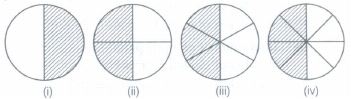
Write the fractions. Are all these fractions equivalent?
1.
(i) \(\frac { 3 }{ 4 } \)
\(\frac { 3 }{ 4 } \)means 3 parts out of 4 equal parts. So, we divide the gap between 0 and 1 into 4 equal parts and show 3 parts as \(\frac { 3 }{ 4 } \) .
.png)
(ii) \(\frac { 1 }{ 2 } \)
\(\frac { 1 }{ 2 } \)means 1 part out of 2 equal parts. So, we divide the gap between 0 and 1 into 2 equal parts and show 1 part as \(\frac { 1 }{ 2 } \) .
.png)
(iii) \(\frac { 9 }{ 10 } \)
\(\frac { 9 }{ 10 } \) means a part out of 10 equal parts. So, we divide the gap between 0 and 1 into 10 equal parts and show 9 parts as \(\frac { 9 }{ 10 } \) .
.png)
(iv) \(\frac { 0 }{ 3 } \)
\(\frac { 0 }{ 3 } \)is the point zero.
.png)
(v) \(\frac { 5 }{ 8 } \)
\(\frac { 5 }{ 8 } \) means 5 parts out of 8 equal parts. So, we divide the gap between 0 and I into 8 equal parts and show 5 parts as \(\frac { 5 }{ 8 } \) .
.png)
2.
\(3\frac{8}{28}\)
3.
Unlike fractions: Fractions having different denominators
4.
In the given table, we see that the minimum value is 3.0 J and maximum value is 5.3 J.
∴ Least energy provide by food = 3.0 J i.e. Milk
Food which provide the maximum energy = 5.3 J i.e. Rice
∴ Required fraction = \(\frac { Least\ energy }{ Maximum\ energy } =\frac { 3.0 }{ 5.3 } =\frac { 30 }{ 53 } \)
5.
Number of pieces the cake cut = 8
Number of pieces each cut piece divided into = 3
∴ Total number of pieces =\(8\times3=24\)
Hence, each piece is represented by the fraction\(\frac{1}{24}.\)
6.
Given, Rajan's age on the joining = 24 yr
and retirement age = 60 yr
The number of years, he did the job
= Retirement age - Joining age
= 60 - 24 = 36 yr
∴ The fraction of his age till retirement, when he was in the job
\(=\frac { Total\ years\ he\ did\ the\ job }{ Retirement\ age } =\frac { 36 }{ 60 } \) [ \(\because\) HCF of 36 and 60 = 12 ]
\(=\frac { 36\div 12 }{ 60\div 12 } =\frac { 3 }{ 5 } \)
Hence, the required fraction is = \(\frac { 3 }{ 5 } .\)
7.
Here, a watermelon is divided into 16 parts.
∴ Each part =\(\frac { 1 }{ 16 } \)
I ate 7 parts out of 16 parts i.e. \(\frac { 7 }{ 16 } \) part
My friend ate 4 parts out of 16 parts i.e\(\frac { 4 }{ 16 } \) part
Now, the part which we eat together
=\(\frac { 7 }{ 16 } +\frac { 4 }{ 16 } =\frac { 7+4 }{ 16 } =\frac { 11 }{ 16 } \) part
Now, difference between our parts = \(\frac { 7 }{ 16 } -\frac { 4 }{ 16 } =\frac { 7-4 }{ 16 } =\frac { 3 }{ 16 } \)
So, I ate\(\frac { 3 }{ 16 } \) part of watermelon more than my friend. Now, remaining part of the watermelon = 1- \(\frac { 11 }{ 16 } -\frac { 16 }{ 16 } -\frac { 11 }{ 16 } \)
[∵ \(\frac { 16 }{ 16 } \)and 1 are equivalent fractions]
= \(\frac { 16-11 }{ 16 } =\frac { 5 }{ 16 } \)
8.
We have,
Pictorially, it can be shown as
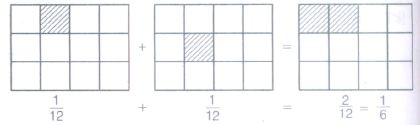
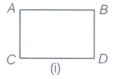
By folding paper, it can be shown in the following way Take a square piece of paper say ABCD [figure (i)].
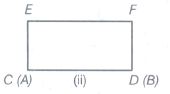
Fold it by overlapping its edge AB and CD to get figure (ii).
Again, refold it by taking EF over C(A) D(B) to get figure (iii).

Now,reopen it, then we get the following figure (iv)

Now,fold it vertically at two places to obtain three equal vertical portion as shown in figure (v)
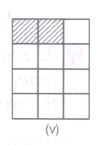
Shaded \(\frac { 1 }{ 12 } \)portion twice,
We see that, \(\frac { 1 }{ 12 } +\frac { 1 }{ 12 } =\frac { 1+1 }{ 12 } =\frac { 2 }{ 12 } =\frac { 1 }{ 6 } \)
9.
(i) Total number of equal parts = 12;
Number of shaded parts = 4
∴ Fraction of shaded portion = \(\frac { 4 }{ 12 } \)
(ii) Total number of equal parts = 9;
Number of shaded parts = 3
∴ Fraction of shaded portion = 3/9
(iii) Total number of equal parts = 6;
Number of shaded parts = 2
∴ Fraction of shaded portion = 2/6
(iv) Total number of equal parts = 3;
Number of shaded parts = 1
∴ Fraction of shaded portion =1/3
(v) Total number of equal parts = 15;
Number of shaded parts = 6
∴ Fraction of shaded portion = \(\frac { 6 }{ 15 } \)
Now, \(\frac { 4 }{ 12 } =\frac { 4\div 4 }{ 12\div 4 } =\frac { 1 }{ 3 } \) [∵HCF of 4 and 12 is 4]
\(\frac { 3 }{ 9 } =\frac { 3\div 3 }{ 9\div 3 } =\frac { 1 }{ 3 } \) [∵HCF of 3 and 9 is 3]
\(\frac { 2 }{ 6 } =\frac { 2\div 2 }{ 6\div 2 } =\frac { 1 }{ 3 } \) [∵HCF of 2 and 6 is 2]
\(\frac { 6 }{ 15 } =\frac { 6\div 3 }{ 15\div 3 } =\frac { 2 }{ 5 } \) [∵HCF of 6 and 15 is 3]
Here, except \(\frac { 6 }{ 15 } \)all the fractions in simplest form are same.
So, \(\frac { 4 }{ 12 } =\frac { 3 }{ 9 } =\frac { 2 }{ 6 } =\frac { 1 }{ 3 } \neq \frac { 2 }{ 5 } \)
Hence, these fractions are not equivalent.
10.
(i) Total number of equal parts = 2;
Number of shaded parts = 1
∴ Fraction of shaded portion = \(\frac { Number\ of\ shaded\ parts\ }{ Total\ number\ of\ equal\ parts } =\frac { 1 }{ 2 } \)
(ii) Total number of equal parts = 4;
Number of shaded parts = 2
∴ Fraction of shaded portion = 2/4
(iii) Total number of equal parts = 6;
Number of shaded parts = 3
∴ Fraction of shaded portion = 3/6
(iv) Total number of equal parts = 8;
Number of shaded parts = 4
∴ Fraction of shaded portion = 4/8
Now, \(\frac { 2 }{ 4 } =\frac { 2\div 2 }{ 4\div 2 } =\frac { 1 }{ 2 } \) [∵ HCF of 2 and 4 is 2]
\(\frac { 3 }{ 6 } =\frac { 3\div 3 }{ 6\div 3 } =\frac { 1 }{ 2 } \) [∵ HCF of 3 and 6 is 3]
\(\frac { 4 }{ 8 } =\frac { 4\div 4 }{ 8\div 4 } =\frac { 1 }{ 2 } \) [∵ HCF of 4 and 8 is 4]
Since all fraction in simple form are same.
∴ \(\frac { 1 }{ 2 } =\frac { 2 }{ 4 } =\frac { 3 }{ 6 } =\frac { 4 }{ 8 } \) i.e the fractions are equivalent.

6th Standard CBSE Syllabus & Materials
6th Standard CBSE
CBSE 6th Social Science Locating Places on the Earth - New Sample Question Papers Study Material - QB365 Set A
NEW6th Standard CBSE
CBSE 6th Science A Journey Through States of Water - New Sample Question Papers Study Material - QB365 Set A
NEW6th Standard CBSE
CBSE 6th Science Temperature and its Measurement - New Sample Question Papers Study Material - QB365 Set A
NEW6th Standard CBSE
CBSE 6th Science Materials Around Us - New Sample Question Papers Study Material - QB365 Set A



NCERT Books

Syllabus

Exam Pattern

Sample Question Papers

Previous year Question Papers

Important Notes

MCQ Practice test

NCERT Exemplers

Case study Questions

Image Based Questions

Passage based Questions

HOT Questions

Value Based Questions

Model Questions Papers
NCERT ( Book Back ) Questions

Assertion and Reason
Important Questions And Answers

CBSE 6th Standard CBSE Subjects
CBSE Standards


