
 100% FREE ACCESS
6th Standard CBSE Syllabus & Materials
6th Standard CBSE
CBSE 6th Social Science The Value of Work - New Sample Question Papers Study Material - QB365 Set A
NEW6th Standard CBSE
CBSE 6th Social Science Family and Community - New Sample Question Papers Study Material - QB365 Set A
NEW6th Standard CBSE
CBSE 6th Social Science India's Cultural Roots - New Sample Question Papers Study Material - QB365 Set A
NEW6th Standard CBSE
CBSE 6th Social Science India,That is Bharat - New Sample Question Papers Study Material - QB365 Set A
NEW6th Standard CBSE
CBSE 6th Social Science Timeline and sources of history - New Sample Question Papers Study Material - QB365 Set A
NEW6th Standard CBSE
CBSE 6th Social Science Oceans and Continents - New Sample Question Papers Study Material - QB365 Set A

Published on: 24/10/2025
Download CBSE Class 6th Standard CBSE Mathematics question papers, sample papers, important questions, and previous year solved papers in PDF format. Get free study materials, NCERT solutions, and exam preparation resources for Class 6th Standard CBSE Mathematics
Questions + Answers key
Take MCQ Mathematics Test
1.
Locate the fractions \(\frac { 3 }{ 4 } ,\frac { 1 }{ 2 } ,\frac { 9 }{ 10 } ,\frac { 0 }{ 3 } ,\frac { 5 }{ 8 } \)on separate number lines.
2.
What should be subtracted from the sum of \(2\frac{1}{4} \) and \(3\frac{1}{7}\) to get \(2\frac{3}{28}\)?
3.
If \(\frac{7}{18}=\frac{x}{12},\) then what is the value of x?
4.
The fish caught by Neetu was of weight 3\(\frac{3}{4}\) kg and the fish caught by Narendra was of weight 2\(\frac{1}{2}\) kg. How much more was Neetu's fish weight than that of Narendra?
5.
Mr. Rajan got a job at the age of 24 yr and he got retired from the job at the age of 60 yr. What fraction of his age till retirement was he in the job?
6.
Riya saves \(\frac{1}{3}\)of her salary. She spends \(\frac{1}{2}\)of the remaining and gives the left amount to charity.
(a) Find the fraction she gives for charity?
(b) Mention the values you depict from this.
7.
On an average,\(\frac{1}{10}\)of the food eaten is turned into organism's own body and is available for the next level of consumer in a food chain. What fraction of the food eaten is not available for the next level?
8.
Add\(\frac { 1 }{ 12 } +\frac { 1 }{ 12 } \) .How will we show this pictorially? Using paper folding?
9.
The following fraction represent just three different numbers. Separate them into three groups of equivalent fractions, by changing each one in its simplest form.
(a) \(\frac { 2 }{ 12 } \) (b)\(\frac { 3 }{ 15 } \) (c)\(\frac { 8 }{ 50 } \) (d)\(\frac { 16 }{ 100 } \)(e) \(\frac { 10 }{ 60 } \)(f) \(\frac { 15 }{ 75 } \) (g)\(\frac { 12 }{ 60 } \) (h)\(\frac { 16 }{ 96 } \) (i)\(\frac { 12 }{ 75 } \) (j)\(\frac { 12 }{ 72 } \)(k)\(\frac { 3 }{ 18 } \) (l)\(\frac { 4 }{ 25 } \)
10.
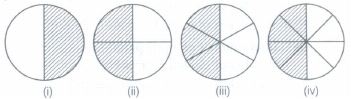
Write the fractions. Are all these fractions equivalent?
1.
(i) \(\frac { 3 }{ 4 } \)
\(\frac { 3 }{ 4 } \)means 3 parts out of 4 equal parts. So, we divide the gap between 0 and 1 into 4 equal parts and show 3 parts as \(\frac { 3 }{ 4 } \) .
.png)
(ii) \(\frac { 1 }{ 2 } \)
\(\frac { 1 }{ 2 } \)means 1 part out of 2 equal parts. So, we divide the gap between 0 and 1 into 2 equal parts and show 1 part as \(\frac { 1 }{ 2 } \) .
.png)
(iii) \(\frac { 9 }{ 10 } \)
\(\frac { 9 }{ 10 } \) means a part out of 10 equal parts. So, we divide the gap between 0 and 1 into 10 equal parts and show 9 parts as \(\frac { 9 }{ 10 } \) .
.png)
(iv) \(\frac { 0 }{ 3 } \)
\(\frac { 0 }{ 3 } \)is the point zero.
.png)
(v) \(\frac { 5 }{ 8 } \)
\(\frac { 5 }{ 8 } \) means 5 parts out of 8 equal parts. So, we divide the gap between 0 and I into 8 equal parts and show 5 parts as \(\frac { 5 }{ 8 } \) .
.png)
2.
\(3\frac{8}{28}\)
3.
\(x=\frac{14}{3}\)
4.
Given, weight of fish caught by Neetu
\(=3\frac { 3 }{ 4 } \)kg \(=\frac { 15 }{ 4 } \) kg
and weight of the fish caught by Narendra
\(=2\frac { 1 }{ 2 } \) kg \(=\frac { 5 }{ 2 }\) kg
∴ Difference between their weights
\(=\frac { 15 }{ 4 } -\frac { 5 }{ 2 } =\frac { 15 }{ 4 } -\frac { 5\times 2 }{ 4 } \) [ \(\because\) LCM of 2 and 4 = 4 ]
\(=\frac { 15 }{ 4 } -\frac { 10 }{ 4 } =\frac { 15-10 }{ 4 } =\frac { 5 }{ 4 }\)kg
Hence, Neetu's fish weight is \(\frac{5}{4}\) kg more than the Narendra's fish weight.
5.
Given, Rajan's age on the joining = 24 yr
and retirement age = 60 yr
The number of years, he did the job
= Retirement age - Joining age
= 60 - 24 = 36 yr
∴ The fraction of his age till retirement, when he was in the job
\(=\frac { Total\ years\ he\ did\ the\ job }{ Retirement\ age } =\frac { 36 }{ 60 } \) [ \(\because\) HCF of 36 and 60 = 12 ]
\(=\frac { 36\div 12 }{ 60\div 12 } =\frac { 3 }{ 5 } \)
Hence, the required fraction is = \(\frac { 3 }{ 5 } .\)
6.
(a) Riya's saving = \(\frac{1}{3}\) of her salary
Remaining salary \(=1-{1\over 3}={2\over 3}\)
She spends = \(\frac{1}{2}\) of \(\frac{2}{3}\)\(=\frac { 1 }{ 2 } \times \frac { 2 }{ 3 } =\frac { 2 }{ 6 } =\frac { 1 }{ 3 } \)
She gives for charity=\(\frac { 2 }{ 3 } -\frac { 1 }{ 3 } =\frac { 2-1 }{ 3 } =\frac { 1 }{ 3 } \)
∴ The fraction she gives for charity=\(\frac{1}{3}\)
(b) The values depict from this are:
Helpfulness, caring for poor people and cooperation.
7.
Quantity of food eaten which turned into organism's own body = \(\frac{1}{10}\)of the total food Now, the quantity of food eaten which is not available for the next level =1-\(\frac{1}{10}\)
\(=\frac { 10-1 }{ 10 } =\frac { 9 }{ 10 } \)
Hence, the required fraction =\(\frac { 9 }{ 10 } \)
8.
We have,
Pictorially, it can be shown as
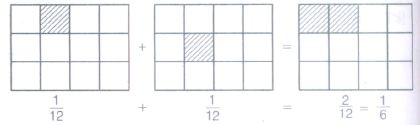
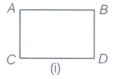
By folding paper, it can be shown in the following way Take a square piece of paper say ABCD [figure (i)].
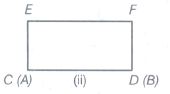
Fold it by overlapping its edge AB and CD to get figure (ii).
Again, refold it by taking EF over C(A) D(B) to get figure (iii).

Now,reopen it, then we get the following figure (iv)

Now,fold it vertically at two places to obtain three equal vertical portion as shown in figure (v)
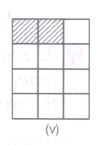
Shaded \(\frac { 1 }{ 12 } \)portion twice,
We see that, \(\frac { 1 }{ 12 } +\frac { 1 }{ 12 } =\frac { 1+1 }{ 12 } =\frac { 2 }{ 12 } =\frac { 1 }{ 6 } \)
9.
First, we have to convert fraction in its simplest form.
(a) We have \(\frac { 2 }{ 12 } \Rightarrow \frac { 2\div 2 }{ 12\div 2 } =\frac { 1 }{ 6 } \) [∵ HCF of 2 and 12 = 2]
(b) We have \(\frac { 3 }{ 15 } \Rightarrow \frac { 3\div 3 }{ 15\div 3 } =\frac { 1 }{ 5 } \) [∵ HCF of 3 and 15 = 3]
(c) We have \(\frac { 8 }{ 50 } \Rightarrow \frac { 8\div 2 }{ 50\div 2 } =\frac { 4 }{ 25 } \) [∵ HCF of 8 and 50 = 2]
(d) We have\(\frac { 16 }{ 100 } \Rightarrow \frac { 16\div 4 }{ 100\div 4 } =\frac { 4 }{ 25 } \) [∵ HCF of 16 and 100 = 4]
(e) We have \(\frac { 10 }{ 60 } \Rightarrow \frac { 10\div 10 }{ 60\div 10 } =\frac { 1 }{ 6 } \) [∵ HCF of 10 and 60 = 10]
(f) We have \(\frac { 15 }{ 75 } \Rightarrow \frac { 15\div 15 }{ 75\div 15 } =\frac { 1 }{ 2 } \) [∵ HCF of 15 and 75 = 15]
(g) We have \(\frac { 12 }{ 60 } \Rightarrow \frac { 12\div 12 }{ 60\div 12 } =\frac { 1 }{ 5 } \) [∵ HCF of 12 and 60 = 12]
(h) We have \(\frac { 16 }{ 96 } \Rightarrow \frac { 16\div 16 }{ 96\div 16 } =\frac { 1 }{ 6 } \) [∵ HCF of 16 and 96 = 16]
(i) We have \(\frac { 12 }{ 75 } \Rightarrow \frac { 12\div 3 }{ 75\div 3 } =\frac { 4 }{ 25 } \) [∵HCF of 12 and 75 = 3]
(j) We have \(\frac { 12 }{ 72 } \Rightarrow \frac { 12\div 12 }{ 72\div 12 } =\frac { 1 }{ 6 } \) [∵HCF of 12 and 72 = 12]
(k) We have \(\frac { 3 }{ 18 } \Rightarrow \frac { 3\div 3 }{ 18\div 3 } =\frac { 1 }{ 6 } \) [∵HCF of 3 and 18 = 3]
(l) We have,\(\frac { 4 }{ 25 } \Rightarrow \frac { 4\div 1 }{ 25\div 1 } =\frac { 4 }{ 25 } \) [∵HCF of 4 and 25 = 1]
Now, on grouping into three groups of equivalent fractions with the help of simplest form of fractions, we get
(i) \(\frac { 2 }{ 12 } =\frac { 10 }{ 60 } =\frac { 16 }{ 96 } =\frac { 12 }{ 72 } =\frac { 3 }{ 18 } \) [Simplest form of each fraction = \(\frac { 1 }{ 6 } \)]
(ii) \(\frac { 3 }{ 15 } =\frac { 15 }{ 75 } =\frac { 12 }{ 60 } \) [Simplest form of each fraction = \(\frac { 1 }{ 5 } \)]
(iii) \(\frac { 8 }{ 50 } =\frac { 16 }{ 100 } =\frac { 12 }{ 75 } =\frac { 4 }{ 25 } \) [Simplest form of each fraction = \(\frac { 4 }{ 25 } \)]
10.
(i) Total number of equal parts = 2;
Number of shaded parts = 1
∴ Fraction of shaded portion = \(\frac { Number\ of\ shaded\ parts\ }{ Total\ number\ of\ equal\ parts } =\frac { 1 }{ 2 } \)
(ii) Total number of equal parts = 4;
Number of shaded parts = 2
∴ Fraction of shaded portion = 2/4
(iii) Total number of equal parts = 6;
Number of shaded parts = 3
∴ Fraction of shaded portion = 3/6
(iv) Total number of equal parts = 8;
Number of shaded parts = 4
∴ Fraction of shaded portion = 4/8
Now, \(\frac { 2 }{ 4 } =\frac { 2\div 2 }{ 4\div 2 } =\frac { 1 }{ 2 } \) [∵ HCF of 2 and 4 is 2]
\(\frac { 3 }{ 6 } =\frac { 3\div 3 }{ 6\div 3 } =\frac { 1 }{ 2 } \) [∵ HCF of 3 and 6 is 3]
\(\frac { 4 }{ 8 } =\frac { 4\div 4 }{ 8\div 4 } =\frac { 1 }{ 2 } \) [∵ HCF of 4 and 8 is 4]
Since all fraction in simple form are same.
∴ \(\frac { 1 }{ 2 } =\frac { 2 }{ 4 } =\frac { 3 }{ 6 } =\frac { 4 }{ 8 } \) i.e the fractions are equivalent.

6th Standard CBSE Syllabus & Materials
6th Standard CBSE
CBSE 6th Social Science Locating Places on the Earth - New Sample Question Papers Study Material - QB365 Set A
NEW6th Standard CBSE
CBSE 6th Science A Journey Through States of Water - New Sample Question Papers Study Material - QB365 Set A
NEW6th Standard CBSE
CBSE 6th Science Temperature and its Measurement - New Sample Question Papers Study Material - QB365 Set A
NEW6th Standard CBSE
CBSE 6th Science Materials Around Us - New Sample Question Papers Study Material - QB365 Set A



NCERT Books

Syllabus

Exam Pattern

Sample Question Papers

Previous year Question Papers

Important Notes

MCQ Practice test

NCERT Exemplers

Case study Questions

Image Based Questions

Passage based Questions

HOT Questions

Value Based Questions

Model Questions Papers
NCERT ( Book Back ) Questions

Assertion and Reason
Important Questions And Answers

CBSE 6th Standard CBSE Subjects
CBSE Standards


