
 100% FREE ACCESS
6th Standard CBSE Syllabus & Materials
6th Standard CBSE
CBSE 6th Social Science The Value of Work - New Sample Question Papers Study Material - QB365 Set A
NEW6th Standard CBSE
CBSE 6th Social Science Family and Community - New Sample Question Papers Study Material - QB365 Set A
NEW6th Standard CBSE
CBSE 6th Social Science India's Cultural Roots - New Sample Question Papers Study Material - QB365 Set A
NEW6th Standard CBSE
CBSE 6th Social Science India,That is Bharat - New Sample Question Papers Study Material - QB365 Set A
NEW6th Standard CBSE
CBSE 6th Social Science Timeline and sources of history - New Sample Question Papers Study Material - QB365 Set A
NEW6th Standard CBSE
CBSE 6th Social Science Oceans and Continents - New Sample Question Papers Study Material - QB365 Set A

Published on: 24/10/2025
Download CBSE Class 6th Standard CBSE Mathematics question papers, sample papers, important questions, and previous year solved papers in PDF format. Get free study materials, NCERT solutions, and exam preparation resources for Class 6th Standard CBSE Mathematics
Questions + Answers key
Take MCQ Mathematics Test
1.
Find the solution of (- 5) + 3 using a number line
2.
Sarita bought\(\frac { 2 }{ 5 } \) metre of ribbon and Lalita bought \(\frac { 3 }{ 4 } \) metre of ribbon. What is the total length of the ribbon they bought?
3.
Solve \(\frac { 2 }{ 3 } +\frac { 3 }{ 4 } +\frac { 1 }{ 2 } \)
4.
Find the sum of the following:
25.65+9.005+3.7
5.
Fill in the missing fractions \(\Box { } -\frac { 3 }{ 21 } =\frac { 5 }{ 21 } \)
6.
Write four fractions equivalent to \(\frac { 3 }{ 7 } \)
7.
Find (-7)- 8 - (-25)
8.
Write each of the following decimals in words. 5.008
9.
Find the sum (37)+ (-2) + (-65) + (-8)
10.
Write all the integers between -15 and -5.
11.
Write each of the following as decimals. 200 + 60 + 5 + \(\frac { 1 }{ 10 } \)
12.
What fraction of an hour is 40 minutes?
13.
The sale of cars of Maruti Udhyog in the city of Delhi from January to June in a year are as follows:
Take  = 50 cars.
| Months | January | February | March | April | May | June |
| Number of cars | 350 | 400 | 250 | 200 | 350 | 200 |
Represent them as a pictograph.
14.
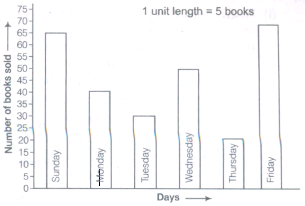
The number of Mathematics books sold by a shopkeeper on six consecutive days is shown below:
| Days | Sunday | Monday | Tuesday | Wednesday | Thursday | Friday |
| Number of books sold | 65 | 40 | 30 | 50 | 20 | 70 |
Draw a bar graph to represent the above information choosing the scale of your choice.
15.
Write the following decimals in the place value table.
(a) 0.29 (b) 2.08 (c) 19.60 (d) 148.32 (e) 200.812
16.
5 kg 5 g =
5.005 kg
5.05 kg
5.5 kg
0.55 kg.
17.
\(\cfrac { 22 }{ 10 } =\)
0.22
2.2
2.02
2.002.
18.
The fraction representing the shaded portion
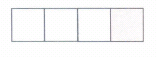
is
\(\frac { 1 }{ 4 } \)
\(\frac { 3 }{ 4 } \)
\(\frac { 1 }{ 2 } \)
\(\frac { 1 }{ 8 } \)
19.
(- 1) + (- 2) =?
-1
-2
-3
+3
20.
\(19+\frac { 5 }{ 10 } +\frac { 7 }{ 100 } \) in decimal form is written as
19.75
19.057
19.705
19.57
21.
On subtracting \(\frac{6}{13}\) from \(\frac{11}{13}\) the result is
5/13
2/13
3/13
8/13
22.
Sum of \(\frac{4}{17}\) and \(\frac{15}{17}\) is
\(2\frac{1}{17}\)
\(1\frac{2}{17}\)
\(3\frac{1}{17}\)
\(3\frac{2}{17}\)
23.
Using tally marks, which one of the following represents the number eight?
IIII II
.png)
.png)
.png)
24.
Number of integers lying between -2 and 2 is
3
4
2
1
25.
The predecessor of the integer -1 is
0
0
-2
1
26.
9 cm 8 mm = _______________ cm
27.
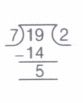
\(\frac{19}{7}\)is equal to the mixed fraction _______ .
28.
The fraction \(\frac{25}{40}\) in simplest form is _________.
29.
A _________ is a collection of numbers gathered to give some meaningful information.
30.
The additive inverse of 14 is _________
31.
13 rupees 30 paise = Rs 13.03
32.
Forty five point zero six four is equal to 45.064
33.
Sum of two fractions is always a fraction.
34.
All integers are whole numbers.
35.
Since, 15 > 12, therefore -15 < -12.
36.
Write all the integers between the given pair (write them in the increasing order).
- 30 and - 23.
37.
Nasir travelled \(3\frac{1}{2}\) km by bus and then walked \(1\frac{1}{8}\) km to reach a town. How much did he travel to reach the town?
38.
Subtract 0.316 kg from 2.876 kg.
39.
The blood groups of 25 students are recorded as follows:
A, B, 0, A, AB, 0, A, 0, B, A, O, B, A, AB, AB, A, A, B, B, O, B, AB, O, A, B.
Arrange the information in a table using tally marks.
40.
Write the following integers in ascending order -15, 5, 0, -2, -5, 3, 2, -17
1.
First we move 5 steps to the left of 0 reaching - 5 and then from this point we move 3 steps to the
right. We reach the point - 2. Thus, (- 5) + 3 = - 2.

2.
Given, ribbon bought by Sarita = \(\frac { 2 }{ 5 } \)m and ribbon bought by Lalitha =\(\frac { 3 }{ 4 } \) m
∴ Total length of the ribbon bought by them =\(\frac { 2 }{ 5 } +\frac { 3 }{ 4 } \)
Now, LCM of 5 and 4 = 20
∴ \(\frac { 2 }{ 5 } +\frac { 3 }{ 4 } =\frac { 2\times 4 }{ 4\times 5 } +\frac { 3\times 5 }{ 4\times 5 } \)=\(\frac { 8 }{ 10 } +\frac { 15 }{ 20 } =\frac { 8+15 }{ 20 } =\frac { 23 }{ 20 } \)
Hence, total length of the ribbon bought by them is\(\frac { 23 }{ 20 } \) m.
3.
\(\frac { 2 }{ 3 } +\frac { 3 }{ 4 } +\frac { 1 }{ 2 } =\frac { 23 }{ 12 } \)
4.
| 1 | 1 | |||||
| 2 | 5 | . | 6 | 5 | 0 | |
| 9 | . | 0 | 0 | 5 | ||
| + | 3 | . | 7 | 0 | 0 | |
| 3 | 8 | . | 3 | 5 | 5 |
Thus, 25.65 + 9.005 + 3.7 = 38.355
5.
We have \(\Box { } -\frac { 3 }{ 21 } =\frac { 5 }{ 21 } \)
Here\(\frac { 3 }{ 21 } \) is subtracted from missing fraction to get \(\frac { 5 }{ 21 } .\)
So, we add \(\frac { 3 }{ 21 } \)to \(\frac { 5 }{ 21 } \)get missing fraction
∴ Missing fraction =\(\frac { 3 }{ 21 } +\frac { 5 }{ 21 } =\frac { 3+5 }{ 21 } =\frac { 8 }{ 21 } \)
Thus, \(\boxed { \frac { 8 }{ 21 } } -\frac { 3 }{ 21 } =\frac { 5 }{ 21 } \)
6.
\(\frac { 6 }{ 14 } ,\frac { 9 }{ 21 } ,\frac { 12 }{ 28 } ,\frac { 15 }{ 35 } \)
7.
(-7) - 8 - (-25) = (-7) + (-8) + 25 [∵ additive inverse of -25 is 25]
= -15 + 25 = -15 + 15 + 10 [∵ 25=15+10]
=0+10=10 [∵ -15+15=0]
8.
Decimals in words are given below:
We have, 5.008 = Five point zero zero eight
9.
We have, (37) + (-2) + (-65) + (-8)
= 37 - (2 + 65 + 8) = 37 - 75
=37 -37 -38 [∵ 75 = 37 + 38 ⇒ - 75 = - 37 - 38]
= 0 - 38 = - 38 [∵ -37+37=0]
10.
Integers between -15 and -5 are -14, -13:-12, -11, -10, - 9, - 8, - 7, - 6.
11.
\(200+60+5+\frac { 1 }{ 10 } =265.1\)
12.
We know that, total minutes in an hour = 60 min
∴ Required field fraction = \(\frac { 40\quad min }{ 60\quad min } =\frac { 40 }{ 60 } =\frac { 2 }{ 3 } \)
13.
We draw the following table using given information
.png)
14.
To draw a bar graph, we will use the following steps:
(i) Firstly, draw two perpendicular lines, one is horizontal and one is vertical. Along the horizontal line, mark 'days' and along the vertical line mark 'number of books sold'.
(ii) Now, take scale of 1 unit length = 5 books, along the vertical line and then mark the corresponding values.
Also, the heights of the bars for various days are as follows:
| Sunday | \(\frac{65}{5}=13\) units |
| Monday | \(\frac{40}{5}=8\) units |
| Tuesday | \(\frac{30}{5}=6\) units |
| Wednesday | \(\frac{50}{5}=10\) units |
| Thursday | \(\frac{20}{5}=4\) units |
| Friday | \(\frac{70}{5}=14\) units |
(iii) Drawbars of equal width and of height calculated in Step (ii) on the horizontal line with equal spacing (or gap) between them.
Thus, we get the following bar graph.
15.
The given decimals can be written as
(a) 0.29=\(0+\frac { 2 }{ 10 } +\frac { 9 }{ 100 } \)
(b) 2.08=\(2+\frac { 0 }{ 10 } +\frac { 8 }{ 100 } \)
(c) 19.60=10+9+\(\frac { 6 }{ 10 } +\frac { 0 }{ 100 } \)
(d) 14832=100+40+8+\(\frac { 3 }{ 10 } +\frac { 2 }{ 100 } \)
(e) 200.812=200+00+0+\(\frac { 8 }{ 10 } +\frac { 1 }{ 100 } +\frac { 2 }{ 1000 } \)
Now, the place value table is given below:
| Decimal number | Hundreds (100) |
Tens (10) |
Ones (1) |
Tenths (1/10) |
Hundredths (1/100) |
Thousandths (1/1000) |
|
|---|---|---|---|---|---|---|---|
| (a) | 0.29 | 0 | 0 | 0 | 2 | 9 | 0 |
| (b) | 2.08 | 0 | 0 | 2 | 0 | 8 | 0 |
| (c) | 19.60 | 0 | 1 | 9 | 6 | 0 | 0 |
| (d) | 148.32 | 1 | 4 | 8 | 3 | 2 | 0 |
| (e) | 200.812 | 2 | 0 | 0 | 8 | 1 | 2 |
16.
(a)
5.005 kg
17.
(b)
2.2
18.
(a)
\(\frac { 1 }{ 4 } \)
19.
(c)
-3
20.
(d)
19.57
21.
(a)
5/13
22.
(b)
\(1\frac{2}{17}\)
23.
(d)
24.
The integers lying between -2 and 2 are -1, 0 and 1. So, there are 3 integers.
25.
The predecessor of -1 = -1 - 1 = -2
\(\therefore\) The required predecessor is -2.
26.
()
9.8 cm
27.
()
we have, \(\frac{19}{7}=2\frac{5}{7}\)
28.
()
we have, \(\frac{25}{20}=\frac{25+5}{40+5}=\frac{5}{8}\)[∵ HCF of 25 and 40 is 5]
29.
()
data
30.
The additive inverse of 14 is -14.
31.
(b)
32.
(a)
33.
(b)
34.
(b)
35.
(a)
36.
Increasing order of these integers is - 29 < - 28 < - 27 < - 26 < - 25 < - 24, because we are moving to the right from -30 to -23.
37.
Distance travelled by bus = \(3\frac{1}{2}\) km
Nasir walked to reach town = \(1\frac{1}{8}\) km
∴ Total distance = \(3\frac{1}{2}+1\frac{1}{8}=\frac{7}{2}+\frac{9}{8}\)
= \(\frac{28+9}{8}\) [ ∵ LCM of 2 and 8 is 8]
=\(\frac{37}{8}=4\frac{5}{8}\)km
38.
2.876 kg - 0.316 kg
i.e.
\(\quad 2.876\\-0.316\\ \_\_\_\_\_\_\_\_\\ \ Rs\ 2.560 kg\\ \_\_\_\_\_\_\_\_\)
39.
| Blood group | Tally marks | Number of students |
| A | |
8 |
| B | .png) |
7 |
| O | .png) |
6 |
| AB | I I I I | 4 |
40.
-17,-15,-5,-2,0,2,3,5

6th Standard CBSE Syllabus & Materials
6th Standard CBSE
CBSE 6th Social Science Locating Places on the Earth - New Sample Question Papers Study Material - QB365 Set A
NEW6th Standard CBSE
CBSE 6th Science A Journey Through States of Water - New Sample Question Papers Study Material - QB365 Set A
NEW6th Standard CBSE
CBSE 6th Science Temperature and its Measurement - New Sample Question Papers Study Material - QB365 Set A
NEW6th Standard CBSE
CBSE 6th Science Materials Around Us - New Sample Question Papers Study Material - QB365 Set A



NCERT Books

Syllabus

Exam Pattern

Sample Question Papers

Previous year Question Papers

Important Notes

MCQ Practice test

NCERT Exemplers

Case study Questions

Image Based Questions

Passage based Questions

HOT Questions

Value Based Questions

Model Questions Papers
NCERT ( Book Back ) Questions

Assertion and Reason
Important Questions And Answers

CBSE 6th Standard CBSE Subjects
CBSE Standards


