
 100% FREE ACCESS
6th Standard CBSE Syllabus & Materials
6th Standard CBSE
CBSE 6th Social Science The Value of Work - New Sample Question Papers Study Material - QB365 Set A
NEW6th Standard CBSE
CBSE 6th Social Science Family and Community - New Sample Question Papers Study Material - QB365 Set A
NEW6th Standard CBSE
CBSE 6th Social Science India's Cultural Roots - New Sample Question Papers Study Material - QB365 Set A
NEW6th Standard CBSE
CBSE 6th Social Science India,That is Bharat - New Sample Question Papers Study Material - QB365 Set A
NEW6th Standard CBSE
CBSE 6th Social Science Timeline and sources of history - New Sample Question Papers Study Material - QB365 Set A
NEW6th Standard CBSE
CBSE 6th Social Science Oceans and Continents - New Sample Question Papers Study Material - QB365 Set A

Published on: 24/10/2025
Download CBSE Class 6th Standard CBSE Mathematics question papers, sample papers, important questions, and previous year solved papers in PDF format. Get free study materials, NCERT solutions, and exam preparation resources for Class 6th Standard CBSE Mathematics
Questions + Answers key
Take MCQ Mathematics Test
1.
Catherine threw a dice 40 times and noted the number appearing each time as shown below:
| 1 | 3 | 5 | 6 | 6 | 3 | 5 | 4 | 1 | 6 |
| 2 | 5 | 3 | 4 | 6 | 1 | 5 | 5 | 6 | 1 |
| 1 | 2 | 2 | 3 | 5 | 2 | 4 | 5 | 5 | 6 |
| 5 | 1 | 6 | 2 | 3 | 5 | 2 | 4 | 1 | 5 |
Make a table and enter the data using tally marks. Find the number that appeared.
(a) The minimum number of times.
(b) The maximum number of times.
(c) Find those numbers that appear an equal number of times.
2.
Following is the account of a shopkeeper which shows profit and loss from the sale of certain items. Using proper sign in the above account, fill up the blanks.
| Name of items | Profit | Loss | Representation with proper sign |
| Mustard oil Rice Black pepper Wheat Groundnut oil |
Rs.150 Rs.225 Rs.200 |
|
________ ________ ________ ________ ________ |
3.
Write all the integers between the given pair (write them in the increasing order).
- 30 and - 23.
4.
Prachi read \(\frac{4}{7}\) of a book and Neha read 120 pages of a book containing 280 pages. Who read more?
5.
In each of the following numbers, replace *by the smallest number to make it divisible by 3.
53* 46
6.
From the following figure, find its
(i) Perimeter (ii) Area of square
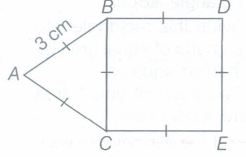
Given, ABC is an equilateral triangle of side 3cm each and BCED is a square
7.
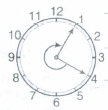
Write the revolution for each figure.
8.
The blood groups of 25 students are recorded as follows:
A, B, 0, A, AB, 0, A, 0, B, A, O, B, A, AB, AB, A, A, B, B, O, B, AB, O, A, B.
Arrange the information in a table using tally marks.
9.
The following table shows the growth of a baby in 6 months.
| Months | March | April | May | June | July | August |
| Mass gained (in grams) |
300 | 200 | 500 | 450 | 250 | 100 |
Draw a bar graph to represent the above information and answer the following questions.
(a) In which month, did the baby gain the most mass?
(b) What is the total mass gained by the baby in 6 months?
(c) In which month, was the mass gained twice that of July?
(d) What was the least mass gained by the baby in a month?
10.
Convert the following angles of degrees into fractional right angle. 135°.
11.
Using the information given, name the right angles in each part of figure.
RT 丄 ST 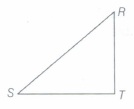
12.
The number of tins of paint sold by three different shops are given below:
| Shops | Number of tins of paint |
| Shop A | 80 |
| Shop B | 140 |
| Shop C | 180 |
Draw a pictograph and answer the following questions.
(a) What is the total profit of shop A, if the profit gained on each tin is 150?
(b) If the total number of tins sold is 400, how many figures must be drawn for shop C?
(c) Find the difference between the number of tins sold by shop B and the number of tins sold by shop C. Use scale  = 20 tins.
13.
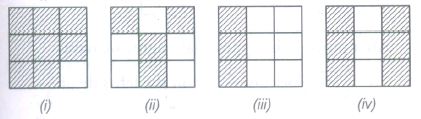
Write shaded portion as fraction . Arrange them in ascending and descending order using correct sign '<', '=','>' between the fractions.
14.
Find the perimeter of the following figures.
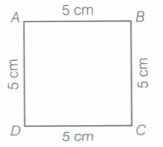
Perimeter = AB + BC + CD + DA
=__+__+__+__=__
15.
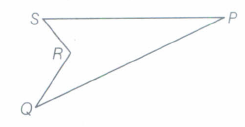
Is PQRS a figure of polygon? If yes, what is the special name for it?
16.
A million people visited a newly opened shopping complex in a week. Then, find the average number of people who visit the shopping complex each day correct to the nearest thousand.
17.
Following pictograph represents some surnames of people listed in the telephone directory of a city.
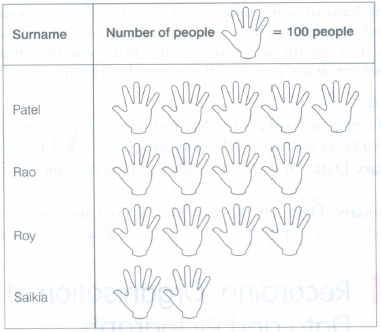
Observe the pictograph and answer the following questions:
(a) How many people have surname 'Roy'?
(b) Which surname appears the maximum number of times in the telephone directory?
(c) Which surname appears the least number of times in the telephone directory?
(d) Which two surnames appear an equal number of times?
18.
Write the five (consecutive) successors of each of the following integers.
0
19.
In a school, there are four sections of class VI. Each section has 50 students. Money collected for picnic from each student is Rs 125. Find the r total amount collected.
20.
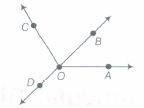
Measure and classify each angle.
| Angle | Measure | Type |
|---|---|---|
| \(\angle AOB\) | ||
| \(\angle AOC\) | ||
| \(\angle BOC\) | ||
| \(\angle DOC\) | ||
| \(\angle DOA\) | ||
| \(\angle DOB\) |
21.
Write five situations for the following, where brackets would be necessary. 7 (8- 3)
22.
Investigate Use strips and fasteners to make a triangle and a quadrilateral. Try to push inward at any one vertex of the triangle. Do the same to the quadrilateral? Is the triangle distorted? Is the quadrilateral distorted? Is the triangle rigid? Why is it that structures like electric towers make use of triangular shapes and not quadrilaterals?
23.
Write the following numbers (integers) in decreasing order with using inequality sign' >' .
9,8,4,-3,-2,1,10
24.
Find the difference between the greatest and least numbers that can be written using the digits 1, 4, 3, 2, 6 each only once.
25.
Suppose David and Mohan have started walking from zero position in opposite directions. Let the steps to the right of zero be represented by '+' sign and to the left of zero be represented by '-' sign. If Mohan moves 5 steps to the right of zero, it can be represented as +5 and if David moves 5 steps to the left of zero, it can be represented as -5. Now, represent the following positions with + sign or - sign.
(a) 8 steps to the left of zero
(b) 7 steps to the right of zero
(c) 11 steps to the right of zero
(d) 6 steps to the left of zero
26.
Draw a rough diagram, if possible of the following:
(a) An open curve made up entirely of line segment.
(b) A polypon with two sides.
27.
If the product of two whole numbers is zero, can we say that one or both of them will be zero? Justify through examples.
28.
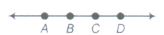
Name the line given in all possible (twelve) ways, choosing only two letters at a time from the four given letters.
29.
Arrange the following numbers in descending order.
(a) 5000, 7500, 85400, 7861
(b) 1971,45321,88715,92547
30.
Find the greatest and the smallest numbers. 15623, 15073, 15189, 15800.
1.
| Numbers | Tally Marks | Number of times |
|---|---|---|
| 1 |  I I I I |
7 |
| 2 | I |
6 |
| 3 | |
5 |
| 4 | I I I I | 4 |
| 5 | I |
11 |
| 6 | I I |
7 |
(a) The number that appeared the minimum number of times is 4.
(b) The number that appeared the maximum number of times is 5.
(c) The numbers that appeared an equal number of times are 1 and 6.
2.
| Name of items | Profit | Loss | Representation with proper sign |
| Mustard oil Rice Black pepper Wheat Groundnut oil |
Rs.150 Rs.225 Rs.200 |
|
+Rs.150 -Rs.250 +Rs.225 +Rs.200 -Rs.330 |
3.
Increasing order of these integers is - 29 < - 28 < - 27 < - 26 < - 25 < - 24, because we are moving to the right from -30 to -23.
4.
Prachi
5.
For divisible by 3, the sum of the digits should be divisible by 3.
Sum of digits of 53 * 46 = 5 + 3 + 4 + 6=18
\(\therefore\)replace * by 0
6.
(i) Perimeter = AB + AC + BC + BD + DE + CE
= 3+ 3+ 3+ 3+ 3+ 3= 18 cm
(ii) Area of square BCED = Side2 = 32 = 9 sq cm
7.
\(\frac { 3 }{ 4 } \) revolution
8.
| Blood group | Tally marks | Number of students |
| A | .png) |
8 |
| B | .png) |
7 |
| O | .png) |
6 |
| AB | I I I I | 4 |
9.
.png)
(a) May
(b) 1800 g
(c) May
(d) 100 g.
10.
We know that, 1 right angle = 90°
\({ 1 }°=\frac { 1 }{ 90 } \) right angle.
\({ 135 }°=\frac { { 135 }° }{ { 90 }° } =\left( \frac { 3 }{ 2 } \right) \) right angle.
11.
The right angles in each part of the given figure are as follow:
\(\angle RTS = 90°\)
12.
Let represents 20 tins of paint.
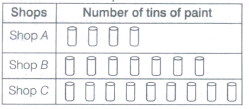
(a) Rs 12000
(b) 9 tins
(c) 40 tins.
13.
Here, total number of equal parts in all figures = 9
Shaded portion of figure (i) represents fraction = \(\frac { 8 }{ 9 } \)
Shaded portion of figure (ii) represents fraction = \(\frac { 6 }{ 9 } \)
Shaded portion of figure (iii) represents fraction = \(\frac { 4 }{ 9 } \)
Shaded portion of figure (iii) represents fraction = \(\frac { 3 }{ 9 } \)
Shaded portion of figure (iii) represents fraction = \(\frac { 6 }{ 9 } \)
∴ Denominators of all fractions are same. So, we arrange them in ascending and descending order according to their numerators.
∴ Ascending order of fractions =\(\frac { 3 }{ 9 } <\frac { 4 }{ 9 } <\frac { 6 }{ 9 } <\frac { 8 }{ 9 } \) and descending order of fractions =\(\frac { 8 }{ 9 } >\frac { 6 }{ 9 } >\frac { 4 }{ 9 } >\frac { 3 }{ 9 } \)
14.
From the given figure, we have
AB= BC = CD = DA= 5cm
i.e. eaeh side of the given figure is 5 cm.
Now, the sum of the lengths of the four sides
= AB + BC + CD + DA = 5 cm + 5 cm + 5 cm + 5 cm
= (5 + 5 + 5 + 5)cm = 20 cm
∴ Perimeter of the given figure
= Sum of the lengths of four sides
=20cm
Hence, the perimeter of the given figure is 20cm
15.
Yes, it is a polygon, because it is a simple closed curve. Figure made up of line segments only. It is a quadrilateral.
16.
143000 (nearest thousand)
17.
(a) The number of people having surname 'Roy' are 400. Because in the given pictograph, the picture symbol represents 100 people.
(b) Surname 'Patel' appears maximum number of times. Because in the given pictograph, the picture symbol represents 100 people. According to this, surname Patel appears 500 times.
(c) The surname 'Saikia' appears the least number of times. Because in the given pictograph, the picture symbol represents 100 people. According to this, surname 'Saikia' appears 200 times.
(d) The surname 'Rao' and 'Roy' appears an equal number of times.
18.
1,2,3,4,5
19.
25000
20.
The measure of angle (by using the protractor) and its classification is shown as below
| Angle | Measure | Type |
|---|---|---|
| \(\angle AOB\) | 40° | Acute angle |
| \(\angle AOC\) | 125° | Obtuse angle |
| \(\angle BOC\) | 85° | Acute angle |
| \(\angle DOC\) | 95° | Obtuse angle |
| \(\angle DOA\) | 140° | Obtuse angle |
| \(\angle DOB\) | 180° | Straight angle |
21.
We can make many situations of this kind, five situations of them are as follows:
Situation 1. Marry is a maid (servant). She charges Rs. 8 per day to clean a house but gives back Rs. 3 to the house owner for saving. What amount does she carry in her hand from 7 houses?
Situation 2. Ankit's pocket money is Rs. 8 per day. He spents Rs. 3 daily. Find his total saving in 7 days.
Situation 3. What will be the seven times the difference of eight and three?
Situation 4. A clerk works 8 h daily in an office, but he remains absent for 3 h daily. In a week, for how many hours did he work?
Situation 5. Seven children with Rs. 8 each went to market. Each of them bought pencils costing Rs. 3. What is total money left with them?
22.
On pushing inward at anyone vertex of the triangle, we find thai the triangle is not distorted. Whereas doing so with the quadrilateral, we find that it is distorted. Triangle is rigid. Thus, we use triangular shapes in making structures like electric tower as triangular shapes.
23.
10> 9 > 8 > 4> 1 > -2>-3
24.
51975
25.
We know that, on the number line, all numbers to the right of a are positive integers and all numbers to the left of a are negative integers.
Thus, representation of numbers on the number line is as follows:

(a) 8 steps to the left of zero is represented by - 8.
(b) 7 steps to the right of zero is represented by + 7.
(c) 11 steps to the right of zero is represented by + 11.
(d) 6 steps to the left of zero is represented by - 6.
26.
(a)
(b) not possible.
27.
Yes, if the product of two whole numbers is zero, then one or both of them will be zero. Since, we know that the product of any whole number with zero is always zero i.e. a x 0 = 0, where a is any whole number and 0 x 0 = 0. Some examples are as follows:
| Whole number | Product | Is the product zero? | |
| (a x 0) | (0 x a) | ||
| 5 | 5 x 0 = 0 | 0 x 5 = 0 | Yes |
| 3 | 3 x 0 = 0 | 0 x 3 = 0 | Yes |
| 0 | 0 x 0 = 0 | 0 x 0 = 0 | Yes |
| 4 | 4 x 0 = 0 | 0 x 4 = 0 | Yes |
| 25 | 25 x 0 = 0 | 0 x 25 = 0 | Yes |
28.
We know that, a line is a line segment which can extend indefinitely in both directions. Name oflines in all possible ways are as follow:
(i) By taking A, all possible ways are \(\overleftrightarrow { AB } ,\overleftrightarrow { AC } and\overleftrightarrow { AD } \).
(ii) By taking B, all possible ways are \(\overleftrightarrow { BC } ,\overleftrightarrow { BD } and\overleftrightarrow {BA } \).
(iii) By taking C, all possible ways are \(\overleftrightarrow { CD } ,\overleftrightarrow { CA } and\overleftrightarrow {CB } \).
(iv) By taking D, all possible ways are \(\overleftrightarrow { DA } ,\overleftrightarrow { DB } and\overleftrightarrow {DC } \).
29.
(a) We have, 5000, 7500, 85400, 7861
Descending order of given numbers is as follows:
85400> 7861 > 7500 > 5000
(b) We have, 1971,45321,88715,92547
Descending order of given numbers is as follows:
92547> 88715 > 45321 > 1971
30.
We have, 15623, 15073, 15189, 15800
Here, the two leftmost digits 15 i.e. digits at thousand and ten thousands place are same in each numbers. So, we compare the hundreds place digit

∴ The greatest number is 15800 and the smallest number is 15073.

6th Standard CBSE Syllabus & Materials
6th Standard CBSE
CBSE 6th Social Science Locating Places on the Earth - New Sample Question Papers Study Material - QB365 Set A
NEW6th Standard CBSE
CBSE 6th Science A Journey Through States of Water - New Sample Question Papers Study Material - QB365 Set A
NEW6th Standard CBSE
CBSE 6th Science Temperature and its Measurement - New Sample Question Papers Study Material - QB365 Set A
NEW6th Standard CBSE
CBSE 6th Science Materials Around Us - New Sample Question Papers Study Material - QB365 Set A



NCERT Books

Syllabus

Exam Pattern

Sample Question Papers

Previous year Question Papers

Important Notes

MCQ Practice test

NCERT Exemplers

Case study Questions

Image Based Questions

Passage based Questions

HOT Questions

Value Based Questions

Model Questions Papers
NCERT ( Book Back ) Questions

Assertion and Reason
Important Questions And Answers

CBSE 6th Standard CBSE Subjects
CBSE Standards


