
 100% FREE ACCESS
6th Standard CBSE Syllabus & Materials
6th Standard CBSE
CBSE 6th Social Science The Value of Work - New Sample Question Papers Study Material - QB365 Set A
NEW6th Standard CBSE
CBSE 6th Social Science Family and Community - New Sample Question Papers Study Material - QB365 Set A
NEW6th Standard CBSE
CBSE 6th Social Science India's Cultural Roots - New Sample Question Papers Study Material - QB365 Set A
NEW6th Standard CBSE
CBSE 6th Social Science India,That is Bharat - New Sample Question Papers Study Material - QB365 Set A
NEW6th Standard CBSE
CBSE 6th Social Science Timeline and sources of history - New Sample Question Papers Study Material - QB365 Set A
NEW6th Standard CBSE
CBSE 6th Social Science Oceans and Continents - New Sample Question Papers Study Material - QB365 Set A

Published on: 24/10/2025
Download CBSE Class 6th Standard CBSE Mathematics question papers, sample papers, important questions, and previous year solved papers in PDF format. Get free study materials, NCERT solutions, and exam preparation resources for Class 6th Standard CBSE Mathematics
Questions + Answers key
Take MCQ Mathematics Test
1.
In a store, there are 345 L mustard oil, 120 L sunflower oil and 225 L soybean oil. What will be the capacity of the largest container to measure the above three types of oil?
2.
Estimate each difference to the nearest thousand (47005 - 39488)
3.
Estimate (21397 + 27807 + 42505)
4.
Using divisibility tests, determine the following number are divisible by 11? 70169308.
5.
Place commas correctly and write the numerals:
Nine crores five lakhs forty one
6.
Find the value of the following 3845 x 5 x 782 + 769 x 25 x 218.
7.
Find the product by suitable rearrangement 125 x 40 x 8 x 25.
8.
Write the predecessor of
(a) 94
(b) 10000
(c) 208090
(d) 7654321
9.
4 parts out of 100 = \(\frac { 1 }{ 25 } \)
10.
The letter N has two lines of symmetry.
11.
In a pictograph, if a symbol .png) represents 100 books in a library shelf, then the symbol
represents 100 books in a library shelf, then the symbol .png) represents 50 books.
represents 50 books.
12.
531 = DXXXI
13.
All whole numbers are natural numbers.
14.
Add the following 280.64 + 25.5 + 28
15.
Simpify. \(4\frac{3}{5}+2+3\frac{1}{10}\)
16.
Simplify the following: \(\frac{7}{12}-\frac{4}{15}\)
17.
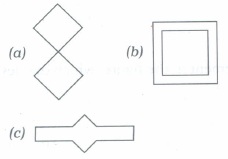
Draw two lines of symmetry in the following figures.
18.
If the cost of 7 m of cloth is Rs. 294, find the cost of 5 m of cloth.
19.
Rakesh is playing with a dice. He threw thedi 40 times and noted the outcomes as follows.
1, 2, 1, 5, 3, 5, 5, 3, 2, 2, 1, 6, 6, 6, 4, 6, 3, 5, 2, 3, 3, 5, 4, 1, 5, 5, 2, 4, 5, 5, 2, 4, 1, 6, 6, 1, 5, 6, 1, 5
Prepare a table using tally marks.
20.
A table-top measures 2 m by 1m 50 cm. What is its area in square metres?
21.
Write the simplest form of \(\frac { 80 }{24 } \)
22.
Kristin received a CD player for her birthday. She bought 3 CDs and received 5 others as gifts. What fraction of her total CDs did she buy and what fraction did she receive as gifts?
23.
The weight of 15 boxes is 60 kg. The weight of 12 boxes is ____________
24.
2 km 590 m is equal to __________ km
25.
The fraction \(\frac{25}{40}\) in simplest form is _________.
26.
The number of line of symmetry in a picture of Taj Mahal is ______
27.
The population of Pune was 2538473 in 2001. Rounded off to nearest thousands, the population was-----
28.
The smallest even number is__________
29.
Two tens and 2-tenths =
20.2
2.02
v
none of these
30.
\(?+\frac { 2 }{ 7 } =\frac { 5 }{ 7 } \)
\(\frac { 1 }{ 7 } \)
\(\frac { 2 }{ 7 } \)
\(\frac { 3 }{ 7 } \)
\(\frac { 4 }{ 7 } \)
31.
Area of a square =
side x side
4x Length of a side
2 x Length of a side
6 x Length of a side.
32.
Which of the following is not co-prime?
8. 10
11, 12
1, 3
31, 33
33.
Which of the following shows the maximum rise in temperature?
0°C to 10°C
-4°C to 8°C
-15°C to -8°C
-70C to 0°C
34.
In Indian system of numeration, the number 58695376 is written as
58,69,53,76
58,695,376
5,86,95,376
586,95,376
35.
Draw \(\angle\)POQ of measure 75° and find its line of symmetry.
36.
Determine, if the following ratios form a proportion or not?
(a) 2 : 3 and 4 : 5
(b) 25 g : 200 g and 6 kg : 48 kg
(c) 440 m : 2 km and 55 cm : 3 m
(d) 200 mL : 2.5 L and Rs. 4: Rs.50
37.
Fill in the following blanks.
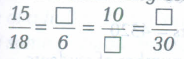
[Are these equivalent ratios?]
38.
Total number of students of a school in different years is shown in the following table.
| Years | Number of students |
| 1996 | 400 |
| 1998 | 535 |
| 2000 | 472 |
| 2002 | 600 |
| 2004 | 623 |
(A) Prepare a pictograph of students using one symbol to represent 100 students and answer the following questions.
(a) How many symbols represent total number of students in the year 2002?
(b) How many symbols represent total number of students in the year 1998?
(B) Prepare another pictograph of students using any other symbol each representing 50 students. Which pictograph do you find more informative?
1.
15
2.
8000
3.
90000
4.
70169308 is divisible by 11.
5.
Numbers after commas are as follows: 9, 05, 00, 041.
6.
We have, 3845 x 5 x 782 + 769 x 25 x 218 = 3845 x 5 x 782 + (769 x 5) x 5 x 218 [\(\because\)25 = 5 x 5]
= 3845 x 5 x 782 + 3845 x 5 x 218
= 3845 x 5 x (782 + 218) [taking 3845 x 5 as common terms]
= 3845 x 5 X 1000 = 19225 x 1000 = 19225000.
7.
We have, 125 x 40 x 8 x 25 = (125 x 40) x (8 x 25)
= 5000 x 200 = 1000000
8.
The predecessor of given numbers are as follows:
| Given number | Successor | |
| (a) | 94 | 94 - 1 = 93 |
| (b) | 10000 | 10000 - 1 = 9999 |
| (c) | 208090 | 208090 - 1 = 208089 |
| (d) | 7654321 | 7654321 - 1 = 7654320 |
9.
(a)
10.
(b)
11.
(b)
12.
(a)
13.
(b)
14.
Here 280.64 + 25.5 + 28 can be written as
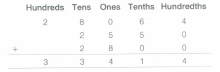
280.64 + 25.5 + 28 = 334.14
15.
\(12\frac{4}{5}\)
16.
we have, \(\frac{7}{12}-\frac{4}{15}\) = \(\frac{35-16}{60}\)
[ ∵ LCM of 12 and 5 is 60]
= \(\frac{19}{60}\)
17.
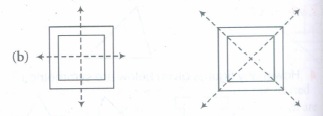
In figures (a) and (c), there ate only two lines of symmetry i. e. horizontal line of symmetry and vertical line of symmetry.
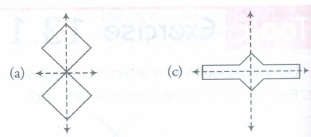
But for figure (b), we can draw more than two lines of symmetry as shown below.
18.
Given, cost of 7 m of cloth = Rs. 294
\(\therefore\) Cost of 1 m of cloth \(=Rs.\frac{294}{7}=Rs.42\)
\(\therefore\) Cost of 5 m of cloth = Rs.42 X 5 = Rs. 210
Hence, the cost of 5 m of cloth is Rs. 210.
19.
We draw the following table using tally marks from given information.
| Numbers | Tally marks | Number of times |
| 1 | .png) |
7 |
| 2 | .png) |
6 |
| 3 | .png) |
5 |
| 4 | I I I I | 4 |
| 5 | .png) |
11 |
| 6 | |
7 |
20.
Given, length of the table-top = 2 m
and breadth of the table-top = 1m 50 cm = 1m + 50 cm
\(=1m+50\times \frac { 1 }{ 100 } m\quad \left[ \because \quad 1cm=\frac { 1 }{ 100 } m \right] \)
\(=1m+\frac { 50 }{ 100 } m\quad =1m+0.50m=1.50m\)
∴ Area of the table-top = Length \(\times\)Breadth
= 2 m \(\times\)1.50 m =3sq m
Hence, the area of the table-top is 3 sq m
21.
Fraction\(\frac { 10 }{ 3 } \)is the simplest form of given fraction
22.
Number of CDs bought by Kristin = 3
Number of CDs received as gifts = 5
∴ Total number of CDs = 3 + 5 = 8
Hence, fraction of CDs bought by Kristin
= \(\frac { Number\ of\ CDs\ bought\ by\ Kristin }{ Total\ number\ of\ CDs } =\frac { 3 }{ 8 } \)
and fraction of CDs, she received as gifts
= \(\frac { Number\ of\ CDs\ recieved\ as\ gift }{ Total\ number\ of\ CDs } =\frac { 5 }{ 8 } \)
23.
()
48 Kg
24.
()
2.590 km
25.
()
we have, \(\frac{25}{20}=\frac{25+5}{40+5}=\frac{5}{8}\)[∵ HCF of 25 and 40 is 5]
26.
()
one.
27.
Given population is 2538473.
Rounded off to nearest thousands = 2538000
28.
()
2
29.
(a)
20.2
30.
(c)
\(\frac { 3 }{ 7 } \)
31.
(a)
side x side
32.
(a)
8. 10
33.
0°C to 10°C = +10° C -4° C to 8° C = +12°C (max.)
-15°C to -8°C = +7°C -7°C to 0°C = +7°C
34.
(b)
58,695,376
35.
To find the line of symmetry of angle 75°, we use the following steps
Step I Draw \(\bar{OB}\) of any length.
.png)
Step II Place the centre of the protractor at O and the zero edge along \(\bar{AB}\).
.png)
Step III Start with zero near B, mark point C at 75°.
.png)
Step IV Join OC. \(\angle\)BOC is the required' angle of measure 75°.
.png)
Step V With O as centre and using compasses, draw an arc that cuts both rays of \(\angle\)O at P and Q.
.png)
Step VI With P as centre, draw (in the interior of \(\angle\)O an arc whose radius is more than half of the length of PQ).
Step VII With the same radius and with Q as centre, draw another arc in the interior of \(\angle\)O. Let the two arcs intersect at D.
.png)
Step VIII Join OD then \(\bar{OD}\) is the required bisector of \(\angle\)O. i.e. OD is the line of symmetry of an angle of measure 75°.
.png)
36.
(a) \(2:3=\frac{2}{3}\ and\ 4:5=\frac{4}{5}\)
2: 3 and 4: 5 are not equal, therefore ratios are not in proportion.
(b) \(25 g:200g=\frac{25}{200}=\frac{1}{8}=1:8\)
\(6kg:48kg=\frac{6}{48}=\frac{1}{8}=1:8\)
Hence, they form a proportion.
(c) \(440m:2km=\frac{440}{2000}[\because1\ km=1000\ m]\)
\(=\frac{11}{50}=11:50\)
\(55\ cm:3 m=\frac{55}{300}=\frac{11}{60}=11:60\)
So, they are not in proportion.
(d) \(200 mL:2.5 L=\frac{200}{2500}=\frac{2}{25}=2:25\)
\(Rs.4:Rs.50=\frac{4}{50}=\frac{2}{25}=2:25\)
So, they are in proportion.
37.
In order to get the missing number, we consider the fact that18 = 6 X 3 i.e. when we divide 18 by 3, we get 6.
So,to get the missing number of second ratio, 15 must also be divided by 3.
Then, we have 15 \(\div\) 3 = 5
Hence, the second ratio is \(\frac{5}{6}\)
i.e \(\frac{15}{18}=\frac{5}{6}\)................(i)
Similarly,to get third ratio, we multiply both terms of secondratio by 2. [\(\because\) 5 X 2 = 10]
i.e \(\frac{5}{6}=\frac{5\times2}{6\times2}=\frac{10}{12}=10:12\) [multiplying numerator and denominator by 2]
\(\therefore \frac{5}{6}=\frac{10}{12}\)...............(ii)
Hence, the third ratio is 10/12.
Now, to get the fourth ratio, we consider the fact that 30 = 6 X 5 i.e. when we divide 30 by 6, we get 5.
So, In second ratio we muItipIy by 5,i.e. \(\frac{5}{6}=\frac{5\times5}{6\times5}=\frac{25}{30}\)
\(\therefore \frac{5}{6}=\frac{25}{30}\)..................(iii)
From Eqs. (i), (ii) and (iii), we have
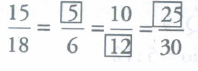
Here, from the above relation, we can say that all these are equivalent ratios.
38.
(A) According to the question, 100 students can be represented by = 1symbol .png)
\(\therefore\) 1 student can be represented by \(\frac{1}{100}\) symbols
Now, for year 1996,
400 students can be represented by \(\frac{400\times 1}{100}\)
= 4 symbols
For year 1998,
535 students can be represented by \(\frac{535\times 1}{100}\)
= 5 complete symbols + 35 students
= 5 complete symbols and 1 incomplete symbol
For year 2000,
472 students can be represented by \(\frac{472\times 1}{100}\)
= 4 complete symbols + 72 students
= 4 complete symbols and 1 incomplete symbol
For year 2002,
600 students can be represented by \(\frac{600\times 1}{100}\)
= 6 complete symbols
For year 2004,
623 students can be represented by \(\frac{623\times 1}{600}\)
6 complete symbol + 23 students = = 6 complete symbols and 1 incomplete symbol
Hence, the required pictograph of given data is shown below
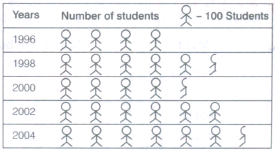
(a) 6 symbols represent total number of students in the year 2002.
(b) 5 complete symbols and 1 incomplete symbol represent total number of students for the year 1998.
(B) According to the question, 50 students can be represented by 1symbol
\(\therefore\) 1 student can be represented by \(\frac{1}{50}\) symbols
Now, for year 1996,
400 students can be represented by \(\frac{400\times 1}{50}\) symbols
= \(\frac{400}{50}\)
= 8 complete symbols.
For year 1998,
535 students can be represented by \(\frac{535\times 1}{50}\)
= \(\frac{535}{50}\) symbols
= 10 complete symbols + 1 incomplete symbol
For year 2000,
472 students can be represented by \(\frac{472\times 1}{50}\) symbols
= \(\frac{472}{50}\)
= 9 complete symbols + 1 incomplete symbol
For year 2002,
600 students can be represented by \(\frac{600\times 1}{50}\) symbols
= \(\frac{600}{50}\)
= 12 complete symbol
For year 2004,
623 students can be represented by \(\frac{623\times 1}{50}\) symbols
= \(\frac{623}{50}\)
= 12 complete symbols + 1 incomplete symbol
Hence, the required pictograph of given data is shown below
.png)
Therefore, we observe that pictograph B is more informative because it gives better approximation.

6th Standard CBSE Syllabus & Materials
6th Standard CBSE
CBSE 6th Social Science Locating Places on the Earth - New Sample Question Papers Study Material - QB365 Set A
NEW6th Standard CBSE
CBSE 6th Science A Journey Through States of Water - New Sample Question Papers Study Material - QB365 Set A
NEW6th Standard CBSE
CBSE 6th Science Temperature and its Measurement - New Sample Question Papers Study Material - QB365 Set A
NEW6th Standard CBSE
CBSE 6th Science Materials Around Us - New Sample Question Papers Study Material - QB365 Set A



NCERT Books

Syllabus

Exam Pattern

Sample Question Papers

Previous year Question Papers

Important Notes

MCQ Practice test

NCERT Exemplers

Case study Questions

Image Based Questions

Passage based Questions

HOT Questions

Value Based Questions

Model Questions Papers
NCERT ( Book Back ) Questions

Assertion and Reason
Important Questions And Answers

CBSE 6th Standard CBSE Subjects
CBSE Standards


