
 100% FREE ACCESS
6th Standard CBSE Syllabus & Materials
6th Standard CBSE
CBSE 6th Social Science The Value of Work - New Sample Question Papers Study Material - QB365 Set A
NEW6th Standard CBSE
CBSE 6th Social Science Family and Community - New Sample Question Papers Study Material - QB365 Set A
NEW6th Standard CBSE
CBSE 6th Social Science India's Cultural Roots - New Sample Question Papers Study Material - QB365 Set A
NEW6th Standard CBSE
CBSE 6th Social Science India,That is Bharat - New Sample Question Papers Study Material - QB365 Set A
NEW6th Standard CBSE
CBSE 6th Social Science Timeline and sources of history - New Sample Question Papers Study Material - QB365 Set A
NEW6th Standard CBSE
CBSE 6th Social Science Oceans and Continents - New Sample Question Papers Study Material - QB365 Set A

Published on: 24/10/2025
Download CBSE Class 6th Standard CBSE Mathematics question papers, sample papers, important questions, and previous year solved papers in PDF format. Get free study materials, NCERT solutions, and exam preparation resources for Class 6th Standard CBSE Mathematics
Questions + Answers key
Take MCQ Mathematics Test
1.
Solve \(\frac { 2 }{ 5 } +\frac { 1 }{ 6 } \)
2.
Find the HCF of the following number 91, 112, 49
3.
Is 47 and 56 co-prime numbers?
4.
Using divisibility tests, determine the following number are divisible by 11? 10824
5.
Draw a number line and answer the following:
If we are at -8 on the number line, in which direction should we move to reach -13 ?
6.
A milk dairy produced 75,678 L of milk in a day. It supplied 67,689 L of milk to milk depot. Find the milk left in the dairy.
7.
Place commas correctly and write the numerals:
Seventy three lakhs seventy five thousands three hundreds seven.
8.
Find the value of (1063 x 127)- (1063 x 27).
9.
What fraction of a day is 15 hours?
10.
Find the difference, using the number line 6 - 2.
11.
Ali divided one fruit cake equally among six persons. The part of the cake he gave to each person is \(\frac{1}{6}\)
12.
In a pictograph, if a symbol .png) represents 100 books in a library shelf, then the symbol
represents 100 books in a library shelf, then the symbol .png) represents 50 books.
represents 50 books.
13.
Smallest negative integer is -1.
14.
All prime numbers are odd.
15.
Zero is the smallest natural number.
16.
Find the common factors of
(a) 8, 12, 20
(b) 9,15,21.
17.
Write all the integers between the given pair (write them in the increasing order).
- 8 and - 15
18.
Anil got Rs 1000 as pocket money. He spent Rs 439.74 in playing games and Rs 246.40 in food. How mush did he save?
19.
Fill in the boxes \(\Box{ } -\frac { 5 }{ 8 } =\frac { 1 }{ 4 } \)
20.
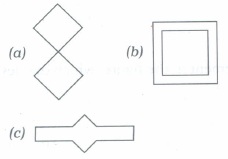
Draw two lines of symmetry in the following figures.
21.
If the cost of 7 m of cloth is Rs. 294, find the cost of 5 m of cloth.
22.
Find the perimeter of the following figures.
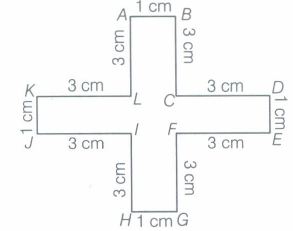
Perimeter = AB+ BC +CD + DE + EF + FG +GH +HI + IJ + JK + KL + LA
=__+__+__+__+__+__+__+__+__+__+__+__=__
23.
The pictogram shows the number of persons using various brands of perfumes.
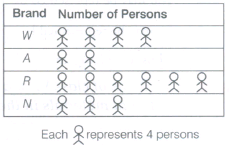
(a) How many persons use R brand?
(b) Which brand is used by maximum number of persons?
24.
Reduce the following fraction to simplest form \(\frac { 84 }{ 98 } \)
25.
Show\(\frac { 1 }{ 10 } ,\frac { 0 }{ 10 } ,\frac { 5 }{ 10 } \)and\(\frac { 10 }{ 10 } \)on a number line
26.
See the figure and fill in the blanks.
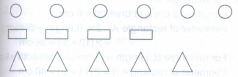
The ratio of the number of circles to that of triangles is ____________
27.
The greatest 2-digit prime number is ___________
28.
The number 60 in roman numeral is------
29.
10005 x 0 = ___________.
30.
Fill up using one of these: '>','<' or '=' 1☐\(\frac { 7 }{ 8 } \)
31.
Jack has painted \(1\frac{2}{5}\) part of a wall and Mike has \(\frac{3}{4}\) painted part of the same wall. How much did they paint together?
32.
Draw \(\angle\)POQ of measure 75° and find its line of symmetry.
33.
With \(\bar{PQ}\) of length 6.1 cm as diameter, draw a circle.
34.
Number of persons in various age groups in a town is given in the following table
| Age group | Number of persons |
| 1 - 14 | 2 lakh |
| 15 - 29 | 1 lakh 60 thousand |
| 30 - 44 | 1 lakh 20 thousand |
| 45 - 59 | 1 lakh 20 thousand |
| 60 - 74 | 80 thousand |
| 75 and above | 40 thousand |
Draw a bar graph to represent the above information and answer the following questions.
(take 1 unit length = 20 thousands)
(a) Which two age groups have same population?
(b) All persons in the age group of 60 and above are called senior citizens. How many senior citizens are therein the town?
35.
The sale of electric bulbs on different days of a week is shown below
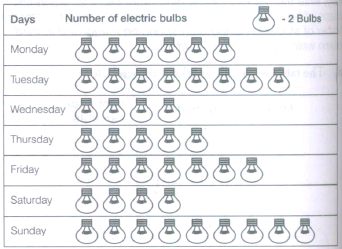
Observe the pictograph and answer the following questions.
(a) How many bulbs were sold on Friday?
(b) On which day, were the maximum number of bulbs sold?
(c) On which of the days, same number of bulbs were sold?
(d) On which of the days, minimum number of bulbs were sold?
(e) If one big carton can hold 9 bulbs. How many cartons were needed in the given week?
36.
A person had Rs.10,00,000 with him. He purchased a colour TV for Rs. 16580, a motorcycle for Rs.45,890 and a flat for Rs. 8,70,000. How much money was left with him?
37.
Draw any line segment \(\bar{PQ}\). Take any point R not on it. Through R, draw a perpendicular to \(\bar{PQ}\). Which of the following figure satisfy the above condition?
.png)
.png)
.png)
None of these
38.
Lowest form of decimal 0.005 is
\(\frac { 3 }{ 1000 } \)
\(\frac { 1 }{ 200 } \)
\(\frac { 2 }{ 200 } \)
\(\frac { 5 }{ 100 } \)
39.
Sum of \(\frac{4}{17}\) and \(\frac{15}{17}\) is
\(2\frac{1}{17}\)
\(1\frac{2}{17}\)
\(3\frac{1}{17}\)
\(3\frac{2}{17}\)
40.
Which of the following letters does not have any line of symmetry?
E
T
N
X
41.
The perimeter of a triangle whose sides are 1.2cm, 3.4 cm and 1.7 cm, is
6.3 cm
6.2 m
6.5 cm
6.4 cm
42.
The marks obtained by 10 students in Science test are given below:
53, 36, 95, 73, 62, 42, 25, 78, 75, 62
Answer the following questions that are related to the given data.
How many students got marks below 62?
3
4
5
2
43.
Every integer less than 0 has the sign
+
-
\(\times\)
÷
44.
The expanded form of the number 9578 is
9 \(\times\) 10000 + 5 \(\times\) 1000 + 7 \(\times\)10+ 8 \(\times\)1
9 \(\times\) 1000 + 5 \(\times\) 100 + 7 \(\times\) 10 + 8 \(\times\) 1
9 \(\times\) 1000 + 57 \(\times\) 10 + 8 \(\times\) 1
9 \(\times\) 100 + 5 \(\times\)100 + 7\(\times\) 10 + 8 \(\times\) 1
45.
600.40-200.20
46.
\(\frac{6}{16}\)
47.
Isosceles triangle
48.
i.png)
49.
The smallest integer greater than every negative integer
1.
\(\frac { 2 }{ 5 } +\frac { 1 }{ 6 } =\frac { 17 }{ 30 } \)
2.
HCF of 91, 112 and 49 = 7
3.
yes
4.
We have, 10824,
\(\begin{matrix} 1 \\ \downarrow \\ O \end{matrix}\begin{matrix} 0 \\ \downarrow \\ E \end{matrix}\begin{matrix} 8 \\ \downarrow \\ O \end{matrix}\begin{matrix} 2 \\ \downarrow \\ E \end{matrix}\begin{matrix} 4 \\ \downarrow \\ O \end{matrix}\)
Sum of digits at odd places from right = 4 +8 + 1= 13
Sum of digits at even places from right = 2 + 0 = 2
Now, difference = 13 - 2 = 11
So, 10824 is divisible by 11.
5.

Here, -8 > -13. So, -13 is on the left of -8. Hence, if we are at -8 on number line, then move to the left from -8 to reach at -13.
6.
Production of milk in one day = 75678 L 75678
Supply to milk depot in one day = 67689 L -67689
So, the milk left in the dairy = (75678 - 67689) = 7989 L 7989
7.
Numbers after commas are as follows: 73, 75, 307.
8.
We have, (1063 x 127) - (1063 x 27) = 1063 (127 - 27)= 1063 x 100 = 106300 [taking 1063 as common term].
9.
We know that, one day = 24 h
\(\therefore\) The required fraction = \(\frac { 15\ h }{ 24\ h } =\frac { 15 }{ 14 } =\frac { 5 }{ 8 } \)
10.
To find 6 - 2
Let us start from 6 and make 2 equal jumps to the left of 6. Each jump is equal to 1 unit. Now, we reach at 4.
.png)
\(\therefore\) 6 - 2 = 4.
11.
(a)
12.
(b)
13.
(b)
14.
(b)
15.
(b)
16.
(a) Factors of 8 are: 1,2,4 and 8
Factors of 12 are: 1,2,3,4,6 and 12
Factors of 20 are: 1,2,4,5, 10 and 20
Hence, common factors of 8, 12 and 20 are 1, 2 and 4.
(b) Factors of9 are 1,3 and 9
Factors of 15 are 1, 3, 5 and 15
Factors of 21 are 1,3, 7 and 21
Hence, common factors of 9, 15 and 21 are 1 and 3.
17.
Increasing order of these interger is -14 < -13 < - 12 < - 11 < - 10 < - 9, because we are moving to the right from -15 to -8.
18.
Rs 313.86
19.
We have \(\Box{ } -\frac { 5 }{ 8 } =\frac { 1 }{ 4 } \)
Here\(\frac { 5 }{ 8 } \) is subtracted from missing fraction to get\(\frac { 1 }{ 4 } .\) This means addition of \(\frac { 5 }{ 8 } \) and \(\frac { 1 }{ 4 } \) gives the missing fraction.
∴ Missing fraction = \(\frac { 1 }{ 4 } +\frac { 5 }{ 8 } \)
⇒ \(\frac { 1 }{ 4 } =\frac { 1\times 2 }{ 4\times 2 } =\frac { 2 }{ 8 } \)
Now, \(\frac { 1 }{ 4 } +\frac { 5 }{ 8 } =\frac { 2 }{ 8 } +\frac { 5 }{ 8 } =\frac { 2+5 }{ 8 } =\frac { 7 }{ 8 } \)
Hence \(\boxed { \frac { 7 }{ 8 } } -\frac { 5 }{ 8 } =\frac { 1 }{ 4 } \)
20.
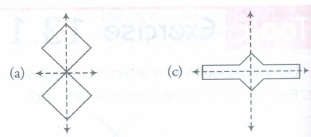
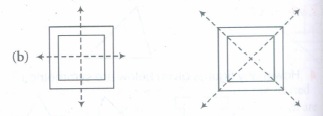
In figures (a) and (c), there ate only two lines of symmetry i. e. horizontal line of symmetry and vertical line of symmetry.
But for figure (b), we can draw more than two lines of symmetry as shown below.
21.
Given, cost of 7 m of cloth = Rs. 294
\(\therefore\) Cost of 1 m of cloth \(=Rs.\frac{294}{7}=Rs.42\)
\(\therefore\) Cost of 5 m of cloth = Rs.42 X 5 = Rs. 210
Hence, the cost of 5 m of cloth is Rs. 210.
22.
The perimeter of the given figure is 28 cm
23.
(a) 24 persons
(b) R brand.
24.
Simplest form of the fraction \(\frac { 84 }{ 98 } \) is \(\frac { 6 }{ 7 } \)
25.
We know that, all given fractions are greater than zero but less than or equal to 1. So, they will lie between 0 and 1. So, we have to divide the gap between 0 and 1 into ten equal parts, then each part shows\(\frac { 1 }{ 10 } \) and 5 parts show\(\frac { 5 }{ 10 } \), 10 parts show\(\frac { 10 }{ 10 } \) Also, 0 shows \(\frac { 0 }{ 10 } \)

\(\left[ also,\frac { 0 }{ 5 } =0 \right] \)
Hence, points A, B, C and D respectively represent the fractions \(\frac { 0 }{ 10 } ,\frac { 1 }{ 10 } ,\frac { 5 }{ 10 } \)and \(\frac { 10 }{ 10 } .\)
26.
()
6:5
27.
()
97
28.
Here, given number is 60 i.e. LX.
29.
()
0
30.
()
1 \(\boxed { > } \) \(\frac { 7 }{ 8 } \)
31.
\(2\frac{3}{20}\)
32.
To find the line of symmetry of angle 75°, we use the following steps
Step I Draw \(\bar{OB}\) of any length.
.png)
Step II Place the centre of the protractor at O and the zero edge along \(\bar{AB}\).
.png)
Step III Start with zero near B, mark point C at 75°.
.png)
Step IV Join OC. \(\angle\)BOC is the required' angle of measure 75°.
.png)
Step V With O as centre and using compasses, draw an arc that cuts both rays of \(\angle\)O at P and Q.
.png)
Step VI With P as centre, draw (in the interior of \(\angle\)O an arc whose radius is more than half of the length of PQ).
Step VII With the same radius and with Q as centre, draw another arc in the interior of \(\angle\)O. Let the two arcs intersect at D.
.png)
Step VIII Join OD then \(\bar{OD}\) is the required bisector of \(\angle\)O. i.e. OD is the line of symmetry of an angle of measure 75°.
.png)
33.
To draw a circle, of diameter 6.1 cm, we use the following steps:
Step I Draw a line segment \(\bar{PQ}\) of length 6.1 cm.
.png)
Step II With P as centre, using compasses, draw an arc of a circle (here, we can draw a circle also) with radius more than half of the length of \(\bar{PQ}\) .
Step III With the same radius and with Q as centre, draw another circle using compasses. Let it cut the previous circle at M and N.
.png)
Step IV Now, join \(\bar{MN}\) . It cuts \(\bar{PQ}\) at O.
Therefore, MN is the perpendicular bisector of \(\bar{PQ}\) and O is the mid-point of \(\bar{PQ}\). Now, with O as centre and OP or OQ as radius, draw a circle.
Thus, it is a circle whose diameter is the line segment \(\bar{PQ}\).
Hence, the circle PMQN is the required circle.
34.
To draw the bar graph, we will use the following steps:
(i) Firstly, draw two perpendicular lines, one is horizontal and one is vertical. Along the horizontal line, mark 'age-group' and along vertical line mark 'number of persons'.
(ii) Now, take scale of 1 unit length = 20000 along the vertical line and then mark the corresponding values.
Also, the heights of bars for various groups are as follows:
| 1-14 | \(\frac{200000}{20000}=10\) units |
| 15-29 | \(\frac{160000}{20000}=8\) units |
| 30-44 | \(\frac{120000}{20000}=6\) units |
| 45-59 | \(\frac{120000}{20000}=6\) units |
| 60-74 | \(\frac{80000}{20000}=4\) units |
| 75 and above | \(\frac{40000}{20000}=2\) units |
(iii) Draw bar of equal width and of height calculated in Step (ii) on the horizontal line with equal gaps between them.
Thus,we get the following bar graph
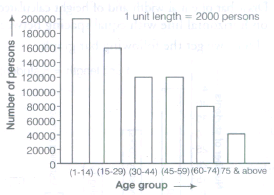
(a) From bar graph, we see that the lengths of bars for age group 30-44 and 45-59 are same, so age group (30 - 44) and (45 - 59) have the same population.
(b) Persons having age 60 or above are called senior citizens.
\(\therefore\) Number of senior citizens in the town
= Number of persons of age group (60 - 74) + Number of persons of age 75 and above
= 80000 + 40000 = 120000.
35.
In the given pictograph, 1 picture = 2 bulbs
Now, number of bulbs sold on Monday = 6 pictures
= 6 x 2 = 12bulbs
Number of bulbs sold on Tuesday = 8 x 2 = 16 bulbs
Number of bulbs sold on Wednesday = 4 x 2 = 8 bulbs
Number of bulbs sold on Thursday = 5 x 2 = 10 bulbs
Number of bulbs sold on Friday = 7 x 2 = 14 bulbs
Number of bulbs sold on Saturday = 4 x 2 = 8 bulbs
Number of bulbs sold on Sunday = 9 x 2 = 18 bulbs
(a) Number of bulbs sold on Friday = 7 x 2 = 14 bulbs
(b) Maximum number of bulbs were sold on Sunday i.e. 18 bulbs.
(c) The same number of bulbs were sold on Wednesday and Saturday i.e. 8 bulbs.
(d) The minimum number of bulbs were sold on Wednesday and Saturday i.e. 8 bulbs.
(e) Total number of bulbs sold in a week
= 12 + 16 + 8 + 10 + 14 + 8 + 18 = 86
Now, number of cartons which can hold 9 bulbs = 1 and number of carton which can hold 1 bulb = \(\frac{1}{9}\)
\(\therefore\) Number of cartons which can hold 86 bulbs = \(\frac{1\times 86}{9}\)
= \(\frac{86}{9}=9\frac{5}{9}=10\)
Hence, 10 cartons were needed in the given week.
36.
Given, total money = Rs.10,00,000
Money spent on a colour TV = Rs. 16,580
Money spent on a motorcycle = Rs. 45,890
and money spent on a flat = Rs. 8,70,000
Total amount spent = 16,580 + 45,890 + 8,70,000
= Rs. 9,32,470
∴ Money left with him = 10,00,000 - 9,32,470
= Rs.67,530
Hence, Rs. 67,530 was left with him.
37.
(a)
38.
(b)
\(\frac { 1 }{ 200 } \)
39.
(b)
\(1\frac{2}{17}\)
40.
(c)
N
41.
(a)
6.3 cm
42.
(b)
4
43.
We know that, all the negative integers are less than zero and they have '-' sign.
44.
(c)
9 \(\times\) 1000 + 57 \(\times\) 10 + 8 \(\times\) 1
45.
()
400.20
46.
()

47.
()
1
48.
()
12
49.
()
0

6th Standard CBSE Syllabus & Materials
6th Standard CBSE
CBSE 6th Social Science Locating Places on the Earth - New Sample Question Papers Study Material - QB365 Set A
NEW6th Standard CBSE
CBSE 6th Science A Journey Through States of Water - New Sample Question Papers Study Material - QB365 Set A
NEW6th Standard CBSE
CBSE 6th Science Temperature and its Measurement - New Sample Question Papers Study Material - QB365 Set A
NEW6th Standard CBSE
CBSE 6th Science Materials Around Us - New Sample Question Papers Study Material - QB365 Set A



NCERT Books

Syllabus

Exam Pattern

Sample Question Papers

Previous year Question Papers

Important Notes

MCQ Practice test

NCERT Exemplers

Case study Questions

Image Based Questions

Passage based Questions

HOT Questions

Value Based Questions

Model Questions Papers
NCERT ( Book Back ) Questions

Assertion and Reason
Important Questions And Answers

CBSE 6th Standard CBSE Subjects
CBSE Standards


