
 100% FREE ACCESS
6th Standard CBSE Syllabus & Materials
6th Standard CBSE
CBSE 6th Social Science The Value of Work - New Sample Question Papers Study Material - QB365 Set A
NEW6th Standard CBSE
CBSE 6th Social Science Family and Community - New Sample Question Papers Study Material - QB365 Set A
NEW6th Standard CBSE
CBSE 6th Social Science India's Cultural Roots - New Sample Question Papers Study Material - QB365 Set A
NEW6th Standard CBSE
CBSE 6th Social Science India,That is Bharat - New Sample Question Papers Study Material - QB365 Set A
NEW6th Standard CBSE
CBSE 6th Social Science Timeline and sources of history - New Sample Question Papers Study Material - QB365 Set A
NEW6th Standard CBSE
CBSE 6th Social Science Oceans and Continents - New Sample Question Papers Study Material - QB365 Set A

Published on: 24/10/2025
Download CBSE Class 6th Standard CBSE Mathematics question papers, sample papers, important questions, and previous year solved papers in PDF format. Get free study materials, NCERT solutions, and exam preparation resources for Class 6th Standard CBSE Mathematics
Questions + Answers key
Take MCQ Mathematics Test
1.
LXXV is greater than LXXIV.
2.
Every whole number is except zero the successor of another whole number.
3.
1 has no predecessor in the whole numbers.
4.
If an even number is divided by 2, The quotient is always odd.
5.
The predecessor of a two-digit number is never a single digit number.
6.
Complete the pattern:
9 + 1 = 10
99 + 1 = 100
999 + 1 = ........
9,999 + 1 = .......
99,999 + 1 = .........
9,99,999 + 1 = .........
99,99,999 + 1 = 1,00,00,000
7.
Find the product 847 x 99, using distributive property.
8.
Estimate each difference to the nearest thousand (35863 - 27677)
9.
Using divisibility tests, determine the following number are divisible by 4 and 8?
572
10.
Round off these numbers to the nearest thousands 2936
11.
Express the following as the sum of two odd prime numbers 32
12.
Place commas correctly and write the numerals:
Seven crores fifty two lakhs twenty one thousands three hundreds two
13.
Write all the factors of the following number: 20
14.
A taxi driver filled his car petrol tank with 40 L of petrol on Monday. The next day, he filled the tank with 50 L of petrol. If the petrol cost Rs 44 per litre, how much did he spend in all on petrol?
15.
Find the value of 8937 x 648+ 8937x 122 + 8937 x 230.
16.
The piece of cloth required for a shirt is 3 m 05 cm. How much cloth will be required for 14 shirts?
17.
Estimate the product 5981 \(\times\) 4428 by rounding off each number to the nearest.
(i) tens (ii) hundreds
18.
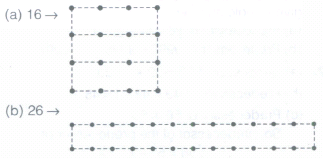
Write the following numbers as directed using dots.
(a) 16 as a square
(b) 26 as a rectangle.
19.
Check, if the following rounding off is correct or not.
(i) 2573 ⟶ 3000 (ii) 53,552 ⟶ 53,000 (iii) 6404 ⟶ 6000 (iv) 65,437 ⟶ 65,000 (v) 7805 ⟶ 7000 (vi) 3499 ⟶ 4000
Correct those, which are wrong.
20.
Kirti bookstore sold books worth Rs. 2,85,891 in the first week of June and book worth Rs. 4,00,768 in the second week of the month. How much was the sale for the two weeks together? In which week was the sale greater and by how much?
21.
From the digits 3, 0 and 4, make five numbers each with 6-digits. Use commas.
22.
The greatest 2-digit prime number is ___________
23.
In Indian system of numeration, the number 61711682 is written, using commas, as -------
24.
1001 x 2002 = 1001 x (1001 + ______).
25.
28 x 25 = 28 x \(\frac{\Box}{4}\) = 700.
26.
125 + (68 + 32) = (125 + ______ ) + 32.
27.
10005 x 0 = ___________.
28.
1 is neither________ nor__________.
29.
1 million = _______ hundred thousands
30.
Find the difference between the smallest number of 7-digit and the largest number of 4-digit.
31.
Using divisibility tests, determine which of the following numbers are divisible by 2; by 3; by 4; by 5; by 6; by 8; by 9; by 10; by 11 (say, yes or no)?
| Number | Divisible by | ||||||||
| 2 | 3 | 4 | 5 | 6 | 8 | 9 | 10 | 11 | |
| (i) 128 | Yes | No | Yes | No | No | Yes | No | No | No |
| (ii) 990 | |||||||||
| (iii) 1586 | |||||||||
| (iv) 275 | |||||||||
| (v) 6686 | |||||||||
| (vi) 639210 | |||||||||
| (vii) 429714 | |||||||||
| (viii) 2856 | |||||||||
| (ix) 3060 | |||||||||
| (x) 406839 | |||||||||
32.
| Raman's shop | The sales during the last year | |
| Things | Price | Apples 2457 kg |
| Apples | Rs.40 per kg | Oranges 3004 kg |
| Oranges | Rs.30 per kg | Combs 22760 |
| Combs | Rs.3 for one | Toothbrushes 25367 |
| Toothbrushes | Rs.10 for one | Pencils 38530 |
| Pencils | Rs.1 for one | Notebooks 40002 |
| Notebooks | Rs.6 for one | Soapcakes 20005 |
| Soapcakes | Rs.8 for one | |
(a) Can you find the total weight of apples and oranges Raman sold last year?
Weight of apples = ________kg
Weight of oranges = _______kg
Therefore, total weight = __ kg +__ kg = __ kg
(b) Can you find the total money Raman got by selling apples?
(c) Can you find the total money Raman got by selling apples and oranges together?
(d) Make a table showing how much money Raman received from selling each item? Arrange the entries of amount of money received in descending order. Find the item which brought him the highest amount. How much is this amount?
33.
A bus started its journey and reached different places with a speed of 60 km/h. The journey is shown below:
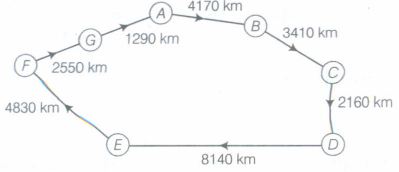
(i) Find the total distance covered by the bus from A to D.
(ii) Find the total distance covered by the bus from D to G.
(iii) Find the total distance covered by the bus, if it starts from A and returns back to A.
(iv) Can you find the difference of distances from C to D and D to E?
(v) Find out the time taken by the bus to reach
(a) A to B (b) C to D (c) E to G (d) Total journey.
34.
Which of the following numbers is not a factor of 12?
4
2
3
8
35.
Manish multiplied 100 by 89 instead of multiplying by 79. How much was his answer greater than the correct answer?
100
1000
10000
None of these
36.
60 in Roman numerals is
LX
LXX
LXXX
XL
37.
Arrange the following numbers in descending order: 4000, 8500,50600, 7235.
50600, 8500, 7235, 4000
50600, 8500, 4000, 7235
50600,7235, 8500, 4000
50600,7235, 4000, 8500
38.
The smallest of the number 1000, 50000, 111, 3222, 225 is
111
225
1000
3222
39.
I purchased 10 litres of milk in the morning and 5 litres of milk in the evening. If the milk costs ~ 30 per litre, how much money will I have to pay to the milkman?
Rs 450
Rs 300
Rs 150
None of these
40.
Find 27 \(\div\) (9 \(\div\) 3 ).
3
6
9
27.
41.
The number of distinct prime factors of the largest 4-digit number is
2
3
5
11
42.
Which of the following roman symbol is never repeated?
I
V
X
C
1.
(a)
2.
(a)
3.
(b)
4.
(b)
5.
(b)
6.
999 + 1 =1000
9,999 + 1 =10,000
99,999 + 1 = 1,00,000
9,99,999 + 1 = 10,00,000
7.
83853
8.
8000
9.
We have, 572
(i) Divisibility by 4

Number formed by last two digits = 72.
On dividing 72 by 4, we get
Remainder = 0
\(\because\) 72 is divisible by 4, so 572 is also divisible by 4.
(ii) Divisibility by 8
Number formed by last three digits = 572

On dividing 572 by 8, we get Remainder \(\neq\) 0
\(\therefore\) 572 is not divisible by 8.
10.
Given number is 2936. Here, hundred digit is 9, which is more than 5 i.e. 9 > 5.
∴ The required rounded number 2936 = 3000
11.
Here, we have 32
32 = 29 +3
12.
Numbers after commas are as follows: 7, 52, 21, 302.
13.
We have, 20
20 = 1 x 20; 20 = 2 x 10; 20 = 4 x 5
\(\therefore\)Factors of 20 are 1, 2, 4, 5, 10 and 20.
14.
Given, quantity of petrol filled on Monday = 40 L
Quantity of petrol filled on the next day i.e. Tuesday = 50 L
Total quantity of petrol = 40 + 50 = 90 L
Cost of petrol = Rs 44 per litre
Total cost of petrol = Cost per litre x Total quantity of petrol
= 44 x 90 = Rs 3960
Hence, total cost of petrol is Rs 3960.
15.
We have, 8937 x 648 + 8937 x 122 + 8937 x 230 = 8937 (648 + 122 + 230)
= 8937 x 1000 = 8937000 [taking 8937 as common term].
16.
Cloth required for 1 shirt =3 m 05 cm
Cloth required for 14 shirts = (3 m 05 cm) \(\times\) 14
=14\(\times\)3+14\(\times\)05=42 m 70 cm
17.
(i) 5981 rounded off to nearest tens = 5980
4428 rounded off to nearest tens = 4430
∴ Estimated product = 5980 \(\times\) 4430 = 26491400
(ii) 5981 rounded off to nearest hundreds = 6000
4428 rounded off to nearest hundreds = 4400
∴ Estimated product = 6000 \(\times\) 4400 = 26400000
18.
According to the patterns of whole number,
19.
On checking the rounding off in respect of given numbers, we find that the rounding off of 7805, 53552 and 3499 are incorrect.
Their correct results should be 7800, 54000 and 3000, respectively.
20.
Given, sale of books in Ist week = Rs. 2,85,891
Sale of books in IInd week = Rs. 4,00,768
Total sales of two weeks =Sale of Ist week + Sale of IInd week
= 2,85,891 + 4,00,768 = Rs. 6,86,659
Since, 4,00,768 > 2,85,891
Thus, sale in the second week is greater.
∴ Difference in the sales amount = 4,00,768 - 2,85,891
= Rs. 1,14,877
Hence, sale in the second week was greater by Rs. 1,14,877.
21.
Given digits are 3, 0 and 4.
We can make many numbers by using these digits, five of them are as follows:
(i) 330443 (ii) 343404 (iii) 344430 (iv) 434043 (v) 344034
Using commas, these numbers can be rewritten as :
(i) 3,30,443 (ii) 3,43,404 (iii) 3,44,430 (iv) 4,34,043 (v) 3,44,034
22.
()
97
23.
According to Indian system of numeration, 6,17,11,682.
24.
()
1001
25.
()
100
26.
According to the associative law under addition,
125 + (68 + 32) = (125 + 68) + 32.
27.
()
0
28.
()
prime nor composite number.
29.
We know that,
1 million = 1000000 (in digits) = 10 \(\times\) 100000
= ten\(\times\) hundred thousands
(in number name)
∴ 1 million = ten hundred thousands
30.
The smallest number of 7-digit = 1000000
and the largest number of 4-digit = 9999
\(\therefore\) The difference between them
= 1000000 - 9999 = 990001
31.
Now, complete table is shown below:
| Number | Divisible by | ||||||||
| 2 | 3 | 4 | 5 | 6 | 8 | 9 | 10 | 11 | |
| (i) 128 | Yes | No | Yes | No | No | Yes | No | No | No |
| (ii) 990 | Yes | Yes | No | Yes | Yes | No | Yes | Yes | Yes |
| (iii) 1586 | Yes | No | No | No | No | No | No | No | No |
| (iv) 275 | No | No | No | Yes | No | No | No | No | Yes |
| (v) 6686 | Yes | No | No | No | No | No | No | No | No |
| (vi) 639210 | Yes | Yes | No | Yes | Yes | No | No | Yes | Yes |
| (vii) 429714 | Yes | Yes | No | No | Yes | No | Yes | No | No |
| (viii) 2856 | Yes | Yes | Yes | No | Yes | Yes | No | No | No |
| (ix) 3060 | Yes | Yes | Yes | Yes | Yes | No | Yes | Yes | No |
| (x) 406839 | No | Yes | No | No | No | No | No | No | No |
We know that a number is divisible by
2, if it has digits 0, 2, 4, 6 or 8 in one's place.
3, if the sum of the digits is a multiple 00 or it is divisible by 3.
4, if last two digits of the number is completely divisible by 4.
5, if a number has 0 or 5 in its one's place.
6, if it is divisible by 2 and 3 both.
.8, if last three digits of the number is completely divisible by 8.
9, if the sum of the digits of the number is divisible by 9.
10, if a number has 0 in its one's place.
11, if the difference of sum of the digits of even place and sum of the digits at odd place is either 0 or multiple of 11.
32.
(a) Weight of apples sold during the last year = 2457 kg
Weight of oranges sold during the last year = 3004 kg
∴ Total weight of apples and oranges Raman sold, during the last year = 2457 + 3004= 5461 kg
(b) Total money Raman got by selling apples
=Total number of apples \(\times\) Cost per kg
= 2457 \(\times\) 40 = Rs. 98280
(c) Total money Raman got by selling oranges
=Total number of oranges \(\times\) Cost per kg
=3004 \(\times\) 30 = Rs. 90120
∴ Total money Raman got by selling apples and oranges together =98280 + 90120 = Rs. 188400
(d) Following table shows the money received from selling items:
| Items | Sales | Rate | Money received |
| Apples | 2457 | Rs.40 per kg | 2457 \(\times\) 40 =Rs. 98280 |
| Oranges | 3004 | Rs.30 per kg | 3004 \(\times\) 30 = Rs. 90120 |
| Combs | 22760 | Rs.3 for one | 22760 \(\times\) 3 = Rs. 68280 |
| Toothbrushes | 25367 | Rs.10 for one | 25367\(\times\) 10 =Rs. 253670 |
| Pencils | 38350 | Rs.1 for one | 38350 \(\times\) 1= Rs. 38350 |
| Notebooks | 40002 | Rs.6 for one | 40002 \(\times\) 6 = Rs. 240012 |
| Soapcakes | 20005 | Rs.8 for one | 20005 \(\times\) 8 = Rs. 160040 |
The entries of amount of money received in descending order are as follows:
Rs. 253670 >Rs. 240012 >Rs. 160040 > Rs. 98280 > Rs. 90120 >Rs. 68280 > Rs. 38350
The item, which brought him the highest amount is tooth brushes. This amount is Rs. 253670.
33.
From the given figure,
(i) Total distance covered by bus from A to D
= AB + BC + CD =4170 +3410 + 2160 =9740 km
(ii) Total distance covered by bus from D to G
= DE + EF + FG = 8140 + 4830 + 2550 = 15520 km
(iii) Total distance covered by bus = Distance from A to D + Distance from D to G + Distance from G to A
=9740+15520+1290 [from (i) and (ii) parts)
=26550 km
(iv) Distance from C to D = 2160 km
Distance from D to E = 8140 km
∴ Difference of distances from C to D and D to E
=8140 - 2160 = 5980 km
(v) To find out the time for individual places, we will use the formula of time i.e.
\(Time=\frac { Distance }{ Speed } \)
(a) Time taken by bus to reach from A to B
\(=\frac { Distance\quad from\quad AtoB }{ Speed } =\frac { 4170 }{ 60 } =\frac { 139 }{ 2 } =69\frac { 1 }{ 2 } h\)
(b) Time taken by bus to reach from C to D
\(=\frac { Distance\quad from\quad CtoD }{ Speed } =\frac { 2160 }{ 60 } =36h\)
(c) Time taken by bus to reach from E to G
\(=\frac { Distance\quad from\quad EtoG }{ Speed } =\frac { 4830+2550 }{ 60 } =\frac { 7380 }{ 60 } =123h\)
(d) Time taken by bus for total journey
\(=\frac { Total\quad distance\quad covered }{ Speed } =\frac { 26550 }{ 60 } =\frac { 885 }{ 2 } =442\frac { 1 }{ 2 } h\).
34.
(d)
8
35.
100 x 89 = 8900
100 x 79 = 7900
8900 - 7900 = 1000
36.
(a)
LX
37.
(a)
50600, 8500, 7235, 4000
38.
(a)
111
39.
(a)
Rs 450
40.
(c)
9
41.
(b)
3
42.
(b)
V

6th Standard CBSE Syllabus & Materials
6th Standard CBSE
CBSE 6th Social Science Locating Places on the Earth - New Sample Question Papers Study Material - QB365 Set A
NEW6th Standard CBSE
CBSE 6th Science A Journey Through States of Water - New Sample Question Papers Study Material - QB365 Set A
NEW6th Standard CBSE
CBSE 6th Science Temperature and its Measurement - New Sample Question Papers Study Material - QB365 Set A
NEW6th Standard CBSE
CBSE 6th Science Materials Around Us - New Sample Question Papers Study Material - QB365 Set A



NCERT Books

Syllabus

Exam Pattern

Sample Question Papers

Previous year Question Papers

Important Notes

MCQ Practice test

NCERT Exemplers

Case study Questions

Image Based Questions

Passage based Questions

HOT Questions

Value Based Questions

Model Questions Papers
NCERT ( Book Back ) Questions

Assertion and Reason
Important Questions And Answers

CBSE 6th Standard CBSE Subjects
CBSE Standards


