
 100% FREE ACCESS
6th Standard CBSE Syllabus & Materials
6th Standard CBSE
CBSE 6th Social Science The Value of Work - New Sample Question Papers Study Material - QB365 Set A
NEW6th Standard CBSE
CBSE 6th Social Science Family and Community - New Sample Question Papers Study Material - QB365 Set A
NEW6th Standard CBSE
CBSE 6th Social Science India's Cultural Roots - New Sample Question Papers Study Material - QB365 Set A
NEW6th Standard CBSE
CBSE 6th Social Science India,That is Bharat - New Sample Question Papers Study Material - QB365 Set A
NEW6th Standard CBSE
CBSE 6th Social Science Timeline and sources of history - New Sample Question Papers Study Material - QB365 Set A
NEW6th Standard CBSE
CBSE 6th Social Science Oceans and Continents - New Sample Question Papers Study Material - QB365 Set A

Published on: 24/10/2025
Download CBSE Class 6th Standard CBSE Mathematics question papers, sample papers, important questions, and previous year solved papers in PDF format. Get free study materials, NCERT solutions, and exam preparation resources for Class 6th Standard CBSE Mathematics
Questions + Answers key
Take MCQ Mathematics Test
1.
The measures of the sides of some of the rectangles are given. Find their areas by placing them on a graph paper and counting the number of squares.
| Length | Breadth | Area |
| 3 cm | 4 cm | ___ |
| 7 cm | 5 cm | ___ |
| 5 cm | 3 cm | ___ |
2.
The perimeter of a regular hexagon is 72 cm How long is its each side?
3.
The sum of the length of a side and perimeter of a square is 20. Find the area of a square
4.
The perimeter of a squared garden is 48 m. A small flower bed covers 18 sq m area inside this garden. What is the area of the garden that is not covered by the flower bed? What fractional part of the garden is covered by flower bed? Find the ratio of the area covered by the flower bed and the remaining area.
5.
A room 9.68 m long and 6.2 m wide. Its floor is to be covered with glazed tiles of 22 cm by 10 cm each. If rate of tiles is Rs.25 per tile. Find the total cost of tiles.
6.
Find the cost of fencing a rectangular field 34 m long and 18 m wide at Rs.2.25 per metre. What is the cost of cultivating the field at Rs. 4.50 per square metre?
7.
How many tiles whose length and breadth are 12 cm and 5 cm respectively will be needed to fit in a rectangular region whose length and breadth are respectively.
(a) 100 cm and 144 cm (b) 70 cm and 36 cm
8.
Five square flower beds each of sides 1 m are dug on a piece of land 5 m long and 4 m wide. What is the area of the remaining part of the land?
9.
The length and breadth of three rectangles are as given below.
(a)9 m and 6 m (b) 17 m and 3 m (c)4 m and 14 m
Which one has the largest area and which one has the smallest?
10.
A table-top measure 2 m 25 cm by 1 m 50 cm. What is the perimeter of the table-top?
1.
| Length | Breadth | Area |
| 3 cm | 4 cm | 12 cm2 |
| 7 cm | 5 cm | 35 cm2 |
| 5 cm | 3 cm | 15 cm2 |
(i)
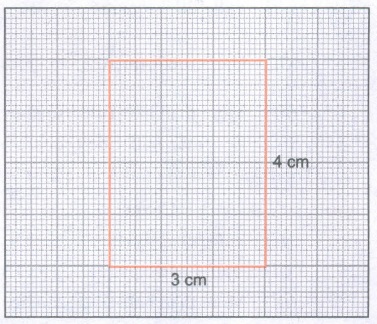
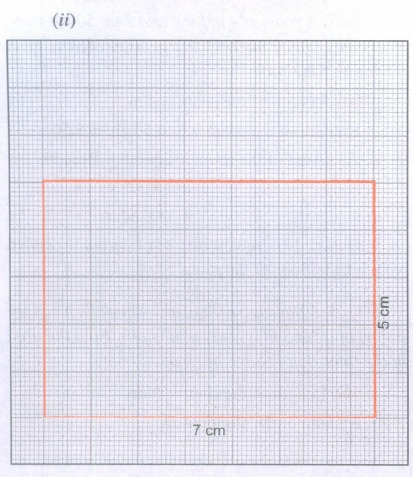
(iii)
2.
12 cm
3.
16 cm2
4.
Let side of squared garden be x m.
Given that, perimeter of a squared garden = 48 m
∴ 4 x Side of a square = 48
⇒ 4x=48⇒x=\(\frac{48}{4}=12m\)
Now, area of the squared garden = (X)2
=(12)2=144m2
Also given, area of small flower bed cover inside the garden = 18 m2
∴ Area of the 9B.rden not covered by flower bed
= Area of squared garden - Area of flower bed
=144 m2 -18 m2 = 126 m2
The fractional part of the garden covered by flower bed=\(\frac { Area\quad covered\quad by\quad the\quad flower }{ Remaming\quad Area\quad of\quad the\quad squared\quad garden } \)
\(=\frac { 18 }{ 126 } =\frac { 2 }{ 14 } =\frac { 1 }{ 7 } \)
Hence, ratio of the area covered by the flower bed and the remaining area is 1 : 7.
5.
Given, length of floor of the room (l)= 9.68 m
and width of floor ofthe room (b)= 6.2 m
Area of the room = 9.68\(\times\) 6.2 sq m . ... (i)
Also, given that length of each tile = 22 cm
and width of each tile = 10 cm
Now, area of each tile = 22 \(\times\) 10 sq cm ... (ii)
Number of tiles required to cover the floor of the room
\(=\frac { 9.68\times 6.2\times 100\times 100 }{ 22\times 10 } \left[ \because 1m=100cm \right] \)
\(=\frac { 968\times 62\times 10 }{ 22\times 10 } =\frac { 968\times 62 }{ 22 } =2728\)
Total cost = Rs. 2728 \(\times\) 25 = Rs. 68200
6.
Given, length of field (1)= 34 m
and width (b)= 18 m
Perimeter of rectangular field = 2 (34 + 18) m
= 104 m ... (i)
Area of rectangular field = 34 \(\times\) 18 sq m
= 612 sq m ... (ii)
Cost of fencing of this rectangular field at Rs. 2.25 per m
=Rs.104\(\times\)2.25=Rs.234
Now, cost of cultivating the field at Rs.4.50 per sq m
= 612 \(\times\) 4.50=Rs. 2754
7.
Given, length of a tile = 12 cm and breadth of a tile = 5 cm
∴ Area of one tile = Length x Breadth = 12 cm \(\times\) 5 cm =60 sq cm
(a) Here, length of the rectangular region = 100 cm
and breadth of the rectangular region = 144 cm
:. Area of the rectangular region = Length \(\times\) Breadth
=100 cm \(\times\) 144 cm
= 14400 sq cm
Now, number of required tiles
\(=\frac { Area\quad of\quad the\quad rectangular\quad region }{ Area\quad of\quad the\quad one\quad tile } \)
\(=\frac { 14400 }{ 60 } =240\)
Hence, the number of required tiles is 240.
(b) Given, length of the rectangular region = 70 cm
and breadth of the rectangular region = 36 cm
∴ Area of the rectangular region = Length \(\times\) Breadth
= 70 cm \(\times\) 36 cm
= 2520 sq cm
Now, number of the required tiles
\(=\frac { Area\quad of\quad the\quad rectangular\quad region }{ Area\quad of\quad the\quad one\quad tile } \)
\(=\frac { 2520 }{ 60 } =42\)
Hence, the number of the required tiles is 42.
8.
Given, length of the piece of land = 5 m
and breadth of the piece of land = 4 m
Area of the piece of land = Length \(\times\) Breadth
= 5 m \(\times\) 4 m= 20 sq m
Given, side of one square flower bed = 1m
∴ Area of one square flower bed = Side \(\times\) Side
= (1m \(\times\) 1rn) = 1sq m
Then, area of 5 such flower beds = 5 \(\times\) Area of one square flower bed
= 5 \(\times\) 1sq m = 5 sq m
Now, area of the remaining part of land
= Area of the piece of land - Area of 5 square flower beds
= (20 - 5)sq m =15 sq m
Hence, the area of the remaining part of the land is 15 sq m.
9.
(a) Here, length of the rectangle = 9 m
and breadth of the rectangle = 6 m
∴ Area of the rectangle = Length \(\times\) Breadth = 54 sq m
Hence, the area of the rectangle is 54 sq m.
(b) Here, length of the rectangle = 17 m
and breadth of the rectangle = 3 m
∴ Area of the rectangle = Length \(\times\) Breadth
= 17m \(\times\) 3m = 51 sq m
Hence, the area of the rectangle is 51 sq m.
(c) Here, length of the rectangle = 14 m
and breadth of the rectangle = 4 m
∴ Area of the rectangle = Length \(\times\) Breadth
= 14 m \(\times\) 4 m = 56 sq m
Hence, the area of the rectangle is 56 sq m.
Now, we have 56> 54> 51
Hence, the rectangle having sides 4 m and 14 m has the largest area and the rectangle having sides 17m and 3 m has the smallest area.
10.
Given, length of table-top = 2 m 25 cm
\(=2m+25\times \frac { 1 }{ 100 } m\quad \left[ \because \quad 1cm=\frac { 1 }{ 100 } m \right] \)
\(=2m+\frac { 25 }{ 100 } m =2m+0.25m\)
= (2 + 0.25) m = 2.25 m
Breadth of table-top = 1m 50 cm = 1 m + 50 cm
\(=1m+50\times \frac { 1 }{ 100 } m\quad \left[ \because 1cm=\frac { 1 }{ 100 } m \right] \)
\(=1m+\frac { 50 }{ 100 } m\quad =1m+0.50m\)
= (1+ 050) m = 1.50 m
∴ Perimeter of table top = 2\(\times\)(Length + Breadth)
= 2\(\times\) (2.25 m + 1.50 rn)
= 2 \(\times\) 3.75 m = 7.50 m
Hence, the perimeter of the table top is 7.50 m.

6th Standard CBSE Syllabus & Materials
6th Standard CBSE
CBSE 6th Social Science Locating Places on the Earth - New Sample Question Papers Study Material - QB365 Set A
NEW6th Standard CBSE
CBSE 6th Science A Journey Through States of Water - New Sample Question Papers Study Material - QB365 Set A
NEW6th Standard CBSE
CBSE 6th Science Temperature and its Measurement - New Sample Question Papers Study Material - QB365 Set A
NEW6th Standard CBSE
CBSE 6th Science Materials Around Us - New Sample Question Papers Study Material - QB365 Set A



NCERT Books

Syllabus

Exam Pattern

Sample Question Papers

Previous year Question Papers

Important Notes

MCQ Practice test

NCERT Exemplers

Case study Questions

Image Based Questions

Passage based Questions

HOT Questions

Value Based Questions

Model Questions Papers
NCERT ( Book Back ) Questions

Assertion and Reason
Important Questions And Answers

CBSE 6th Standard CBSE Subjects
CBSE Standards


