
 100% FREE ACCESS
6th Standard CBSE Syllabus & Materials
6th Standard CBSE
CBSE 6th Social Science The Value of Work - New Sample Question Papers Study Material - QB365 Set A
NEW6th Standard CBSE
CBSE 6th Social Science Family and Community - New Sample Question Papers Study Material - QB365 Set A
NEW6th Standard CBSE
CBSE 6th Social Science India's Cultural Roots - New Sample Question Papers Study Material - QB365 Set A
NEW6th Standard CBSE
CBSE 6th Social Science India,That is Bharat - New Sample Question Papers Study Material - QB365 Set A
NEW6th Standard CBSE
CBSE 6th Social Science Timeline and sources of history - New Sample Question Papers Study Material - QB365 Set A
NEW6th Standard CBSE
CBSE 6th Social Science Oceans and Continents - New Sample Question Papers Study Material - QB365 Set A

Published on: 24/10/2025
Download CBSE Class 6th Standard CBSE Mathematics question papers, sample papers, important questions, and previous year solved papers in PDF format. Get free study materials, NCERT solutions, and exam preparation resources for Class 6th Standard CBSE Mathematics
Questions + Answers key
Take MCQ Mathematics Test
1.
Find the common factors of 7 and 16.
2.
Express the following number as the sum of two odd primes 18
3.
Find the prime factorisation of 90.
4.
Find the prime factorisation of 630.
5.
Are 97 and 47 co-prime?
6.
Give prime factorisation of 60775.
7.
Give the prime factorisation of 20570.
8.
Write all the common factors between 12 and 64.
9.
A number is divisible by 3, 4, 5 and 13. Is that number also divisible by 780?
10.
4096 is divisible by 64. Can we say it is divisible by 8 also?
11.
A number is divisible by 8. By what other numbers will that number be divisible?
12.
Is 47 and 56 co-prime numbers?
13.
Find the common factors of 42 and 70
14.
Find the common factors of 25 and 80
15.
A number is divisible by both 5 and 12. By which other number will that number be always divisible?
16.
Find first three common multiples of 12 and 18
17.
Find first three common multiples of 6 and 8
18.
Find the common factors of 5, 15 and 25
19.
Find the common factors of 56 and 120
20.
Find the common factors of 9, 15
21.
Which of the following pairs are co-prime?
(a) 8, 25
(b) 4, 10
22.
Find the common factors of 8 and 20.
23.
Is the number 17152652 divisible by both 4 and 11?
24.
Is 93455120 divisible by 11?
25.
Using divisibility tests, determine the following number are divisible by 4 and 8?
5500
26.
Express the following number as sum of two prime numbers. 49
27.
Express each of the following numbers as the sum of three odd primes 31
28.
Express each of the following numbers as the sum of three odd primes 21
29.
Express the following as the sum of two odd prime numbers 32
30.
Write all the factors of the following number 60
31.
Find all the multiples of 9 upto 100
32.
Write first five multiples of 8
33.
Write first five multiples of 5
34.
Write all the factors of the following number: 23
35.
Write all the factors of the following number: 18
36.
Write all the factors of the following number: 20
37.
Write all the factors of the following number: 21
38.
Write all the factors of the following number: 15
39.
Write all the factors of the following number: 24
40.
Find the factors of the first four multiples of 12.
41.
A number is divisible by 5 and 6. It may not be divisible by
10
15
30
85
42.
The HCF of 144 and 160 is
24
15
9
None of these
43.
The number of distinct prime factors of the smallest 5-digit number is
2
4
6
8
44.
Which of the following number is divisible by 8?
293
1205
1648
2063
45.
The number of distinct prime factors of the largest 4-digit number is
2
3
5
11
46.
The number of common prime factors of 75, 60, 105 is
2
3
4
5
47.
Which of the following is not co-prime?
8. 10
11, 12
1, 3
31, 33
48.
State which of the following is correct prime factorisation of the numbers.
7x13x31x37x46
7x13x31x37x47
49.
State which of the following is correct prime factorisation of numbers.
2x3x3x3x4=216
2x3x7x7x7x11=22638
50.
Which of the following is divisible by both 8 and 12?
1312
1626
1612
1926
None of the given number is divisible by 8 and 12
51.
Which of the following numbers is divisible by both 13 and 3?
1625
1296
121229
None of these
52.
Which of the following numbers is divisible by 11?
7249
250
1250
53.
Which of the following numbers is divisible by 3?
2592
5493
39583
54.
Using divisibility tests, determine which of the following numbers is divisible by 2?
315623
34678
789
2651
55.
A factor of 29161137 is
13
7
23
83
1.
Factors of 7 are: 1 and 7
Factors of 16 are: 1, 2, 4, 8 and 16
Hence, common factor of 7 and 16 is 1.
2.
18 = 5 + 13 or 7 + 11
3.
By factor tree method,
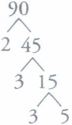
\(\therefore\) 90 = 2 x 3 x 3 x 5
4.
By division method,
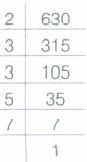
\(\therefore\) 630 = 2 x 3 x 3 x 5 x 7
5.
Yes
6.
5x5x11x13x17
7.
2 x 5 x 11 x 11 x 17
8.
2
9.
Yes
10.
Yes, it is divisible by 8 also.
11.
1, 2, 4
12.
yes
13.
1, 2, 7, 14
14.
1,5
15.
The given number will be divisible by the product of 5 and 12. i.e. it is always divisible by 5 x 12 = 60.
Note If a number is divisible by two co-prime numbers, then it is divisible by their product also.
16.
Multiples of 12 = 12, 24, 36,48,60, 72, 84, 96, 108, 120, 132, ...
Multiples of 18 = 18, 36, 54, 72,90, 108, 126, 144, ...
Hence, first three common multiples are 36, 72 and 108.
17.
Multiples of 6 = 6, 12,18, 24, 30, 36, 42, 48, 54, 60, 66,72, ...
Multiples of 8 = 8, 16, 24, 32, 40, 48, 56, 64, 72, 80,88,96, ...
Hence, first three common multiples are 24, 48 and 72.
18.
Common factors of 5, 15 and 25 are 1 and 5.
19.
Factors of 56 and 120 are as follows:
56 = 1 x 56 ; 56 = 2 x 28 ; 56 = 4 x 14; 56 = 7 x 8 and 120 = 1 x 120 ; 120 = 2 x 60; 120 = 3 x 40; 120 = 4 x 30
120 = 5 x 24; 120 = 6 x 20; 120 = 8 x 15; 120 = 10 x 12
Now, all factors of 56 = 1, 2, 4, 7, 8, 14, 28, 56 and all factors of 120 = 1, 2, 3, 4, 5, 6, 8, 10, 12, 15, 20, 24, 30, 40, 60, 120.
\(\therefore\)Common factors = 1, 2, 4, 8
Hence, common factors of 56 and 120 are 1, 2, 4 and 8.
20.
Factors of 9 and 15 are as follows:
9 = 1 x 9; 9 = 3 x 3 and 15 = 1 x 15; 15 = 3 x 5
Now, all factors of 9 = 1, 3, 9 and all factors of 15 = 1, 3, 5, 15
\(\therefore\)Common factors = 1,3
Hence, common factors of 9 and 15 are 1 and 3.
21.
(a) Factors of 8 = 1, 2, 4, 8
Factors of 25 = 1,5,25
\(\because\)8 and 25 have only 1 as common factor
\(\therefore\)8 and 25 are co-prime numbers.
(b) Factors of 4 = 1, 2, 4
Factors of 10 = 1,2,5,10
\(\because\)4 and 10 have 1,2 as common factors.
\(\therefore\)4 and 10 are not co-prime numbers.
22.

8=2x2x2x1
Factors of 8 are 1, 2, 4, 8.

12=2x2x3x1
Factors of 12 are 1, 2, 3, 4, 6, 12
Now, common factors of 8 and 12 are 1, 2, 4.
23.
Yes
24.
Yes
25.
5500 is divisible by 4.
5500 is not divisible by 8.
26.
47 + 2
27.
We have, 31 \(\Rightarrow\) 31= 3+5+23
where 3, 5 and 23 are odd prime numbers.
28.
We have, 21 \(\Rightarrow\) 21 = 3 + 5 + 13
where 3, 5 and 13 are odd prime numbers.
29.
Here, we have 32
32 = 29 +3
30.
1, 2, 3, 4, 5, 6,10,12,15,20,30,60
31.
Multiples of 9 upto 100 are as follows:
9 x 1= 9
9 x 2 = 18
9 x 3 = 27
9 x 4 = 36
9 x 5 = 45
9 x 6 = 54
9 x 7 = 63
9 x 8 = 72
9 x 9 = 81
Hence, all the multiples of 9 upto 100 are 9,18,27,36,45, 54, 63, 72, 81, 90 and 99.
32.
Multiples of 8
8 x 1= 8; 8 x 2 = 16; 8 x 3 = 24; 8 x 4 = 32; 8 x 5 = 40
\(\therefore\)First five multiples of 8 are 8, 16, 24, 32 and 40.
33.
Multiples of 5,
5 x 1= 5; 5 x 2 = 10; 5 x 3 = 15; 5 x 4 = 20; 5 x 5 = 25
\(\therefore\)First five multiples of 5 are 5, 10, 15, 20 and 25.
34.
We have, 23
23 = 1x 23
\(\therefore\)Factors of 23 are 1 and 23.
35.
We have, 18
18 = 1 x 18; 18 = 2 x 9; 18 = 3 x 6
\(\therefore\)Factors of 18 are 1, 2, 3, 6, 9 and 18
36.
We have, 20
20 = 1 x 20; 20 = 2 x 10; 20 = 4 x 5
\(\therefore\)Factors of 20 are 1, 2, 4, 5, 10 and 20.
37.
We have, 21
21 = 1 x 21; 21 = 3 x 7
\(\therefore\)Factorsof 21 are 1, 3, 7 and 21.
38.
We have, 15
15 = 1 x 15; 15 = 3 x 5
\(\therefore\)Factors of 15 are 1, 3, 5 and 15.
39.
We have, 24
24 = 1x 24; 24 = 2 x 12; 24 = 3 x 8; 24 = 4 x 6
\(\therefore\) Factors of 24 are 1, 2, 3, 4, 6, 8, 12 and 24
40.
Factor is the exact divisor of that number. So, for finding factors, we use factorisation method.
Factors of 12 = 1, 2, 3, 4, 6 and 12.
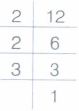
Now, for finding multiples, we multiply 12 with natural numbers.
So, first four multiples of 12 are 12 x 1, 12 x 2, 12 x 3,12 x 4
i.e. 12, 24, 36 and 48.
41.
(d)
85
42.
(d)
None of these
43.
(a)
2
44.
(c)
1648
45.
(b)
3
46.
(a)
2
47.
(a)
8. 10
48.
(b)
7x13x31x37x47
49.
(b)
2x3x7x7x7x11=22638
50.
(e)
None of the given number is divisible by 8 and 12
51.
(d)
None of these
52.
(a)
7249
53.
(a)
2592
54.
(b)
34678
55.
(d)
83

6th Standard CBSE Syllabus & Materials
6th Standard CBSE
CBSE 6th Social Science Locating Places on the Earth - New Sample Question Papers Study Material - QB365 Set A
NEW6th Standard CBSE
CBSE 6th Science A Journey Through States of Water - New Sample Question Papers Study Material - QB365 Set A
NEW6th Standard CBSE
CBSE 6th Science Temperature and its Measurement - New Sample Question Papers Study Material - QB365 Set A
NEW6th Standard CBSE
CBSE 6th Science Materials Around Us - New Sample Question Papers Study Material - QB365 Set A



NCERT Books

Syllabus

Exam Pattern

Sample Question Papers

Previous year Question Papers

Important Notes

MCQ Practice test

NCERT Exemplers

Case study Questions

Image Based Questions

Passage based Questions

HOT Questions

Value Based Questions

Model Questions Papers
NCERT ( Book Back ) Questions

Assertion and Reason
Important Questions And Answers

CBSE 6th Standard CBSE Subjects
CBSE Standards


