
 100% FREE ACCESS
6th Standard CBSE Syllabus & Materials
6th Standard CBSE
CBSE 6th Social Science The Value of Work - New Sample Question Papers Study Material - QB365 Set A
NEW6th Standard CBSE
CBSE 6th Social Science Family and Community - New Sample Question Papers Study Material - QB365 Set A
NEW6th Standard CBSE
CBSE 6th Social Science India's Cultural Roots - New Sample Question Papers Study Material - QB365 Set A
NEW6th Standard CBSE
CBSE 6th Social Science India,That is Bharat - New Sample Question Papers Study Material - QB365 Set A
NEW6th Standard CBSE
CBSE 6th Social Science Timeline and sources of history - New Sample Question Papers Study Material - QB365 Set A
NEW6th Standard CBSE
CBSE 6th Social Science Oceans and Continents - New Sample Question Papers Study Material - QB365 Set A

Published on: 24/10/2025
Download CBSE Class 6th Standard CBSE Mathematics question papers, sample papers, important questions, and previous year solved papers in PDF format. Get free study materials, NCERT solutions, and exam preparation resources for Class 6th Standard CBSE Mathematics
Questions + Answers key
Take MCQ Mathematics Test
1.
Find the product of first natural, first whole and first prime number.
2.
Write down separately the prime and composite numbers less than 20.
3.
Is 27 a factor of 5427?
4.
Write all the factors of the following number: 20
5.
Write all the factors of the following number: 21
6.
Smallest odd prime number
7.
Quotient when zero is divided by any non-zero whole number
8.
25
9.
15
10.
35
11.
If the sum of the digits of a number is divisible by 3, then the number itself is divisible by 9.
12.
A number with three or more digits is divisible by 6 if the number formed by its last two digits (i.e. ones and tens) is divisible by 6.
13.
All even numbers are composite numbers.
14.
Sum of two prime numbers is always even.
15.
All prime numbers are odd.
16.
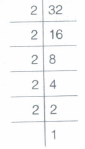
Write all the factors of 32
17.
Write five pairs of prime numbers less than 20, whose sum is divisible by 5.
18.
The greatest 2-digit prime number is ___________
19.
The LCM of 12 and 15 is __________
20.
The common factor of 25 and 30 is ___________
21.
A number for which the sum of all its factors is equal to twice the number is called a ________________number.
22.
The smallest even number is__________
23.
The LCM of 12, 24, 32 is
92
86
27
96
24.
A number is divisible by 5 and 6. It may not be divisible by
10
15
30
85
25.
State which of the following is correct prime factorisation of the numbers.
7x13x31x37x46
7x13x31x37x47
26.
Which of the following is divisible by both 8 and 12?
1312
1626
1612
1926
None of the given number is divisible by 8 and 12
27.
Using divisibility tests, determine which of the following numbers is divisible by 2?
315623
34678
789
2651
28.
Find a 4-digit odd number using each of digits 1, 2, 4 and 5 only once such that when the first and last digits are interchanged, it is divisible by 4.
1.
0
2.
Prime numbers are those numbers whose only factors are 1 and the number itself.
So, prime numbers less than 20 are 2,3,5,7,11,13, 17 and 19.
Composite numbers are those numbers which have more than two factors.
So, composite numbers less than 20 are 4,6,8,9, 10, 12,14,15,16 and 18.
3.
Yes
4.
We have, 20
20 = 1 x 20; 20 = 2 x 10; 20 = 4 x 5
\(\therefore\)Factors of 20 are 1, 2, 4, 5, 10 and 20.
5.
We have, 21
21 = 1 x 21; 21 = 3 x 7
\(\therefore\)Factorsof 21 are 1, 3, 7 and 21.
6.
()
3
7.
()
0
8.
()
factor of 50
9.
()
factor of 30
10.
()
multiple of 7
11.
(b)
12.
(b)
13.
(b)
14.
(b)
15.
(b)
16.
Factors of 32 = 1,2,4,8, 16 and 32
17.
Prime numbers less than 20 are 2, 3, 5, 7, 11, 13, 17 and 19.
Here,
2 + 3 = 5 (divisible by 5)
2 + 13 = 15 (divisible by 5)
3 + 7 = 10 (divisible by 5)
3 + 17 = 20 (divisible by 5)
7 + 13 = 20 (divisible by 5)
Hence, five pairs of prime numbers, whose sum is divisible by 5 are
(i) 2, 3 (ii) 2, 13 (iii) 3, 7 (iv) 3,17 (v) 7, 13
18.
()
97
19.
()
60
20.
()
5
21.
()
Perfect Number
22.
()
2
23.
(d)
96
24.
(d)
85
25.
(b)
7x13x31x37x47
26.
(e)
None of the given number is divisible by 8 and 12
27.
(b)
34678
28.
The 4-digit number will be an odd number, if the unit place digit is an odd number (i.e. 1 or 5).
Total such odd numbers are,
4125,4215,1245,1425,2145,2415,4251,4521,5241,5421,2451,2541.
Also we know that, any 4-digit number is divisible by 4,if the last two digit number is divisible by 4.
Consider a number 4521, if we interchange the first and the last digit, the new number will be 1524. Here, we see that the last two digit (i.e. 24) is divisible by 4. So, the number 1524 is divisible by 4. Hence, the required 4-digit number is 4521.

6th Standard CBSE Syllabus & Materials
6th Standard CBSE
CBSE 6th Social Science Locating Places on the Earth - New Sample Question Papers Study Material - QB365 Set A
NEW6th Standard CBSE
CBSE 6th Science A Journey Through States of Water - New Sample Question Papers Study Material - QB365 Set A
NEW6th Standard CBSE
CBSE 6th Science Temperature and its Measurement - New Sample Question Papers Study Material - QB365 Set A
NEW6th Standard CBSE
CBSE 6th Science Materials Around Us - New Sample Question Papers Study Material - QB365 Set A



NCERT Books

Syllabus

Exam Pattern

Sample Question Papers

Previous year Question Papers

Important Notes

MCQ Practice test

NCERT Exemplers

Case study Questions

Image Based Questions

Passage based Questions

HOT Questions

Value Based Questions

Model Questions Papers
NCERT ( Book Back ) Questions

Assertion and Reason
Important Questions And Answers

CBSE 6th Standard CBSE Subjects
CBSE Standards


