
 100% FREE ACCESS
6th Standard CBSE Syllabus & Materials
6th Standard CBSE
CBSE 6th Social Science The Value of Work - New Sample Question Papers Study Material - QB365 Set A
NEW6th Standard CBSE
CBSE 6th Social Science Family and Community - New Sample Question Papers Study Material - QB365 Set A
NEW6th Standard CBSE
CBSE 6th Social Science India's Cultural Roots - New Sample Question Papers Study Material - QB365 Set A
NEW6th Standard CBSE
CBSE 6th Social Science India,That is Bharat - New Sample Question Papers Study Material - QB365 Set A
NEW6th Standard CBSE
CBSE 6th Social Science Timeline and sources of history - New Sample Question Papers Study Material - QB365 Set A
NEW6th Standard CBSE
CBSE 6th Social Science Oceans and Continents - New Sample Question Papers Study Material - QB365 Set A

Published on: 24/10/2025
Download CBSE Class 6th Standard CBSE Mathematics question papers, sample papers, important questions, and previous year solved papers in PDF format. Get free study materials, NCERT solutions, and exam preparation resources for Class 6th Standard CBSE Mathematics
Questions + Answers key
Take MCQ Mathematics Test
1.
Observe the pattern in the following statement:
31 x 39 = 13 x 93
The two numbers on each side are co-prime and are obtained by reversing the digits of respective numbers. Try to write some more pairs of such numbers.
2.
What is the measure of an angle whose bisector makes an angle of a right angle?
3.
What are the different methods to draw a perpendicular bisector of a line?
4.
Given, two different lengths as 8.1 cm and 3.4 cm. Construct a length equal to the difference of these two lengths. Measure the new length.
5.
Draw two circles such that they intersect at two points and their centres lie on the circumference of the other circle. What will be the radius of the circles?
6.
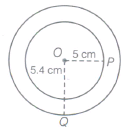
With same centre O, draw two circles of radii 5 cm and 5.4 cm.
7.
The ratio of income to expenditure of Mr. Natarajan is 7: 5. if he saves Rs 2000 a month, what could be his income?
8.
Two boatmen start simultaneously from the opposite shores of a river and they cross each other after 45 minutes of their starting from the respective shores. They rowed till they reached the opposite shore and returned immediately after reaching the shores. When will they cross each other again?
9.
How will you construct a 90° angle?
10.
Draw PO of length 7 cm and find its axis of symmetry.
11.
Given, a circle of r = 3 cm. Draw two perpendicular diameters AB and CD. Join the endpoints of the diameters. State the name of the quadrilateral so formed.
12.
Draw a circle of radius 4 cm. Draw the longest chord. Will it pass through the centre, if yes, what is the name such chord?
13.
Draw a line segment of length 7.3 cm using a ruler.
14.
If the diameter of a circle is 16 cm, then what will be its radius?
16 cm
10 cm
8 cm
None of these
15.
Which of the following angles can be drawn with the help of a compass?
20°
40°
60°
80
16.
Perpendicular bisector of a line segment
is perpendicular to it
divides it into two equal parts
Both (a) and (b) are true
None of the above
17.
The instrument in the geometry box having the shape of a triangle is called a
protractor
compasses
divider
set-square
18.
The line of symmetry of a line segment is the __________ bisector of the line segment.
19.
An angle having degree measure as 90° is called ___________.
20.
Circles, which have the same centre and different radii are called _________ circles.
21.
A chord of a circle divide the circle into two parts, where each part is called an __________ of the circle.
22.
A diameter of a circle is the _________ chord of the circle.
23.
A chord of a circle is a line segment with its ends point ___________.
24.
If one counts one for the thumb, two for the index finger, three for the middlefinger,four for the ring finger, five for the little finger and continues counting backwards, six for the ring finger, seven for the middle finger, eight for the index finger, 9 for the thumb, tenfor the index finger, elevenfor the middle finger, twelvefor the ring finger, thirteenfor the little finger, fourteen for the ring finger and so on. Which finger will be counted as one thousand ?
25.
Which two digit numbers when added to 27 get reversed?
26.
Get 100 using four 9's and some of the symbols like +, ÷ x, etc.
1.
Another pair of such numbers is
13 x 62 = 31 x 26.
2.
The required angle is 180o.
3.
(i) By paper folding
(ii) By using ruler and compasses.
4.
4.7 cm.
5.
Radius of the circles will be equal.
6.
Here, given the radii of two circles are 5 cm and 5.4 cm.
7.
Ratio of income to expenditure = 7 : 5
Let the income and expenditure per month be Rs 7x and 5x respectively.
Then, saving per month = Rs 7x - Rs 5x = Rs 2x
According to the question,
2x= 2000
⇒ x =\(\frac{2000}{2}\) =1000
⇒ 7x = 7 x 1000 = 7000
Hence, his income is Rs 7000 per month.
8.
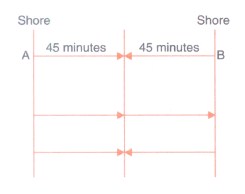
The conditions remaining the same, they will cross each other again after 45 + 45 = 90 minutes.
9.
Construct a perpendicular to a line from a point on it.
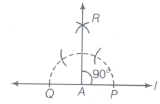
Here, \(\angle\)PAR = 90o.
10.
We know that, perpendicular bisector of a line segment is its axis of symmetry.
Step I Draw a line segment \(\bar{PQ}\) = 7 cm.
Step II With P and 0 as centres and radius more than half of \(\bar{PQ}\), draw two arcs which intersect each other at A and B.
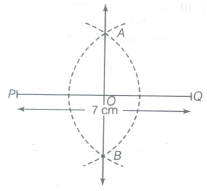
Step III Join A and B.
Thus, AB is the axis of symmetry of \(\bar{PQ}\).
11.
Given, radius of circle is 3 cm.
Steps of construction are as follows:
Step I Draw a circle of radius 3 cm.
Step II Draw two perpendicular diameters AB and CD.
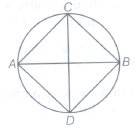
Step III Join A and D, D and B, Band C and A and C.
Thus, quadrilateral ABCD is a square.
12.
Longest chord is diameter. Yes, it will pass through the centre.
13.
In order to construct a line segment of length 7.3 cm using a ruler, we use the following steps:
Step I Mark a point A on the paper and place the ruler so that zero mark of the ruler is at A.
Step II Mark with a pencil a point B against the mark on the ruler which indicates 7.3 cm.
Step III Join the points A and B by moving the tip of the pencil against the straight edge of the ruler.
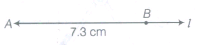
The line segment AB, so obtained is the required line segment of length 7.3 cm.
14.
(c)
8 cm
15.
(c)
60°
16.
(c)
Both (a) and (b) are true
17.
(d)
set-square
18.
()
perpendicular
19.
()
right angle
20.
Circles which have the same centre and different radii are called concentric circles.
.png)
21.
A chord of a circle divides the circle into two parts, where each part is called a segment of the circle.
.png)
22.
()
longest
23.
()
circumference
24.
| Thumb | 1 | 9 | 17 | 25 | 33 | 41 | 49 | ||||||
| Index Finger | 2 | 8 | 10 | 16 | 18 | 24 | 26 | 32 | 34 | 40 | 42 | 48 | 50 |
| Middle Middle | 3 | 7 | 11 | 15 | 19 | 23 | 27 | 31 | 35 | 39 | 43 | 47 | 51 |
| Ring Finger | 4 | 6 | 12 | 14 | 20 | 22 | 28 | 30 | 36 | 38 | 44 | 46 | 52 |
| Little Finger | 5 | 13 | 21 | 29 | 37 | 45 | 53 |
The unit's digit is 0 only in the numbers in front of Index Finger and Ring Finger. Moreover, the greater numbers with 0 as the unit's digit come in front of Index Finger before Ring Finger.
Hence, 1000 will come in front of Index Finger.
25.
Let in the two digit number to be added,
Unit's digit = x and, ten's digit = y
Then, the number to be added = 10y + x
On reversing the digits,
Unit's digit = y and, ten's digit = x
∴ The number to be added = 10x + y
According to the question,
27 + (10y + x) = 10x + y
⇒ 9x- 9y = 27
⇒ x-y=3
⇒ x=y+3
When y = I, x = 4 ∴ Number = 14
When y = 2, x = 5 ∴ Number = 25
When y = 3, x = 6 ∴ Number=36
When y = 4, x = 7 ∴ Number = 47
When y = 5, x = 8 ∴ Number = 58
When y = 6, x = 9 ∴ Number = 69
Hence, the required two digit numbers are 14, 25, 36, 47, 58, 69.
26.
()
99+\(\frac{9}{9}\) =100

6th Standard CBSE Syllabus & Materials
6th Standard CBSE
CBSE 6th Social Science Locating Places on the Earth - New Sample Question Papers Study Material - QB365 Set A
NEW6th Standard CBSE
CBSE 6th Science A Journey Through States of Water - New Sample Question Papers Study Material - QB365 Set A
NEW6th Standard CBSE
CBSE 6th Science Temperature and its Measurement - New Sample Question Papers Study Material - QB365 Set A
NEW6th Standard CBSE
CBSE 6th Science Materials Around Us - New Sample Question Papers Study Material - QB365 Set A



NCERT Books

Syllabus

Exam Pattern

Sample Question Papers

Previous year Question Papers

Important Notes

MCQ Practice test

NCERT Exemplers

Case study Questions

Image Based Questions

Passage based Questions

HOT Questions

Value Based Questions

Model Questions Papers
NCERT ( Book Back ) Questions

Assertion and Reason
Important Questions And Answers

CBSE 6th Standard CBSE Subjects
CBSE Standards


