
 100% FREE ACCESS
6th Standard CBSE Syllabus & Materials
6th Standard CBSE
CBSE 6th Social Science The Value of Work - New Sample Question Papers Study Material - QB365 Set A
NEW6th Standard CBSE
CBSE 6th Social Science Family and Community - New Sample Question Papers Study Material - QB365 Set A
NEW6th Standard CBSE
CBSE 6th Social Science India's Cultural Roots - New Sample Question Papers Study Material - QB365 Set A
NEW6th Standard CBSE
CBSE 6th Social Science India,That is Bharat - New Sample Question Papers Study Material - QB365 Set A
NEW6th Standard CBSE
CBSE 6th Social Science Timeline and sources of history - New Sample Question Papers Study Material - QB365 Set A
NEW6th Standard CBSE
CBSE 6th Social Science Oceans and Continents - New Sample Question Papers Study Material - QB365 Set A

Published on: 24/10/2025
Download CBSE Class 6th Standard CBSE Mathematics question papers, sample papers, important questions, and previous year solved papers in PDF format. Get free study materials, NCERT solutions, and exam preparation resources for Class 6th Standard CBSE Mathematics
Questions + Answers key
Take MCQ Mathematics Test
1.
Are the ratio 10 g : 40 g and 25 kg : 100 kg in proportion?
2.
The yield of wheat from 8 hectares of land is 360 quintals. Find the number of hectares of land required for a yield of 540 quintals.
3.
Determine, if the following are in proportion.
33,44,75,100
4.
Find the ratio of the following.
30 min to 45 min
5.
In a class, there are 40 boys and 80 girls. What is ratio of the number of boys to the number of girls?
6.
Prepare five similar problems and ask your friends to solve them.
Five similar problems are as follows:
1. Meenu purchased 2 handkerchiefs for Rs. 30. Find the cost of one handkerchief.
2. The cost of 3 kg rice is Rs. 600. Find the cost of 1kg rice.
3. The cost of 5 combs is Rs. 30. Find the cost of 1 comb.
4. The cost of 12 envelopes is Rs. 60. Find the cost of 1envelope.
5. The cost of 8postcards is Rs. 8. Find the cost of 1postcard.
7.
In a book shelf, the number of books on Social Studies to the number of books on Economics is 7 : 11, whereas the number of books on Economics to the number of books on Mathematics is 22 : 19. What is ratio of the number of Social Studies books to the Mathematics books?
8.
Determine, if the following ratios form a proportion or not?
(a) 2 : 3 and 4 : 5
(b) 25 g : 200 g and 6 kg : 48 kg
(c) 440 m : 2 km and 55 cm : 3 m
(d) 200 mL : 2.5 L and Rs. 4: Rs.50
9.
Determine, if the following ratios form a proportion.Also, write the middle term and extreme terms, where the ratios form a proportion.
(a) 25 cm : 1 m and Rs.40 : Rs.160
(b) 39 L : 65 L and 6 bottles: 10 bottles
(e) 2 kg: 80 kg and 25 g: 625 g
(d) 200mL : 2.5 L and Rs.4 : Rs.50
10.
In a college, out of 4320 students, 2300 are girls. Find the ratio of
(a) number of girls to the total number of students.
(b) number of boys to the number of girls.
(c) number of boys to the total number of students.
11.
See the figure and find the ratio of
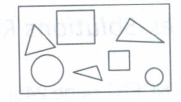
(a) number of triangles to the number of circles inside n the rectangle.
(b) number of squares to all the figures inside the rectangle.
(c) number of circles to all the figures inside the rectangle.
12.
Anish made 42 runs in 6 overs and Anup made 63 runs in 7 overs. Who made more runs per over?
13.
If the cost of 7 m of cloth is Rs. 294, find the cost of 5 m of cloth.
14.
Determine, if the following are in proportion.
33,121,9,96
15.
Cost of a dozen pens is Rs.180 and cost of 8 ball pens is Rs. 56. Find the ratio of the cost of a pen to the cost of a ball pen.
16.
Find the ratio of the following.
30 min to 1.5 h
17.
The ratio 4 : 16 is in its lowest form.
18.
If 10: 30 :: 40 : x, then the value of x is 120.
19.
15 m : 40 m = 40 cm : 80 cm
20.
32 m:64 m=6 s:12 s
21.
5.2 : 3.9 : : 3 : 4
22.
16 : 24 : : 20 : 30
23.
150 kg of oil can be filled in 10 containers. To fill 750 kg of oil, how many containers will be required?
10
20
40
50
24.
the salary of a month of an employee is Rs. 4000. The annual salary of the employee is
Rs. 48000
Rs. 24000
Rs. 12000
Rs. 8000
25.
The cost of 3 envelopes is Rs. 15. The cost of 10 envelopes is
Rs. 20
Rs. 30
Rs. 45
Rs. 50
26.
Which of the following statement is not true?
4 : 7 = 5: 9
Rs. 5 : Rs. 25 = 12 g : 60 g
30 : 80 = 6 : 16
12 : 36 = 14 : 42
27.
Which of the following are in proportion?
2,3,20,30
3,4,15,18
1,3,1,11,22
2,5,40,80
28.
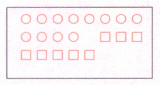
Find the ratio of number of circles and number of squares inside the following rectangle:
3:1
2:1
2:3
3:2
29.
The length and breadth of a rectangular park are 50 m and 40 m respectively. Find the ratio of the length to the breadth of the park.
4:5
4:1
5:1
5:4
30.
The monthly salary of Hari Kishan is Rs. 80000. The monthly salary of Manish is Rs. 40000. How many times of the salary of Manish is the salary of Hari Kishan?
2 times
4 times
3 times
8 times.
31.
In a school library, the ratio of Mathematics books to Science books is same as the ratio of Science books to Hindi books. If there are 450 books of Science and 300 books of Hindi, then find the number of books in Mathematics
720
675
300
450
32.
The ratio of the number of sides of a triangle to the number of edges of a cube is
4: 1
1 : 4
1 : 3
2: 3
33.
Ratio of 5 paise to 25 paise is the same as the ratio of 20 paise to ______________
34.
Sleeping time of a python in a 24h clock is represented by the unshaded portion in figure.
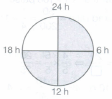
The ratio of sleeping time to the awaking time is ___________
35.
See the figure and fill in the blanks.
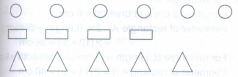
The ratio of the number of circles to that of triangles is ____________
36.
See the figure and fill in the blanks.
The ratio of the number of rectangles to the circles is __________
1.
We have,10 g:40 g \(=\frac{10}{40}=1:4\)
and 25 kg: 100 kg \(=\frac{25}{100}=1:4\)
So, they are in proportion.
2.
Required area to yield 360 quintals wheat = 8 hectares of land
\(\therefore\) To yield 1 quintal wheat, required area \(=\frac{8}{360}\) hectares
\(\therefore\) To yield 540 quintals wheat, required area \(=540\times\frac{8}{360}\) hectares \(\frac{3\times8}{2}\) hectares = 12 hectares of land.
3.
33,44,75 and 100 are in proportion.
4.
Ratio=2:3
5.
Given that, number of boys = 40 and number of girls = 80
Ratio of number of boys to the number of girls \(=\frac{Number\ of\ boys}{Number\ of\ girls}=\frac{40}{80}=\frac{1}{2}=1:2\)
6.
1. \(\because\) Cost of 2 handkerchiefs = Rs. 30
\(\therefore\) Cost of 1 handkerchief = Rs. \(\frac { 30 }{ 2 } \) = 15
2. \(\because\) Cost of 3 kg rice = Rs. 600
\(\therefore\) cost of 1 kg rice = Rs. \(\frac { 600 }{ 3 } \)=200
3. \(\because\) Cost of 5 combs = Rs. 30
\(\therefore\) Cost of 1 comb = Rs. \(\frac { 30 }{ 5 } \) = Rs. 6
4. \(\because\) Cost of 12 envelopes = Rs. 60
\(\therefore\) Cost of 1 envelope = Rs. \(\frac { 60 }{ 12 } \) = Rs. 5
5. \(\because\) Cost of 8 postcards = Rs. 8
\(\therefore\)Cost of 1 postcard = Rs. \(\frac { 8 }{ 8 } \) = Rs. 1
7.
14 : 19
8.
(a) \(2:3=\frac{2}{3}\ and\ 4:5=\frac{4}{5}\)
2: 3 and 4: 5 are not equal, therefore ratios are not in proportion.
(b) \(25 g:200g=\frac{25}{200}=\frac{1}{8}=1:8\)
\(6kg:48kg=\frac{6}{48}=\frac{1}{8}=1:8\)
Hence, they form a proportion.
(c) \(440m:2km=\frac{440}{2000}[\because1\ km=1000\ m]\)
\(=\frac{11}{50}=11:50\)
\(55\ cm:3 m=\frac{55}{300}=\frac{11}{60}=11:60\)
So, they are not in proportion.
(d) \(200 mL:2.5 L=\frac{200}{2500}=\frac{2}{25}=2:25\)
\(Rs.4:Rs.50=\frac{4}{50}=\frac{2}{25}=2:25\)
So, they are in proportion.
9.
(a) Here, 25 cm : 1 m = 25 cm : 1 x 100 cm [\(\because\)1 m=100em]
= 25 cm: 100 cm
\(=25:100=\frac{25}{100}=\frac{25\div25}{100\div25}=\frac{1}{4}=1:4\)
[dividing numerator and denominator both by 25]
and Rs.40:Rs.160=40:160=\(\frac{40}{160}=\frac{4}{16}=\frac{1}{4}=1:4\)
[dividing numerator and denominator both by 10]
Here, 1: 4 = 1: 4 i.e. 25 cm : 1 m = Rs.40 : Rs.160
So, the ratios of 25 cm : 1 m and Rs.40 : Rs.160 are in proportion.
i.e. 25 cm : 1 m: : Rs.40 : Rs.160
Now, middle terms are 1 m and Rs.40 and extreme terms are 25 cm and Rs.160.
(b) Here,39L:65L=39:65=\(\frac{39}{65}\)
\(=\frac{39\div13}{65\div13}\) [\(\because\) HCF of 39 and 65 = 13]
\(=\frac{3}{5}=3:5\)
and 6 bottles: 10 bottles = 6 :10 \(=\frac{6}{10}\)
\(=\frac{6\div2}{10\div2}=\frac{3}{5}=3:5\)
[dividing numerator and denominator both by 2]
Here, 3 : 5 = 3 :5 i.e. 39 L : 65 L = 6 bottles: 10 bottles.
So, the ratio of 39 L : 65 Land 6 bottles: 10 bottles are in proportion.
i.e. 39 L : 65 L : : 6 bottles: 10 bottles
Now, middle terms of ratios are 65 Land 6 bottles and extreme terms of ratios are 39 Land 10 bottles.
(c) Here, 2kg:80kg=2:80=\(=\frac{2}{80}=\frac{2\div2}{80\div2}=\frac{1}{40}=1:40\)
[dividing numerator and denominator both by 2]
and 25 g : 625 g = 25 :625 \(=\frac{25}{625}=\frac{25\div25}{625\div25}=\frac{1}{25}=1:25\)
[\(\because\)HCF of 25 and 625 = 5 X 5 = 25]
Since, both ratios are not equal.
\(\therefore\) 2 kg : 80 kg \(\ne\) 25 g : 625 g
Hence, the given ratios are not in proportion.
(d) Here, 200mL:2.5L=200 \(\times\frac{1}{1000}L:2.5\ L\)
\([\because\ 1\ mL=\frac{1}{1000}L]\)
\(=\frac{200}{1000}L:2.5L=0.200L:2.5L\)
\(=0.200:2.5=\frac{0.200}{2.5}=\frac{2}{25}=2:25\)
[multiplying numerator and denominator both by 10]
and Rs.4:Rs.50=4:50=\(\frac{4}{50}=\frac{4\div2}{50\div2}=\frac{2}{25}=2:25\)
[dividing numerator and denominator both by 2]
Here, 2 : 25 = 2 : 25 i.e. 200 mL : 2.5 L = Rs. 4 : Rs.50
So, the ratios of 200 mL : 2.5 L and Rs. 4 : Rs. 50 are in proportion.
i.e. 200 mL : 2.5 L: : Rs.4 : Rs. 50
Now, middle terms of ratios are 2.5 L and Rs.4 and extreme terms of ratios are 200 mL and Rs.50.
10.
Given, number of girls = 2300
and total number of students = 4320
\(\therefore\) Number of boys = Total number of students - N umber of girls
= 4320 - 2300 = 2020
(a) Ratio = 115: 216
(b) Ratio = 101: 115
(c) Ratio = 101: 216
11.
In the given figure,
Number of triangles = 3; Number of squares = 2
Number of circles = 2
\(\therefore\) Total number of figures = 3 + 2 + 2 = 7
(a) Required ratio of number of triangles to the number of circles \(=\frac{Number\ of\ triangles}{Number\ of\ circles}=\frac{3}{2}=3:2\)
(b) Required ratio of number of squares to all the figure \(=\frac{Number\ of\ squares}{Total\ number\ of\ figures}=\frac{2}{7}=2:7\)
(c) Required ratio of number of circles to all the figure \(=\frac{Number\ of\ circles}{Total\ number\ of\ figures}=\frac{2}{7}=2:7\)
12.
Runs made by Anish in 6 overs = 42
\(\therefore\) Runs made by Anish in 1 over \(=\frac{42}{6}=7\)
Runs made by Anup in 7 overs = 63
\(\therefore\) runs made by Anup in 1 over \(=\frac{63}{7}=9\)
\(\because\) 9>7
Hence, Anup made more runs per over.
13.
Given, cost of 7 m of cloth = Rs. 294
\(\therefore\) Cost of 1 m of cloth \(=Rs.\frac{294}{7}=Rs.42\)
\(\therefore\) Cost of 5 m of cloth = Rs.42 X 5 = Rs. 210
Hence, the cost of 5 m of cloth is Rs. 210.
14.
We have, 33,121,9,96
\(\therefore\) Ratio of 33 to 121 \(=\frac{33}{121}=\frac{33\div11}{120\div11}\) [\(\because\) HCF of33 and 121= 11]
\(=\frac{3}{11}=3:11\)
and ratio of9 to 96 = \(\frac{9}{96}=\frac{9\div3}{96\div3}\)
[\(\because\)HCF of 9 and 96 = 3]
\(=\frac{3}{32}=3:32\)
Here, 3 : 11 \(\ne\)3 : 32 i.e. 33: 121 \(\ne\)9: 96
Therefore, 33,121,9 and 96 are not in proportion.
15.
Given, cost of 12 pens = Rs.180
\(\therefore\ Cost\ of\ 1\ pen=\frac{Total\ cost\ of\ pens}{Number\ of\ pens}=Rs.\frac{180}{12}=Rs.15\) [\(\because\)1 dozen = 12 units]
Also given, cost of 8 ball pens = Rs.56
\(\therefore\ Cost\ of\ 1\ ball\ pen=\frac{Total\ cost\ of\ ball\ pens}{Number\ of\ ball\ pens}=\frac{Rs.15}{Rs.7}=\frac{15}{7}=15:7\)
16.
Here,we have to convert 1.5 h into min.
We know that, 1h=60 min
\(\therefore\) 1.5 h=1.5 \(\times\) 60 min=90 min
\(\therefore\ Required ratio=\frac{30\ min}{90\ min}=\frac{30}{90}\)
\(\because\) 30 = 2 X 3 X 5 and 90 = 2 X 3 X 5 X 3
\(\therefore\) HCF 30 and 90 = 2 X 3 X 5 = 30
\(Ratio=\frac{30\div30}{90\div30}=\frac{1}{3}=1:3\)
17.
(b)
18.
(a)
19.
(b)
20.
(a)
21.
(b)
22.
(a)
23.
\(\frac { 10 }{ 150 } \times 750\) = 50
24.
1 year = 12 months
4000x12 = 48000
25.
\(\frac { 15 }{ 3 } \times 25\) = 50
26.
4 : 7 = \(\frac { 4 }{ 7 } \)
5 : 9 = \(\frac { 5 }{ 9 } \)
\(\frac { 4 }{ 7 } \neq \frac { 5 }{ 9 } \)
27.
2:3=20:30
28.
12:8 = \(\frac { 12 }{ 8 } =\frac { 12\div 4 }{ 8\div 4 } =\frac { 3 }{ 2 } \)=3:2
29.
\(\frac { 50 }{ 40 } =\frac { 5 }{ 4 } \)=5:4
30.
80000=2x40000
31.
(b)
675
32.
(b)
1 : 4
33.
()
100
34.
()
1:3
35.
()
6:5
36.
()
2:3

6th Standard CBSE Syllabus & Materials
6th Standard CBSE
CBSE 6th Social Science Locating Places on the Earth - New Sample Question Papers Study Material - QB365 Set A
NEW6th Standard CBSE
CBSE 6th Science A Journey Through States of Water - New Sample Question Papers Study Material - QB365 Set A
NEW6th Standard CBSE
CBSE 6th Science Temperature and its Measurement - New Sample Question Papers Study Material - QB365 Set A
NEW6th Standard CBSE
CBSE 6th Science Materials Around Us - New Sample Question Papers Study Material - QB365 Set A



NCERT Books

Syllabus

Exam Pattern

Sample Question Papers

Previous year Question Papers

Important Notes

MCQ Practice test

NCERT Exemplers

Case study Questions

Image Based Questions

Passage based Questions

HOT Questions

Value Based Questions

Model Questions Papers
NCERT ( Book Back ) Questions

Assertion and Reason
Important Questions And Answers

CBSE 6th Standard CBSE Subjects
CBSE Standards


