
 100% FREE ACCESS
6th Standard CBSE Syllabus & Materials
6th Standard CBSE
CBSE 6th Social Science The Value of Work - New Sample Question Papers Study Material - QB365 Set A
NEW6th Standard CBSE
CBSE 6th Social Science Family and Community - New Sample Question Papers Study Material - QB365 Set A
NEW6th Standard CBSE
CBSE 6th Social Science India's Cultural Roots - New Sample Question Papers Study Material - QB365 Set A
NEW6th Standard CBSE
CBSE 6th Social Science India,That is Bharat - New Sample Question Papers Study Material - QB365 Set A
NEW6th Standard CBSE
CBSE 6th Social Science Timeline and sources of history - New Sample Question Papers Study Material - QB365 Set A
NEW6th Standard CBSE
CBSE 6th Social Science Oceans and Continents - New Sample Question Papers Study Material - QB365 Set A

Published on: 24/10/2025
Download CBSE Class 6th Standard CBSE Mathematics question papers, sample papers, important questions, and previous year solved papers in PDF format. Get free study materials, NCERT solutions, and exam preparation resources for Class 6th Standard CBSE Mathematics
Questions + Answers key
Take MCQ Mathematics Test
1.
Can you think of some more examples where you have to divide a number of things in some ratio? Frame three such examples and ask your friends to solve them.
Father gave ( 150 to the two brothers and asked to take their shares in the ratio 2 : 3. How much money will each of the two brothers get?
2.
30% of Zuben's house area is equal to 40% of Seema's house area. Express as a ratio, Zuben's house area to Seema's house area.
3.
Write the following ratios in the simplest form.
2 cm to 4 m
4.
The yield of wheat from 8 hectares of land is 360 quintals. Find the number of hectares of land required for a yield of 540 quintals.
5.
What is the relation between terms of a proportion?
6.
Are the ratios 45 : 60 and 36 : 48 in proportion?
7.
Find two equivalent ratios of 2 : 7.
8.
Find the ratio of the following.
33 km to 121 km
9.
Rohan walks 12 km in an hour while Rakesh walks 8 km in an hour. What is the ratio of the distance covered by Rohan to the distance covered by Rakesh?
10.
Give two equivalent ratios of 3 : 5.
11.
Consider this situation. Raju went to the market to purchase tomatoes. One shopkeeper tells him that the cost of tomatoes is Rs. 40 for 5 kg. Another shopkeeper gives the cost as 6 kg for Rs. 42. Now, what should Raju do? Should he purchase tomatoes from the first shopkeeper or from the second? Will the comparison by taking the difference help him decide? No, why not? Think of some way to help him. Discuss with your friends.
12.
The sides of a triangle are in the ratio 2 : 3 : 5. If the total perimeter of the triangle is 70 cm, then find the length of the longest side.
13.
School starts at 7 : 00 am and gets over at 12: 30 pm. If the break time is from 9 : 50 am to 10 : 10 am. What is the ratio of the break time to the total time the students spend at school?
14.
Reshma prepared 18 kg of burfi by mixing khoya with sugar in the ratio of 7 : 2. How much khoya did she use?
15.
If the ratio between 72 and y is same as the ratio between 64 and x, then what is the ratio between x and y?
16.
Check whether the given ratios are equal, i.e. they are in proportion. If yes, then write them in the proper form. 1 : 5 and 3 : 15
17.
If the side of an equilateral triangle is same as the side of a square, then find the ratio of the perimeter of the triangle and square.
18.
Find the ratio of the following.
500 mL to 2 L
19.
In a school, there were 73 holidays in one year. What is the ratio of the number of holidays to the number of days in one year?
20.
Ravi walks 6 km in an hour while Roshan walks 4km in an hour. What is the ratio of the distance coveredby Ravi to the distance covered by Roshan?
21.
A recipe calls for 1 cup of milk for every \(2\frac{1}{2}\) cups of flour to make a cake that would feed 6 persons. How many cups of both flour and milk will be needed to make a similar cake for 8 people?
22.
In a club having 100 members, 20 play carom, 24 play table tennis, 16 play badminton and the remaining do not play any game (no member plays more than one game). Find the ratio of the number of members who play
(a) carom to the numbers of those, who play table tennis.
(b) badminton to the number of those, who play carom.
(c) table tennis to the number of those, who play badminton.
(d) badminton to the number of those, who do not play any game.
23.
A cloth is cut into three pieces in the ratio 3 : 5 : 9. If the smallest piece is 45 m long, then what is value of the total piece of cloth?
24.
There are 102 teachers in a school of 3300 students. Find the ratio of the number of teachers to the number of students.
25.
There are 20 girls and 15 boys in a class.
(a) What is the ratio of number of girls to the number of boys?
(b) What is the ratio of number of girls to the total number of students in the class?
26.
The cost of 8 almirahs is Rs. 8000. The cost of 1 almirah is
Rs. 1000
Rs. 2000
Rs. 4000
Rs. 6000
27.
the salary of a month of an employee is Rs. 4000. The annual salary of the employee is
Rs. 48000
Rs. 24000
Rs. 12000
Rs. 8000
28.
A car requires 5 litres of petrol to cover 80 km. How many litres of petrol are required to cover 32 km?
1
2
3
4
29.
100 students appeared in annual examination. 60 students passed. The ratio of the number of students who failed to the total number of students is
5:2
2:5
2:3
3:2
30.
Which of the following ratios is not equivalent to 10: 5?
1:2
2:1
20:10
30:15
31.
The speed of Shubham is 6 km per hour. The speed of Yash is 2 km per hour. The ratio of the speed of Shubham to the speed ofYash is
2:3
3:1
1:3
3:2
32.
The height of Apala is 150 cm. The height of Pari is 120 em. The ratio of the height of Apala to the height of Pari is
4:5
5:4
5:2
4:1
33.
Ifa bus travels 160 km in 4 h and a train travels 320 km in 5 h at uniform speeds, then the ratio of the distances travelled by them in one hour is
1:2
4:5
5:8
8:5
34.
If 7 : 30 :: x :15, then the value of x is
\(\frac{7}{2}\)
\(\frac{2}{7}\)
6
7
35.
If 66: 72 :: x: 96, then x is equal to
108
78
88
48
36.
Ratio of 5 paise to 25 paise is the same as the ratio of 20 paise to ______________
37.
To find the ratio of two quantities, they must be expressed in ______________ unit.
38.
A ratio expressed in lowest form has no common factor other than ______________ in its terms.
39.
Sleeping time of a python in a 24h clock is represented by the unshaded portion in figure.
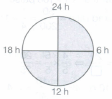
The ratio of sleeping time to the awaking time is ___________
40.
Maya can walk 6 km in 2 h. In 3 h, she can walk ______________
41.
The weight of 15 boxes is 60 kg. The weight of 12 boxes is ____________
42.
The cost of 4 pens is Rs. 40. The cost of 11 pens is ____________
43.
See the figure and fill in the blanks.
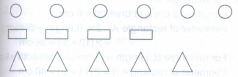
The ratio of the number of circles to that of triangles is ____________
44.
See the figure and fill in the blanks.
The ratio of the number of triangles to the rectangles is _____________
45.
See the figure and fill in the blanks.
The ratio of the number of rectangles to the circles is __________
1.
Yes! we can think of some more examples where we have to divide a number of things in some ratio.
Sum of the ratios = 2 + 3 = 5
Total money = Rs. 150
\(\therefore\) Money got by one brother
= \(\frac { 2 }{ 5 } \times 150\) = Rs. 60
Money got by another brother
= \(\frac { 3 }{ 5 } \times 150\) = Rs. 90
2.
Given,30% of Zuben's house area= 40% of Seema's house area
\(\therefore\)Required ratio of Zuben's house to Seema's house \(=\frac{4}{3}=4:3\)
3.
2 cm to 4 cm \(=\frac{2}{400}=1:200[\because\ 1\ m=100 cm]\)
4.
Required area to yield 360 quintals wheat = 8 hectares of land
\(\therefore\) To yield 1 quintal wheat, required area \(=\frac{8}{360}\) hectares
\(\therefore\) To yield 540 quintals wheat, required area \(=540\times\frac{8}{360}\) hectares \(\frac{3\times8}{2}\) hectares = 12 hectares of land.
5.
Product of means = Product of extremes
6.
We have,\(45:60=\frac{45}{60}\) ,in simplest form \(=\frac{3}{4}=3:4\)
Now, \(36:48=\frac{36}{48}\),in simplest form \(=\frac{3}{4}=3:4\)
So, the ratio 45:60 and 36:48 are in proportion i.e. 45:60::36:48
7.
4: 14 and 6 : 21
8.
Ratio=3:11
9.
\(\because\) Distance covered by Rohan in 1 h = 12 km and distance covered by Rakesh in 1 h = 8 km
\(The\ required\ ratio=\frac{Distance\ covered\ by\ Rohan}{Distance\ covered\ by\ Rakesh}=\frac{12}{8}\)
Now, divide numerator and denominator both by the HCF of 12 and 8 i.e. 4, \(\frac{12\div4}{8\div4}\ \ [\because HCF\ of\ 12\ and\ 8\ is\ 4]\)
\(=\frac{3}{2}=3:2\)
10.
Given, ratio = 3 : 5, firstly multiply and divide the numerator and denominator with the same number.
\(\frac{3}{5}=\frac{3\times2}{5\times2}=\frac{6}{10}\ and\ \frac{3}{5}=\frac{3\times3}{5\times3}=\frac{9}{15},\) hence two equivalent rati.os of 3: 5 are 6 : 10 and 9: 15.
11.
\(\frac { 40 }{ 5 } =\frac { 8 }{ 1 } \)
\(\frac { 42 }{ 6 } =\frac { 7 }{ 1 } \)
\(\because\) 8 > 7
\(\therefore\) First shopkeeper is costlier
\(\therefore\) Tomatoes must be purchased from the second shopkeeper.
The comparison by taking difference will not help him decide as the weights of tomatoes purchased from the two shopkeepers are different.
12.
Ratio of sides of triangle = 2 : 3 : 5
Total perimeter = 70
Total of the ratio of sides = 2 + 3 + 5 =10
\(\therefore\) Length of the longest side = \(70\times\frac{5}{10}=35\ cm\)
13.
School start at 7 : 00 am and gets over at 12 : 30 pm
Total time the student spend at shcool
= 5 h 30 min = (5 x 60 + 30) m = 330 min
Break time = 9: 50 am to 10 : 10 am = 20 min
\(\therefore\) Required ratio \(=\frac{20}{330}=2:33\)
14.
Quantity of burfi = 18 kg
Given, Khoya : Sugar = 7: 2
Total = 7 + 2 = 9
Quantity of khoya \(=\frac{18\times7}{9}=14\ kg\)
So, Reshma used 14 kg khoya.
15.
8:9
16.
We have, 1: 5 and 3: 15
Here, \(3:15=\frac{3}{15}=\frac{3\div3}{15\div3}=\frac{1}{5}=1:5\) [dividing numerator and denominator both by 3]
i.e. 1 : 5 and 3 : 15 are in proportion.
Thus, the proper form is 1 : 5 :: 3: 15.
17.
3:4
18.
Here, we have to convert L into mL.
We know that,1L = 1000 mL
\(\therefore\)2 L=2 X 1000 mL = 2000 mL
\(\therefore\ Required\ ratio=\frac{500\ mL}{2000\ mL}=\frac{500}{2000}=\frac{5}{20}\)
[dividing numerator and denominator by 100]
\(Ratio=\frac{1}{4}=1:4\)
19.
Given, number of holidays in one year = 73
We know that, number of days in one year = 365
\(\therefore\) Ratio of number of holidays to the number of days in one year \(=\frac {Number\ of\ holidays}{Total\ number\ of\ days}=\frac {73}{365}\)
\(=\frac{73\div73}{365\div73}=\frac{1}{5}=1:5\) [\(\because\)HCF of 73 and 365 = 73]
Hence, the required ratio is 1 : 5.
20.
Given, Ravi walks 6 km in an hour i.e. distance covered by Ravi in one hour = 6 km.
and Roshan walks 4 km in an hour i.e. distance covered by Roshan in one hour = 4 km
\(\therefore\) Ratio of distance covered by Ravi to the distance covered by Roshan \(=\frac{Distance\ covered\ by\ Ravi\ in\ one\ hour}{Distance\ covered\ by\ Roshan\ in\ one\ hour}\)
\(=\frac{6\ km}{4\ km}=\frac{6}{4}=\frac{3}{2}=3:2\)
Hence, the required ratio is 3 : 2.
21.
Given, milk needed for making cake = 1cup
and flour needed for making cake = \(2\frac{1}{2}\) cups
\(=\frac{5}{2}\) cups
Then, total amount needed = Milk + Flour
\(=(1+\frac{5}{2})\ cups=\frac{7}{2}\ cups\)
So, \(\frac{7}{2}\) cups of milk and flour needed to make cake for 6 persons.
Let the needed amount of cups of milk and flour to make cake for 8 persons = x [where, x is a multiple of cups]
By ratio and proportion law,\(\frac{\frac{7}{2}}{6}=\frac{x}{8}\)
\(\Rightarrow\frac{7}{2}\times8=6\times x\Rightarrow x=\frac{28}{6}\)
\(\Rightarrow x=\frac{14}{3}\) [dividing by 2
Hence, the cups needed for 8 persons is \(\frac{14}{3}\).
22.
Total number of members = 100
Number of members, who play carom = 20
Number of members, who play table tennis = 24
Number of members, who play badminton = 16
Number of members, who do not play any game
=100 -(20 + 24 + 16)=100 - 60 = 40
(a) Ratio of members of carom to the members of table tennis \(=20:24=\frac{20}{24}=5:6\)
(b) Ratio of members of badminton to the members of carom \(=16:20=\frac{16}{20}=\frac{4}{5}=4:5\)
(c) Ratio of table tennis to the member of those, who play badminton \(=24:16=\frac{24}{16}=\frac{3}{2}=3:2\)
(d) Ratio of badminton to the number of those, who do not play any game \(=16:40=\frac{16}{40}=\frac{2}{5}=2:5\)
23.
255 m
24.
Given, number of teachers = 102
and number of students = 3300
\(\therefore\) Required ratio of teachers to the number of students \(=\frac{Number\ of\ teachers}{Number\ of\ students}=\frac{102}{3300}\)
\(\because\) 102=2x3x17and 3300=2x3x2x5x5x11
\(\therefore\) HCF of 102 and 3300=2x3=6
\(Ratio=\frac{102\div6}{3300\div6}=\frac{17}{55}=17:550\)
25.
Given, number of girls = 20 and number of boys = 15
\(\therefore\) Total number of students in the class = 20 +15 = 35
(a) Ratio of number of girls to the number of boys \(=\frac{Number\ of\ girls}{Number\ of\ boys}=\frac{20}{15}\)
\(=\frac{20\div5}{15\div5}=\frac{4}{3}=4:3\) [ \(\because\)HCFof 20 and 15=5]
(b) Ratio of number of girls to the total number of students in the class \(=\frac{Number\ of\ girls}{Total\ number\ of\ students}=\frac{20}{35}\)
\(=\frac{20\div5}{35\div5}=\frac{4}{7}\) [ \(\because\) HCF of 20 and 35 = 5]
26.
\(\frac { 8000 }{ 8 } \) = 1000
27.
1 year = 12 months
4000x12 = 48000
28.
\(\frac { 5 }{ 80 } \times 32=2\)
29.
100-60=40
40:100 = \(\frac { 40 }{ 100 } =\frac { 40\div 20 }{ 100\div 20 } =\frac { 2 }{ 5 } \)= 2:5
30.
10:5=\(\frac { 10 }{ 5 } =\frac { 10\div 5 }{ 5\div 5 } =\frac { 2 }{ 1 } \)
\(20\div 10=\frac { 20 }{ 10 } =\frac { 20\div 10 }{ 10\div 10 } =\frac { 2 }{ 1 } \)
\(30\div 15=\frac { 30 }{ 15 } =\frac { 30\div 15 }{ 15\div 15 } =\frac { 2 }{ 1 } \)=2:1
31.
\(\frac { 6 }{ 2 } =\frac { 3 }{ 1 } \)=3:1
32.
\(\frac { 150 }{ 120 } =\frac { 15 }{ 12 } =\frac { 5 }{ 4 } \)= 5:4
33.
(c)
5:8
34.
(a)
\(\frac{7}{2}\)
35.
(c)
88
36.
()
100
37.
()
same
38.
()
1
39.
()
1:3
40.
()
9 Km
41.
()
48 Kg
42.
()
Rs.110
43.
()
6:5
44.
()
5:4
45.
()
2:3

6th Standard CBSE Syllabus & Materials
6th Standard CBSE
CBSE 6th Social Science Locating Places on the Earth - New Sample Question Papers Study Material - QB365 Set A
NEW6th Standard CBSE
CBSE 6th Science A Journey Through States of Water - New Sample Question Papers Study Material - QB365 Set A
NEW6th Standard CBSE
CBSE 6th Science Temperature and its Measurement - New Sample Question Papers Study Material - QB365 Set A
NEW6th Standard CBSE
CBSE 6th Science Materials Around Us - New Sample Question Papers Study Material - QB365 Set A



NCERT Books

Syllabus

Exam Pattern

Sample Question Papers

Previous year Question Papers

Important Notes

MCQ Practice test

NCERT Exemplers

Case study Questions

Image Based Questions

Passage based Questions

HOT Questions

Value Based Questions

Model Questions Papers
NCERT ( Book Back ) Questions

Assertion and Reason
Important Questions And Answers

CBSE 6th Standard CBSE Subjects
CBSE Standards


