
 100% FREE ACCESS
6th Standard CBSE Syllabus & Materials
6th Standard CBSE
CBSE 6th Social Science The Value of Work - New Sample Question Papers Study Material - QB365 Set A
NEW6th Standard CBSE
CBSE 6th Social Science Family and Community - New Sample Question Papers Study Material - QB365 Set A
NEW6th Standard CBSE
CBSE 6th Social Science India's Cultural Roots - New Sample Question Papers Study Material - QB365 Set A
NEW6th Standard CBSE
CBSE 6th Social Science India,That is Bharat - New Sample Question Papers Study Material - QB365 Set A
NEW6th Standard CBSE
CBSE 6th Social Science Timeline and sources of history - New Sample Question Papers Study Material - QB365 Set A
NEW6th Standard CBSE
CBSE 6th Social Science Oceans and Continents - New Sample Question Papers Study Material - QB365 Set A

Published on: 24/10/2025
Download CBSE Class 6th Standard CBSE Mathematics question papers, sample papers, important questions, and previous year solved papers in PDF format. Get free study materials, NCERT solutions, and exam preparation resources for Class 6th Standard CBSE Mathematics
Questions + Answers key
Take MCQ Mathematics Test
1.
Draw a figure on the ground in the form of a horizontal number line as shown below. Frame questions as given in the above example and ask your friends.

Few questions framed are as follows:
1. Go 4 steps to the right of o.
2. Go 5 steps to the left of o.
3. Go 6 steps to the right of 0 and then go 4 steps further from there to the left.
4. Go 5 steps to the left of 0 and then go 1 step further from there to the left.
5. Go 8 steps to the right of 0 and then go 6 steps further from there to the left.
6. Go 4 steps to the left of 0 and then go 3 steps further from there to the right.
2.
Going up and down
In Mohan's house there are stairs for going up to the terrace and for going down to the godown.
Let us consider the number of stairs going up to the terrace as positive integer, the number of stairs going down to the godown as negative integer, and the number representing ground level as zero.
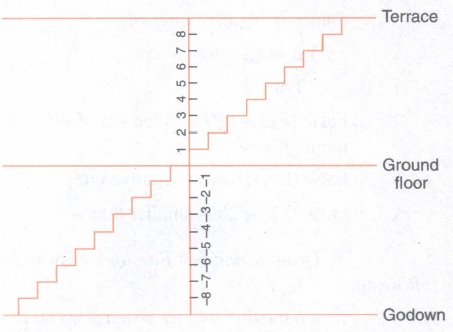
Do the following exercise and write down the answer as integer:
(a) Go 6 steps up from the ground floor.
(b) Go 4 steps down from the ground floor.
(c) Go 5 steps up from the ground floor and then go 3 steps up further from there.
(d) Go 6 steps down from the ground floor and then go down further 2 steps from there.
(e) Go down 5 steps from the ground floor and then move up 12·steps from there.
(f) Go 8 steps down from the ground floor and then go up 5 steps from there.
(g) Go 7 steps up from the ground floor and then 10 steps down from there.
Ameena wrote them as follows:
(a)+6
(b)-4
(c) (+ 5) + (+ 3) = + 8
(d) (-6) + (-2) =-4
(e)(-5)+(+12)=+7
(f)(-8) +(+5)=-3
(g) (+ 7) + (-10) = 17
She has made some mistakes. Can you check her answers and correct those that are wrong?
3.
A merchant has 130 L of oil of one kind, 190 L of another kind and 250 L of a third kind. He wants to sell the oil by filling the three kinds of oil in tins of equal capacity. What should be the greatest capacity of such a tin?
4.
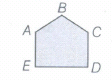
Draw a five sided polygon and shade its interior.
5.
Illustrate, if possible, each one of the following with a rough diagram:
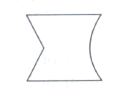
(a) A closed curve that is not a polygon.
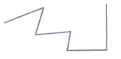
(b) An open curve made up entirely of line segments.
(c) A polygon with two sides.
6.
Read these numbers. Write them using placement boxes and then write their expanded forms.
(i) 475320 (ii) 9847215 (iii) 97645310 (iv) 30458094
(a) Which is the smallest number?
(b) Which is the greatest number?
(c) Arrange these numbers in ascending and descending orders.
7.
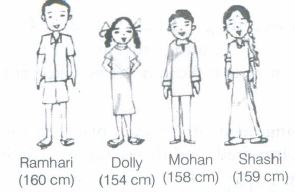
Who is the tallest? Who is the shortest?
(a) Can you arrange them in the increasing order of their heights?
(b) Can you arrange them in the decreasing order of their heights?
8.
Following is the account of a shopkeeper which shows profit and loss from the sale of certain items. Using proper sign in the above account, fill up the blanks.
| Name of items | Profit | Loss | Representation with proper sign |
| Mustard oil Rice Black pepper Wheat Groundnut oil |
Rs.150 Rs.225 Rs.200 |
|
________ ________ ________ ________ ________ |
9.
There are 20 teachers in a school of 500 students. The ratio of the number of teachers to the number of students is
1:20
1:50
1:25
25:1
10.
There are 30 boys and 20 girls in a class. The ratio of the number of girls to the number of boys is
2:3
3:2
2:5
3:5
11.
Which of the following letters has vertical line of symmetry?
N
K
B
M
12.
Which of the following letters has vertical line of symmetry?
R
C
B
T
13.
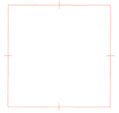
How many lines of symmetry does the figure have?
1
2
3
4
14.
Which of the following is an improper fraction?
\(\frac { 2 }{ 3 } \)
\(\frac { 3 }{ 4 } \)
\(\frac { 4 }{ 5 } \)
\(\frac { 5 }{ 4 } \)
15.
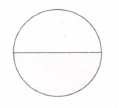
The fraction representing the shaded portion
\(\frac { 1 }{ 4 } \)
\(\frac { 1 }{ 2 } \)
\(\frac { 1 }{ 3 } \)
\(\frac { 1 }{ 8 } \)
16.
The greatest of the numbers 123, 27,650, 2342, 40000 is
40000
2342
27
650.
17.
The angle measure for one-fourth revolution is
90°
360°
180°
none of these.
18.
The angle measure for half a revolution is
90°
180°
360°
none of these.
19.
Find the solution of (-10) + (+ 8) without using number line.
1.
1. +4
2. -5
3. (+ 6) + (- 4) = + 2
4. (-5)+(-1)=-6
5. (+8)+(-6)=+2
6. (-4)+(+3)=-1
2.
(a) correct
(b)correct
(c)correct
(d)Incorrect; the correct is (- 6) + (- 2) = - 8
(e)correct
(f)correct
(g)ncorrect; the correct is (+ 7) + (- 10) = - 3
3.
The greatest capacity of the required measure will be equal to the HCF of 130, 190 and 250 L.
Prime factorisation of 130, 190 and 250.
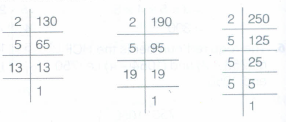
130=2x5x13
190= 2 x 5 x19
250=2x5x5x5
Common factors of 130, 190 and 250 = 2 x 5 = 10
Hence, greatest capacity of tin = 10
4.
5.
(a) The following figure shows a closed curve, but not a polygon, because a polygon is made by line segments only.
(b) The following figure shows an open curve made up entirely of line segments.
(c) It is not possible, because a polygon of two sides cannot be drawn.
6.
After reading these numbers, we have
(i) 475320 Four lakhs seventy five thousands three hundred twenty.
(ii) 9847215 Ninety eight lakhs forty seven thousands two hundreds fifteen.
(iii) 97645310 Nine crores seventy six lakhs forty five thousands three hundreds ten.
(iv) 30458094 Three crores four lakhs fifty eight thousands ninety four.
The placement boxes is shown as below:
| Number | Crores | Ten lakhs | Lakhs | Ten thousands | Thousand | Hundreds | Tens | Ones |
| 475320 | - | - | 4 | 7 | 5 | 3 | 2 | 0 |
| 9847215 | - | 9 | 8 | 4 | 7 | 2 | 1 | 5 |
| 97645310 | 9 | 7 | 6 | 4 | 5 | 3 | 1 | 0 |
| 30458094 | 3 | 0 | 4 | 5 | 8 | 0 | 9 | 4 |
Expanded forms of given numbers are as follow:
(i) 475320 = 4 \(\times\)100000 + 7 \(\times\) 10000 + 5\(\times\) 1000 + 3 \(\times\) 100 +2\(\times\)10+ 0 \(\times\) 1
(ii) 9847215 = 9 \(\times\) 1000000 + 8 \(\times\) 100000 + 4 \(\times\) 10000 + 7 \(\times\) 1000 + 2 \(\times\) 100 + 1 \(\times\)10 + 5 \(\times\) 1
(iii) 97645310 = 9 \(\times\) 10000000 + 7 \(\times\) 1000000 + 6 \(\times\) 100000 + 4 \(\times\) 10000 + 5 \(\times\) 1000 + 3 \(\times\) 100 + 1 \(\times\) 10 + 0 \(\times\)1
(iv) 30458094 = 3\(\times\) 10000000 + 4 \(\times\) 100000 + 5 \(\times\) 10000 + 8 \(\times\) 1000 + 0 \(\times\) 100 + 9\(\times\) 10 + 4 \(\times\) 1
(a) The smallest number = 475320
(b) The greatest number = 97645310
(c) Ascending order of given numbers are as follow:
475320 < 9847215 < 30458094 < 97645310
Descending order of given numbers are as follow:
97645310> 30458094 > 9847215> 475320.
7.
(i) From the given figure, it is clear that,
160> 159> 158> 154
∴ Ramhari is the tallest, because he has the height of 160 cm.
(ii) From the given figure, it is clear that,
154 < 158 < 159 < 160
∴ Dolly is the shortest, because she has the height of 154 cm.
We can arrange height from two types:
(a) Yes, we can arrange their heights in increasing order as follows: Dolly (154 cm) < Mohan (158 cm) < Shashi (159 cm) < Ramhari (160 cm).
(b) Yes, we can arrange their heights in decreasing order as follows: Ramhari (160 cm) > Shashi (159 cm) > Mohan (158 cm) > Dolly (154 cm).
8.
| Name of items | Profit | Loss | Representation with proper sign |
| Mustard oil Rice Black pepper Wheat Groundnut oil |
Rs.150 Rs.225 Rs.200 |
|
+Rs.150 -Rs.250 +Rs.225 +Rs.200 -Rs.330 |
9.
20:500=\(\frac { 20 }{ 500 } =\frac { 1 }{ 25 } \)=1:25
10.
\(\frac { 20 }{ 30 } =\frac { 2 }{ 3 } \)= 2:3
11.
(d)
M
12.
(d)
T
13.
(d)
4
14.
(d)
\(\frac { 5 }{ 4 } \)
15.
(b)
\(\frac { 1 }{ 2 } \)
16.
(a)
40000
17.
18.
(b)
180°
19.
(-10) + (+ 8)
=(-2)+(-8)+(+8)
=(-2)+0=-2

6th Standard CBSE Syllabus & Materials
6th Standard CBSE
CBSE 6th Social Science Locating Places on the Earth - New Sample Question Papers Study Material - QB365 Set A
NEW6th Standard CBSE
CBSE 6th Science A Journey Through States of Water - New Sample Question Papers Study Material - QB365 Set A
NEW6th Standard CBSE
CBSE 6th Science Temperature and its Measurement - New Sample Question Papers Study Material - QB365 Set A
NEW6th Standard CBSE
CBSE 6th Science Materials Around Us - New Sample Question Papers Study Material - QB365 Set A



NCERT Books

Syllabus

Exam Pattern

Sample Question Papers

Previous year Question Papers

Important Notes

MCQ Practice test

NCERT Exemplers

Case study Questions

Image Based Questions

Passage based Questions

HOT Questions

Value Based Questions

Model Questions Papers
NCERT ( Book Back ) Questions

Assertion and Reason
Important Questions And Answers

CBSE 6th Standard CBSE Subjects
CBSE Standards


