
 100% FREE ACCESS
6th Standard CBSE Syllabus & Materials
6th Standard CBSE
CBSE 6th Social Science The Value of Work - New Sample Question Papers Study Material - QB365 Set A
NEW6th Standard CBSE
CBSE 6th Social Science Family and Community - New Sample Question Papers Study Material - QB365 Set A
NEW6th Standard CBSE
CBSE 6th Social Science India's Cultural Roots - New Sample Question Papers Study Material - QB365 Set A
NEW6th Standard CBSE
CBSE 6th Social Science India,That is Bharat - New Sample Question Papers Study Material - QB365 Set A
NEW6th Standard CBSE
CBSE 6th Social Science Timeline and sources of history - New Sample Question Papers Study Material - QB365 Set A
NEW6th Standard CBSE
CBSE 6th Social Science Oceans and Continents - New Sample Question Papers Study Material - QB365 Set A

Published on: 24/10/2025
Download CBSE Class 6th Standard CBSE Mathematics question papers, sample papers, important questions, and previous year solved papers in PDF format. Get free study materials, NCERT solutions, and exam preparation resources for Class 6th Standard CBSE Mathematics
Questions + Answers key
Take MCQ Mathematics Test
1.
You have two set-squares in your instrument box. One is 30°-60°-90° set square, the other is 45°- 45°-90° set square.
You and your friend can jointly do this.
(a) Both of you will have a pair of 30°-60°- 90° set squares. Place them as shown in the figure. Can you. name the quadrilateral described? What is the measure of each of its angles? The quadrilateral is a rectangle. One more obvious property of the rectangle you can see is that opposite sides are of equal length. What other properties can you find?
.JPG)
(b) If you use a pair of 45°-45°-90° set squares, you get another quadrilateral this time.
It is a square.
.JPG)
Are you able to see that all the sides are of equal length? What can you say about the angles and the diagonals? Try to find a few more properties of the square.
(c) If you place the pair of 30°-60°-90° set squares in a different position, you get a parallelogram. Do you notice that the opposite sides are parallel? Are the opposite sides equal? Are the diagonals equal?
.JPG)
(d) If you use four 30°-60°-90° set squares you get a rhombus.
(e) If you use several set-squares you can build a shape like the one given here. Here is a quadrilateral in which two sides are parallel.
.JPG)
It is a trapezium.
Here is an outline-summary of your possible findings. Complete it.
| Quadrilateral | Opposite sides | All sides equal | Opposite angles equal | Diagonals | ||
| Parallel | Equal | Equal | perpendicular | |||
| Parallelogram | Yes | Yes | No | Yes | No | No |
| Rectangle | No | |||||
| Square | Yes | |||||
| Rhombus | Yes | |||||
| Trapezium | ||||||
2.
Using a protractor and a ruler find the measures of the sides and angles of the given triangles. Fill the measures in the given table.
(a)
.JPG)
(b)
.JPG)
(c)
.JPG)
(d)
.JPG)
(e)
.JPG)
(f)
.JPG)
(g)
.JPG)
(h)
.JPG)
| The measure of the angles of the triangle | What can you say about the angles? | Measure of the sides |
| (a) ____60°_____ , 60° ________, 60° _______, (b)___________,_________,____________, (c)_________,_________,____________, (d)__________,___________,___________, (e)___________,___________,__________, (f)____________,_____________,__________, (g)__________,____________,_____________, |
All angles are equal _______angles________, _______angles________, _______angles________, _______angles________, _______angles________, _______angles________, _______angles________, |
Observe the angles and the triangles as well as the measures of the sides carefully. Is there anything special about them?
What do you find?
(i)Triangles in which all the angles are equal. If all the angles in a triangle are equal, then its sides are also _____________.
(ii)Trianges in which all the sides are equal. If all the sides in a triangle are equal, then its angles are___________ .
(iii)Triangles which have two equal angles and two equal sides. If two sides of a triangle are equal, it has __________ equal angles and if two angles of a triangle are equal, it has___________ equal sides.
(iv)Triangles in which no two sides are equal. If none of the angles of a triangle are equal then none of the sides are equal. If the three sides of a triangle are unequal then, the three angles are also___________.
3.
Place a pair of unequal sticks such that they have their end points joined at one end. Now place another such pair meeting the free ends of the first pair.
What is the figure enclosed? It is a quadrilateral, like the one you see here.
The sides of the quadrilateral are \(\overline { AB } \), \(\overline { BC } \) ,...,
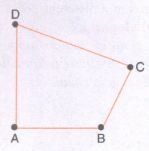
There are 4 angles for this quadrilateral. They are given by \(\angle\)BAD, \(\angle\)ADC, \(\angle\)DCB and.
\(\overline { BD } \) is one diagonal. What is the other?
Measure the length of the sides and the diagonals. Measure all the angles also.
4.
If line segment AB = 10 cm and C, D, E, F are four points at line segment AB, such that AC = CD = DE = EF = FB. Then, find measure of AD.
5.
During Maths lab activity, each student was given four broomsticks of length 8 cm, 8 cm, 5 cm, 5 cm to make different types of quadrilaterals.
(a) How many quadrilaterals can be formed using four broomsticks?
(b) Name the types of quadrilateral formed.
(c) While doing this activity, which value is depicted?
6.
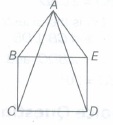
In figure, BCDE is a square and a 3-D shape has been formed by joining the point A in space with the vertices B, C, D and E. Name the 3-D shape and also its
(i) vertices
(ii) edges and
(iii) faces.
7.
Name the type of triangle, if
(a) sides are 7 cm, 8 cm and 9 cm
(b) ΔABC; AB = AC = 6 cm, BC = 8 cm
(e) ΔABC; AB = BC = AC = 5 cm
(d) ΔABC; \(\angle B = 90°\), BC= 4 cm, AB = 3 cm.
8.
Construct two line segments AB and CO of lengths 2.5 cm and 3.2 cm. Construct another segment EF, whose length is the sum of these two segments. Measure the new length.
9.
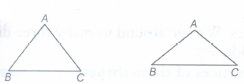
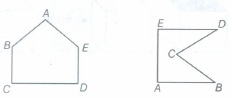
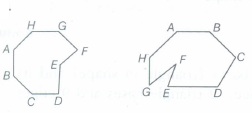
Name each polygon. Make two more examples of each of these.
10.
One of the equal angles of an isosceles triangle is 40°. Find its other angle.
1.
(a) (i) diagonals are equal
(ii) diagonals bisect each other
(iii) each angle is a right angle
(b) (i) The lengths of all the sides of a square are equal. Its each angle is a right angle.
(ii) Its diagonals bisect each other
(iii) Its diagonals bisect each other perpendicularly
(c) (i) Yes, its opposite sides are parallel
(ii) Yes, its opposite sides are equal
(iii) No, its diagonals are not equal
| Quadrilateral | Opposite sides | All sides equal | Opposite angles equal | Diagonals | ||
| Parallel | Equal | Equal | perpendicular | |||
| Parallelogram | Yes | Yes | No | Yes | No | No |
| Rectangle | yes | Yes | No | Yes | Yes | No |
| Square | Yes | Yes | Yes | Yes | Yes | Yes |
| Rhombus | Yes | Yes | Yes | Yes | No | Yes |
| Trapezium | Yes | No | No | No | No | No |
2.
| The measures of the angles of the triangle | What can you say about the angles | Measure of the sides |
| (a) 60°, 60°, 60o | All angles are equal | 1.8 cm, 1.8 cm, 1.8cm |
| (b) 50°, 95°, 35o | All angles are not equal | 3.2 cm, 1.7 cm 2.5 cm |
| (c) 65°, 50°, 65o | Two angles are equal | 1.9 cm, 2.5 cm, 2.5cm |
| (d) 90°, 40°, 50o | All angles are not equal | 1.9 cm, 2.4 cm, 3.1 cm |
| (e) 60°, 60°, 60o | All angles are equal | 2.2cm, 2.2cm, 2.2cm |
| (f) 75°, 30°, 75o | Two angles are equal | 3.3 cm, 3.3 cm, 1.9cm |
| (g) 45°, 90°, 45o | Two angles are equal | 2.3 cm, 2.3 cm, 3.1 cm |
| (h) 60°, 60°, 60o | All angles are equal | 3 cm, 3 cm, 3cm |
(i) If all the angles in a triangle are equal, then its sides are also equal.
(ii) If all the sides of a triangle are equal, then its angles are equal.
(iii) If two sides of a triangle are equal, it has two equal angles and if two angles of a triangle are equal, it has two equal sides.
(iv) If the three sides of a triangle are unequal then the three angles are also unequal.
3.
The figure enclosed is a quadrilateral. The sides of this quadrilateral are
\(\overline { AB } \), \(\overline {BC}\), \(\overline {CD}\) , \(\overline {DA}\)
There are 4 angles for this quadrilateral. They are given by \(\angle\)BAD, \(\angle\)ADC, \(\angle\)DCB and \(\angle\)ABC.
\(\overline {AC}\) is one diagonal. The other diagonal is \(\overline {BD}\) .
On measuring,
AB = 2.6 cm
BC = 1.9 em
CD = 3.5 em
DA= 3.7 em
AC= 3.6 em
BD = 3.8 em
\(\angle\)DAB = 90°
\(\angle\)ABC = 65°
\(\angle\)BCD = 100°
\(\angle\)CDA = 105°
4.
AD = 4 cm
5.
Given, four broom sticks of length 8 cm, 8 cm, 5 cm and 5 cm.
(a) Three types of quadrilaterals can be formed.
(b) Name of the quadrilaterals are rectangle, parallelogram and kite.
(c) The value is scientific, temper and curiosity.
6.
The 3-D shape formed is a square pyramid
(i) Vertices are A, B, C, D and E.
(ii) Edges are AB, AC, AD, AE, BC, CD, DE and EB.
(iii) Faces are: square BCDE, ΔABC, ACD, ΔADE and ΔABE.
7.
(a) Given, sides are 7 cm, 8 cm and 9 cm.
Hence, it is a scalene triangle.
(b) Given, in ΔABC, AB = AC = 6 cm, BC = 8 cm
Hence, it is an isosceles triangle.
(c) Given, in ΔABC
AB =BC = AC = 5 cm
Hence, it is an equilateral triangle.
(d) Given, in ΔABC, \(\angle B = 90°\), BC = 4 cm, AB = 3 cm
Hence, it is a right angled triangle.
8.
Now, first of all, we draw AB = 2.5 cm and CD = 3.2 cm.

\(\overline{ AB } +\overline { CD } =\overline { EF } \)
Now, we have to draw a line segment
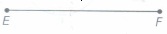
∴ \(\overline { EF } =\overline{ AB } +\overline{ CD } \) = 2.5 +3.2 = 5.7 cm
Hence, new length is 5.7 cm.
9.
This polygon has four sides, so it is a quadrilateral. e.g.
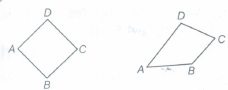
This polygon has three sides, so it is a triangle. e.g.
This polygon has five sides, so it is a pentagon. e.g.
This polygon has eight sides, so it is an octagon. e.g.
10.
100°

6th Standard CBSE Syllabus & Materials
6th Standard CBSE
CBSE 6th Social Science Locating Places on the Earth - New Sample Question Papers Study Material - QB365 Set A
NEW6th Standard CBSE
CBSE 6th Science A Journey Through States of Water - New Sample Question Papers Study Material - QB365 Set A
NEW6th Standard CBSE
CBSE 6th Science Temperature and its Measurement - New Sample Question Papers Study Material - QB365 Set A
NEW6th Standard CBSE
CBSE 6th Science Materials Around Us - New Sample Question Papers Study Material - QB365 Set A



NCERT Books

Syllabus

Exam Pattern

Sample Question Papers

Previous year Question Papers

Important Notes

MCQ Practice test

NCERT Exemplers

Case study Questions

Image Based Questions

Passage based Questions

HOT Questions

Value Based Questions

Model Questions Papers
NCERT ( Book Back ) Questions

Assertion and Reason
Important Questions And Answers

CBSE 6th Standard CBSE Subjects
CBSE Standards


