
 100% FREE ACCESS
6th Standard CBSE Syllabus & Materials
6th Standard CBSE
CBSE 6th Social Science The Value of Work - New Sample Question Papers Study Material - QB365 Set A
NEW6th Standard CBSE
CBSE 6th Social Science Family and Community - New Sample Question Papers Study Material - QB365 Set A
NEW6th Standard CBSE
CBSE 6th Social Science India's Cultural Roots - New Sample Question Papers Study Material - QB365 Set A
NEW6th Standard CBSE
CBSE 6th Social Science India,That is Bharat - New Sample Question Papers Study Material - QB365 Set A
NEW6th Standard CBSE
CBSE 6th Social Science Timeline and sources of history - New Sample Question Papers Study Material - QB365 Set A
NEW6th Standard CBSE
CBSE 6th Social Science Oceans and Continents - New Sample Question Papers Study Material - QB365 Set A

Published on: 24/10/2025
Download CBSE Class 6th Standard CBSE Mathematics question papers, sample papers, important questions, and previous year solved papers in PDF format. Get free study materials, NCERT solutions, and exam preparation resources for Class 6th Standard CBSE Mathematics
Questions + Answers key
Take MCQ Mathematics Test
1.
Using four unequal sticks, as you did in the above activity, see if you canform a quadrilateral such that
(a) all the four angles are acute.
(b) one of the angles is obtuse.
(c) one of the angles is right-angled.
(d) two of the angles are obtuse.
(e) two of the angles are right-angled.
(f) the diagonals are perpendicular to one another.
2.
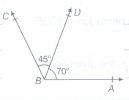
Find \(\angle ABC\), if \(\angle ABD = 70°, \angle DBC = 45°\) (as shown in figure).
3.
If line segment AB = 10 cm and C, D, E, F are four points at line segment AB, such that AC = CD = DE = EF = FB. Then, find measure of AD.
4.
If in ΔABC, \(\angle A = \angle B = \angle C\) and AB = 4 cm. Then find measure of other two sides.
5.
Name the following angles of figure using three alphabets.
(a) \(\angle 1\)
(b) \(\angle 2\)
(c) \(\angle 3\)
(d) \(\angle 1 + \angle 2\)
(e) \(\angle 2 + \angle 3\)
(f) \(\angle 1+\angle 2+\angle 3\)
(g) \(\angle CBA-\angle 1\)
6.
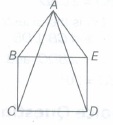
In figure, BCDE is a square and a 3-D shape has been formed by joining the point A in space with the vertices B, C, D and E. Name the 3-D shape and also its
(i) vertices
(ii) edges and
(iii) faces.
7.
Name the type of triangle and also draw it rough sketch.
(a) ΔABC ; \(\angle A = \angle B = \angle C = 60°\)
(b) ΔABC; \(\angle B = \angle C = 50°\)
(c) ΔABC ; \(\angle A = 45°, \angle B = 45°, \angle C = 90°\)
(d) ΔABC; \(\angle A = 50°, \angle B = 60°, \angle C = 70°.\)
8.
Name each polygon. Make two more examples of each of these.
9.
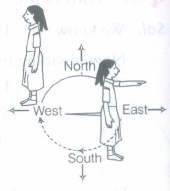
Which direction will you face, if you start facing
(a) East and makes \(\frac { 1 }{ 2 } \) of a revolution, clockwise?
(b) East and make 1\(\frac { 1 }{ 2 } \) of a revolution, clockwise?
(c) West and makes \(\frac { 3 }{ 4 } \) of a revolution, anti-clockwise?
(d) South and makes one full revolution? (Should we specify clockwise or anti-clockwise for this last question? Why not?)
10.
Draw five triangles and measure their sides. Check in each case, if the sum of the lengths of any two sides is always less than the third side.
1.
(a)No
(b)Yes
(c)Yes
(d)Yes
(e)Yes
(f)Yes.
2.
\(\angle ABC = 45° + 70° = 115°\)
3.
AD = 4 cm
4.
BC = 4 cm, CA = 4 cm
5.
Name of the angles are as follows
(a) \(\angle 1=\angle CBD\)
(b) \(\angle 2 =\angle DBE\)
(c) \(\angle 3=\angle EBA\)
(d) \(\angle 1+\angle 2=\angle CBE\)
(e) \(\angle 2+\angle 3=\angle DBA\)
(e) \(\angle 1+\angle 2+\angle 3=\angle CBA\)
(g) Put the value of \(\angle CBA\)
\([\therefore \angle CBA =\angle 1+\angle 2+\angle 3]\)Now, \(\angle CBA-\angle 1=\angle 1+\angle 2+\angle 3-\angle 1\)
\(=\angle 2+\angle 3=\angle DBA\)
\([\because \angle DBA=\angle 2+\angle 3]\)
6.
The 3-D shape formed is a square pyramid
(i) Vertices are A, B, C, D and E.
(ii) Edges are AB, AC, AD, AE, BC, CD, DE and EB.
(iii) Faces are: square BCDE, ΔABC, ACD, ΔADE and ΔABE.
7.
(a) Given, \(\angle A = \angle B = \angle C = 60°\)
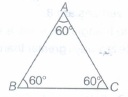
Hence, it is an equilateral triangle.
(b) Given, \(\angle B =\angle C = 50°\)
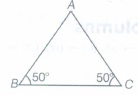
hence, it is an isosceles triangle.
(c) Given, \(\angle A = 45°, \angle B = 45°, \angle C = 90°\)
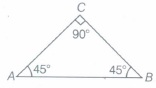
Hence, it is an isosceles right angled triangle.
(d) Given, \(\angle A = 50°, \angle B = 60°, \angle C = 70°\)
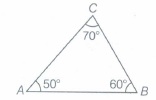
Hence, it is a scalene triangle.
8.
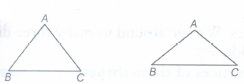
This polygon has four sides, so it is a quadrilateral. e.g.
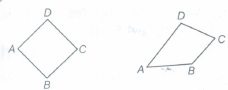
This polygon has three sides, so it is a triangle. e.g.
This polygon has five sides, so it is a pentagon. e.g.
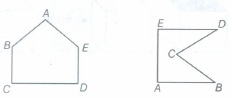
This polygon has eight sides, so it is an octagon. e.g.
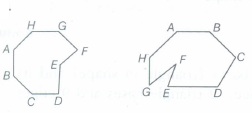
9.
(a) If we starts facing East and makes \(\frac { 1 }{ 2 } \) of a revolution clockwise i.e. two right angles, we will face West.
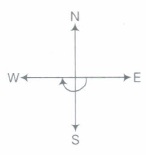
(b) If we starts facing East and makes 1\(\frac { 1 }{ 2 } \)of a revolution clockwise i.e. one complete revolution and two right angles, we will face West.
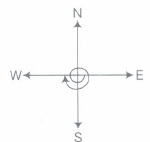
(c) If we starts facing West and makes \(\frac { 3 }{ 4 } \) of a revolution anti-clockwise i.e. three right angles, we will face North.
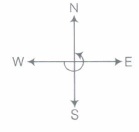
(d) We have,
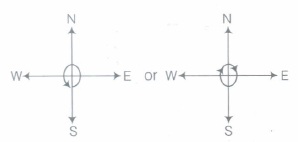
If we starts facing South and makes one full revolution either clockwise or anti-clockwise, we will face South again.
There is no need to specify ciockwise or anti-clockwise because one full revolution will bring us back to the original position.
10.
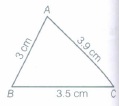
(i) Here, we draw a ΔABC.
In which, AB = 3 cm,
BC = 3.5 cm and AC = 3.9 cm
Now, by adding two sides of Δ ABC
i.e. AB + BC = 3 + 3.5
= 6.5 cm
Clearly, AB + BC > AC
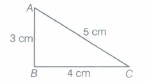
(ii) Here, we draw a ΔABC in which AB =3 cm, BC = 4 cm and AC = 5 cm.
Now, by adding two sides of ΔABC
i.e. AB + BC = 3 + 4 = 7 cm
Clearly, AB + BC > AC.
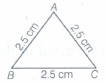
(iii) Here, we draw a ΔABC in which AB = BC = AC = 2.5 cm
Now, by adding two sides of ΔABC
i.e. AB + BC = 2.5 + 2.5 = 5 cm
Clearly, AB + BC > AC
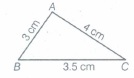
(iv) Here, we draw a ΔABC in which
AB = 3 cm, BC = 35 cm and AC = 4 cm
Now, by adding two sides of ΔABC.
i.e. AB + BC = 3 + 35 = 65 cm
Clearly, AB + BC > AC
(v) Here, we draw a ΔABC in which AB = 2 cm, BC = 4 cm and AC = 45 cm.
Now, by adding two sides of ΔABC
i.e. AB + BC = 2 + 4 = 6 cm
Clearly, AB + BC > AC.
From all these conclusions, we observe that in each case, the sum of the lengths of any two sides is greater than the third side. So, the sum of the lengths of any two sides can never be less than the third side.

6th Standard CBSE Syllabus & Materials
6th Standard CBSE
CBSE 6th Social Science Locating Places on the Earth - New Sample Question Papers Study Material - QB365 Set A
NEW6th Standard CBSE
CBSE 6th Science A Journey Through States of Water - New Sample Question Papers Study Material - QB365 Set A
NEW6th Standard CBSE
CBSE 6th Science Temperature and its Measurement - New Sample Question Papers Study Material - QB365 Set A
NEW6th Standard CBSE
CBSE 6th Science Materials Around Us - New Sample Question Papers Study Material - QB365 Set A



NCERT Books

Syllabus

Exam Pattern

Sample Question Papers

Previous year Question Papers

Important Notes

MCQ Practice test

NCERT Exemplers

Case study Questions

Image Based Questions

Passage based Questions

HOT Questions

Value Based Questions

Model Questions Papers
NCERT ( Book Back ) Questions

Assertion and Reason
Important Questions And Answers

CBSE 6th Standard CBSE Subjects
CBSE Standards


