
 100% FREE ACCESS
6th Standard CBSE Syllabus & Materials
6th Standard CBSE
CBSE 6th Social Science The Value of Work - New Sample Question Papers Study Material - QB365 Set A
NEW6th Standard CBSE
CBSE 6th Social Science Family and Community - New Sample Question Papers Study Material - QB365 Set A
NEW6th Standard CBSE
CBSE 6th Social Science India's Cultural Roots - New Sample Question Papers Study Material - QB365 Set A
NEW6th Standard CBSE
CBSE 6th Social Science India,That is Bharat - New Sample Question Papers Study Material - QB365 Set A
NEW6th Standard CBSE
CBSE 6th Social Science Timeline and sources of history - New Sample Question Papers Study Material - QB365 Set A
NEW6th Standard CBSE
CBSE 6th Social Science Oceans and Continents - New Sample Question Papers Study Material - QB365 Set A

Published on: 24/10/2025
Download CBSE Class 6th Standard CBSE Mathematics question papers, sample papers, important questions, and previous year solved papers in PDF format. Get free study materials, NCERT solutions, and exam preparation resources for Class 6th Standard CBSE Mathematics
Questions + Answers key
Take MCQ Mathematics Test
1.
Why is it better to use a divider than a ruler, while measuring the length of a line segment
2.
What is the disadvantage in comparing line segments by mere observation?
3.
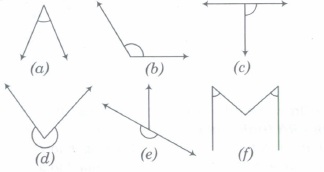
Classify each one of the following angles as right, straight, acute, obtuse or refles.
4.
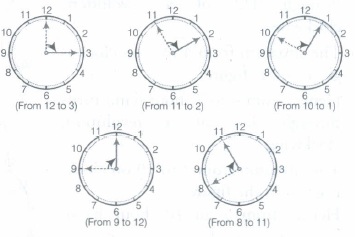
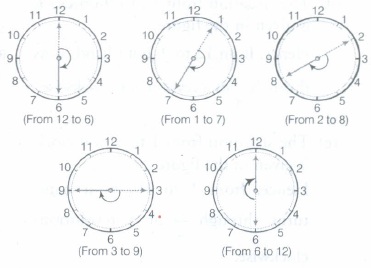
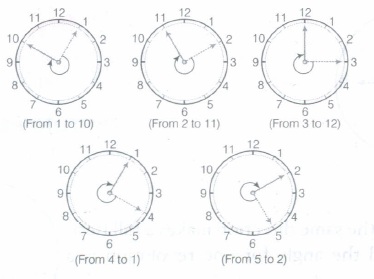
Draw five other situations of one-fourth, half and three-fourth revolution on a clock.
5.
In obtuse angled triangle, there are two angles whose measure is greater than 90°.
6.
In a ΔABC, \(\angle B = 90°\) and AB = BC. Then, ΔABC is right angled isosceles triangle.
7.
Sum of interior angles of scalene triangle and equilateral triangle are different.
8.
A scalene triangle has unequal measure of angle and also has unequal length of sides.
9.
If m\(\angle A\) = 53° and m \(\angle B\) = 35°, then m \(\angle A\) > m \(\angle B.\)
10.
When the sum of the measures of two angles is that of a straight angle and if one of them is acute, then the other should be _______
11.
When the sum of the measures of two angles is that of a right angle, then each one of them is ______.
12.
An angle whose measure is the sum of the measures of two right angles is ______
13.
An angle whose measure is greater than that of a right angle is _______
14.
An angle whose measure is less than that of a right angle is _____
15.
Sphere
16.
Cone
17.
1 obtuse angle
18.
2 sides of equal length
19.
3 sides of equal length
20.
Using the information given, name the right angles in each part of figure.
BA 丄 BD 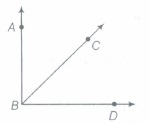
21.
Is it possible for the same, angle to have two different measures?
22.
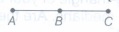
Will the lengths of line segment AB and line segment BC make the length of line segment AC in figure?
23.
Through what angle measure does the hour hand of a clock turn through, when it goes from 3 to 9?
90°
360°180° none of these
180°
none of these
24.
The angle measure for one-fourth revolution is
90°
360°
180°
none of these.
25.
Number of vertices in cylinder are
2
0
3
4
26.
If a bicycle wheel has 48 spokes, then the angle between a pair of two consecutive spokes is
\(\left( 5\frac { 1 }{ 2 } \right) ^{ 0 }\).
\(\left( 7\frac { 1 }{ 2 } \right) ^{ 0 }\).
\(\left( \frac { 2 }{ 11 } \right) ^{ 0 }\).
\(\left( \frac { 2 }{ 15 } \right) ^{ 0 }\).
27.
Measures of the two angles between hour and minutes hands of a clock at 9 O' clock are
60°, 300°
270°, 90°
75°, 285°
30°, 330°
28.
Consider the edges of a post card. Are the edges perpendicular?
29.
Is there any other alphabet which illustrates perpendicularity?
30.
If AB丄CD, then should we say that CD丄AB also?
1.
When we measure the length of a line segment by ruler, there may be some errors due to its thickness and angular viewing. These errors can be removed by measuring a line segment with the help of a divider. Hence, the use of a divider is better than a ruler.
2.
The disadvantage in comparing line segments by mere observation is that, sometimes the difference in lengths between two line segments may not accurate. So, we cannot always be sure about our usual judgement.
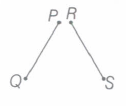
e.g. In the given figure, the line segments \(\overline{ PQ } \) and \(\overline{ RS } \) seems to be equal but actually they are not equal.
3.
We know that,
An angle which is smaller than a right angle is called an acute angle.
An angle with measure 90° is called a right angle.
An angle which is greater than a right angle but smaller than a straight angle is called an obtuse angle.
An angle with measure 180° is called a straight angle.
An angle which is greater than a straight angle but smaller than a complete angle is called a reflex angle.
Now, from these results
(a) Given angle is smaller than a right angle, so it is an acute angle.
(b) Given angle is more than a right angle, so it is an obtuse angle.
(c) Given angle is a right angle.
(d) Given angle is more than a straight angle, so it is a reflex angle.
(e) Given angle is a straight angle.
(f) Both angles are smaller than a right angle, so both these are acute angles.
4.
(i) One-fourth revolution For one-fourth revolution, the clock hand moves in many individual routes. Some of these situations on a clock are as follows:
(ii) Half revolution For half revolution, the clock hand moves in many individual routes. Some of these situations on a clock are as follows:
(iii) Three-fourth revolution For three-fourth revolution, the clock hand moves in many individual routes. Some of these situations on a clock are as follows:
5.
(b)
6.
(a)
7.
(b)
8.
(a)
9.
(a)
10.
()
obtuse angle
11.
()
acute angle
12.
()
straight angle
13.
()
obtuse angle
14.
()
acute angle
15.
()

16.
()

17.
()
Obtuse angled
18.
()
Isosceles
19.
()
Equilateral
20.
The right angles in each part of the given figure are as follow:
\(\angle ABD = 90°\)
21.
No, an angle cannot have two different measurements.
22.
Here, \(\overline { AB } +\overline { BC } =\overline { AC } \)
Hence, the length of line segment \(\overline{ AB } \) and \(\overline{ BC } \) make the length of line segment \(\overline{ AC } \).
23.
(c)
180°
24.
25.
(b)
0
26.
(b)
\(\left( 7\frac { 1 }{ 2 } \right) ^{ 0 }\).
27.
(b)
270°, 90°
28.
()
Yes.
29.
()
Yes.L.
30.
()
Yes

6th Standard CBSE Syllabus & Materials
6th Standard CBSE
CBSE 6th Social Science Locating Places on the Earth - New Sample Question Papers Study Material - QB365 Set A
NEW6th Standard CBSE
CBSE 6th Science A Journey Through States of Water - New Sample Question Papers Study Material - QB365 Set A
NEW6th Standard CBSE
CBSE 6th Science Temperature and its Measurement - New Sample Question Papers Study Material - QB365 Set A
NEW6th Standard CBSE
CBSE 6th Science Materials Around Us - New Sample Question Papers Study Material - QB365 Set A



NCERT Books

Syllabus

Exam Pattern

Sample Question Papers

Previous year Question Papers

Important Notes

MCQ Practice test

NCERT Exemplers

Case study Questions

Image Based Questions

Passage based Questions

HOT Questions

Value Based Questions

Model Questions Papers
NCERT ( Book Back ) Questions

Assertion and Reason
Important Questions And Answers

CBSE 6th Standard CBSE Subjects
CBSE Standards


