
 100% FREE ACCESS
6th Standard CBSE Syllabus & Materials
6th Standard CBSE
CBSE 6th Social Science The Value of Work - New Sample Question Papers Study Material - QB365 Set A
NEW6th Standard CBSE
CBSE 6th Social Science Family and Community - New Sample Question Papers Study Material - QB365 Set A
NEW6th Standard CBSE
CBSE 6th Social Science India's Cultural Roots - New Sample Question Papers Study Material - QB365 Set A
NEW6th Standard CBSE
CBSE 6th Social Science India,That is Bharat - New Sample Question Papers Study Material - QB365 Set A
NEW6th Standard CBSE
CBSE 6th Social Science Timeline and sources of history - New Sample Question Papers Study Material - QB365 Set A
NEW6th Standard CBSE
CBSE 6th Social Science Oceans and Continents - New Sample Question Papers Study Material - QB365 Set A

Published on: 24/10/2025
Download CBSE Class 6th Standard CBSE Mathematics question papers, sample papers, important questions, and previous year solved papers in PDF format. Get free study materials, NCERT solutions, and exam preparation resources for Class 6th Standard CBSE Mathematics
Questions + Answers key
Take MCQ Mathematics Test
1.
Find the common factors of
(a) 8, 12, 20
(b) 9,15,21.
2.
Fill the entries in the blanks left:
| Number | TLakh | Lakh | TTh | Th | H | T | O | Number Name |
| 7,34,543 | - | 7 | 3 | 4 | 5 | 4 | 3 | Seven lakh thirty four thousand five hundred forty three. |
Expansion:
...................
32,75,829
3 x 10,00,000 + 2 x 1,00,000 + 7 x 10,000 + 5 x 1000 + 8 x 100 + 2 x 10 + 9
3.
Following is the account of a shopkeeper which shows profit and loss from the sale of certain items. Using proper sign in the above account, fill up the blanks.
| Name of items | Profit | Loss | Representation with proper sign |
| Mustard oil Rice Black pepper Wheat Groundnut oil |
Rs.150 Rs.225 Rs.200 |
|
________ ________ ________ ________ ________ |
4.
If \(\vec {PQ}\) is a ray,
(a)What is its starting point?
(b)Where does the point Q lie on the ray?
(c)Can we say that Q is the starting point of this ray?
5.
Give the factorisation of 136
6.
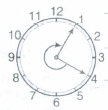
Write the revolution for each figure.
7.
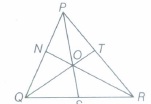
Draw any triangle of your choice, then draw all the three medians. Are they passing through one point?
8.
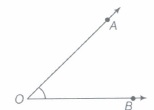
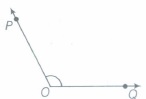
Using a ruler only, draw an acute, obtuse and reflex angle.
9.
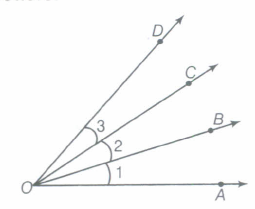
In the following figure, name the angles using three letters.
(a) \(\angle 1\)
(b)\(\angle 2\)
(c)\(\angle 3\)
10.
If 29484 people were seen a football match at a football ground. Write the people to the nearest thousand.
11.
Solve the following using Brackets.
54 \(\times\) 105
12.
Draw a rough sketch of quadrilateral PQRS, write
(a) two pair of opposite sides
(b) two pair of adjacent sides.
13.
Give a rough estimate (by rounding oft to nearest hundreds) and also a closer estimate (by rounding off to nearest tens) 439+ 334+ 4317
14.
Using divisibility tests, determine the following number is divisible by 6? 297144
15.
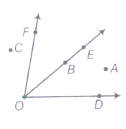
In the given diagram, name the point(s).
(a) In the interior of \(\angle DOE\).
(b) In the exterior of \(\angle EOF\).
(c) On \(\angle EOF\).
16.
What is closed curve? Draw a closed curve.
17.
A box contains 2,00,000 medicine tablets each weighing 20 mg. What is the total weight of all the tablets in the box in grams and in kilograms?
18.
If the product of two whole numbers is zero, can we say that one or both of them will be zero? Justify through examples.
19.
(a) Name the rays given in this picture.
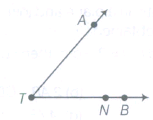
(b) Is 'T' a starting point of each of these rays?
20.
A bus started its journey and reached different places with a speed of 60 km/h. The journey is shown below:
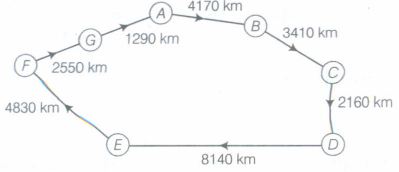
(i) Find the total distance covered by the bus from A to D.
(ii) Find the total distance covered by the bus from D to G.
(iii) Find the total distance covered by the bus, if it starts from A and returns back to A.
(iv) Can you find the difference of distances from C to D and D to E?
(v) Find out the time taken by the bus to reach
(a) A to B (b) C to D (c) E to G (d) Total journey.
21.
Draw a rough figure and label suitably in each of the following cases.
(a) Point P lies on \(\bar {AB}\).
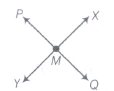
(b)\(\overleftrightarrow {XY}\) and\(\overleftrightarrow {PO}\) intersect at M.
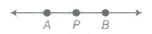
(c) Line I contains E and F but not D.
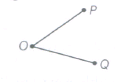
(d)\(\overleftrightarrow {OP}\) and \(\overleftrightarrow {OQ}\) meet at O.
22.
You have the digits 4, 5, 6, 0, 7 and 8. Using them, make five numbers each with 6-digits.
(a) Put commas for easy reading.
(b) Arrange them in ascending and descending orders.
23.
The HCF of 36 and 84 is
3
4
6
12
24.
5g=
0.005 kg
0.05 kg
0.5 kg
none of these
25.
How many vertices are there in a quadrilateral?
1
2
3
4
26.
How many vertices are there in the following figure?
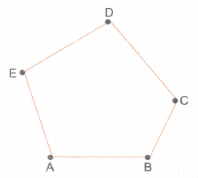
5
3
2
4
27.
'3+ 5 = 5 + 3' The above is known as
closure property
commutativity of addition
commutativity of multiplication
none of these.
28.
On subtracting \(\frac{6}{13}\) from \(\frac{11}{13}\) the result is
5/13
2/13
3/13
8/13
29.
Using tally marks, which one of the following represents the number eight?
IIII II
.png)
.png)
.png)
30.
In figure, AB = BC and AD = BD = DC. Then, the number of isosceles triangles in the figure is
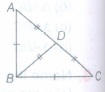
1
2
3
4
31.
Look at all these representations of fraction.
.png)
These fractions are \(\frac { 1 }{ 2 } ,\frac { 2 }{ 4 } ,\frac { 3 }{ 6 } \)representing the parts takenjrom the total numberofparts./fwe place the pictorial representation of one over the other they are found to be equal. Do you agree?
32.
Can you now write the rule for making patterns of F?
33.
In step 2 above, what would happen if we take radius to be smaller than half the length BC?
34.
If AB丄CD, then should we say that CD丄AB also?
35.
How many lakhs make a million?
36.
Look at the following figures:
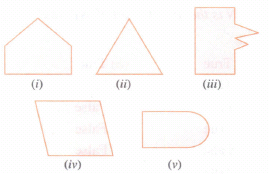
What can you say? Are they closed?
1.
(a) Factors of 8 are: 1,2,4 and 8
Factors of 12 are: 1,2,3,4,6 and 12
Factors of 20 are: 1,2,4,5, 10 and 20
Hence, common factors of 8, 12 and 20 are 1, 2 and 4.
(b) Factors of9 are 1,3 and 9
Factors of 15 are 1, 3, 5 and 15
Factors of 21 are 1,3, 7 and 21
Hence, common factors of 9, 15 and 21 are 1 and 3.
2.
| Number | TLakh | Lakh | TTh | Th | H | T | O |
| 7,34,543 | - | 7 | 3 | 4 | 5 | 4 | 3 |
| Number Name | Expansion |
| Seven lakh thirty four thousand five hundred forty three |
7 x 1,00,000 + 3 x 10,000 + 4 x 1000 + 5 x 100 + 4 x 10 + 3 |
32,75,829 3 2 7 5 8 2 9
Thirty two lakh seventy five thousand eight hundred twenty nine - 3 x 10,00,000 + 2 x 1,00,000 + 7 x 10,000 + 5 x 1000 + 8 x 100 + 2 x 10 + 9.
3.
| Name of items | Profit | Loss | Representation with proper sign |
| Mustard oil Rice Black pepper Wheat Groundnut oil |
Rs.150 Rs.225 Rs.200 |
|
+Rs.150 -Rs.250 +Rs.225 +Rs.200 -Rs.330 |
4.
If \(\vec {PQ}\) is a ray, then
(a)its starting point is P.
(b)point Q lies on the way of ray \(\vec {PQ}\)
(c)No, Q is not the starting point of this ray.
5.
We have, 136
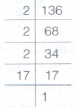
\(\therefore\)136=1x2x2x2x17
6.
\(\frac { 3 }{ 4 } \) revolution
7.
According to the given information, ΔPQR has medians \(\overline{ PS } ,\overline { QT } \) and \(\overline { RN } \). Yes, these medians passing through one point 'O'.
8.
(a) Acute \(\angle AOB\)
(b)
Obtuse \(\angle POQ\)
(c) Reflex \(\angle ROS\)
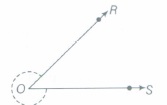
9.
Here, we can write the name of angles with the help of given figure:
(a) \(\angle 1=\angle AOB\)
(b)\(\angle 2=\angle BOC\)
(c)\(\angle 3=\angle COD\)
10.
29000 (nearest thousand)
11.
54 \(\times\) 105 = 54 \(\times\) (100 + 5)
= 5400 + 54 \(\times\) 5 = 5400 + 270 = 5670
12.
In quadrilateral PQRS,
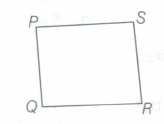
(a) Opposite sides are QR and PS, PQ and SR.
(b) Adjacent sides are \(\bar {PQ}\ and\ \bar {QR},\bar {QR}\ and\ \bar {RS},\bar {RS}\ and\ \bar{SP},\bar {SP}\ and\ \bar {PQ}\).
13.
We have, 439 + 334 + 4317
\(\therefore \begin{matrix} 439\rightarrow 400 \\ 334\rightarrow 300 \\ 4317\rightarrow 4300 \end{matrix}\} [rounding\quad off\quad to\quad nearest\quad hundreds]\)
∴ Rough estimate = 439 + 334 + 4317
= 400 + 300 + 4300 = 5000
\(Again\begin{matrix} 439\rightarrow 440 \\ 334\rightarrow 330 \\ 4317\rightarrow 4320 \end{matrix}\} [rounding\quad off\quad to\quad nearest\quad tens]\)
and closer estimate = 439 +334 +4317
= 440 + 330 + 4320 = 5090
14.
We have, 297144
(i) Divisibility by 2
\(\because\)Unit digit of number = 4, so 297144 is divisible by2.
(ii) Divisibility by 3
Sum of digits of given number = 2 + 9 + 7 + 1+ 4 + 4 = 27
\(\because\) 27 is divisible by 3, so 297144 is also divisible by 3.
Now, we see that 297144 is divisible by 2 and 3 both.
Hence, it is divisible by 6.
15.
(a) In given figure, point A lies between the sides OD and OE.
So, it is in the interior of\(\angle DOE\).
(b) In given figure, points C, A and D are in the exterior of \(\angle EOF\).
(c) In given figure, point E, B, O and F lie on the sides OE and OFof \(\angle EOF\), so these points are on \(\angle EOF\).
16.
A curve, which cut itself called closed curve.
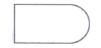
17.
Given, weight of one tablet = 20 mg
Total weight of 200000 tablets in the box = 200000 \(\times\) 20 mg
=4000000 mg
Now, weight in grams =\(\frac{4000000}{1000}g=4000g\) \(\left[ \because \quad 1mg=\frac { 1 }{ 1000 } g \right] \)
Now, weight in kilograms =\(\frac{4000}{1000}kg=4kg\) \(\left[ \because \quad 1g=\frac { 1 }{ 1000 } kg \right] \).
18.
Yes, if the product of two whole numbers is zero, then one or both of them will be zero. Since, we know that the product of any whole number with zero is always zero i.e. a x 0 = 0, where a is any whole number and 0 x 0 = 0. Some examples are as follows:
| Whole number | Product | Is the product zero? | |
| (a x 0) | (0 x a) | ||
| 5 | 5 x 0 = 0 | 0 x 5 = 0 | Yes |
| 3 | 3 x 0 = 0 | 0 x 3 = 0 | Yes |
| 0 | 0 x 0 = 0 | 0 x 0 = 0 | Yes |
| 4 | 4 x 0 = 0 | 0 x 4 = 0 | Yes |
| 25 | 25 x 0 = 0 | 0 x 25 = 0 | Yes |
19.
We know that, a ray is a part of a line which starts at one point and goes endlessly in a direction.
(a) In the given figure, there are four rays namely \(\vec {TA}\), \(\vec {TN}\), \(\vec {NB}\) and \(\vec {TB}\).
(b) No, T is not a starting point of each of these rays. T is a starting point of \(\vec {TA}\), \(\vec {TB}\) and \(\vec {TN}\) only but not of \(\vec {NB}\).
20.
From the given figure,
(i) Total distance covered by bus from A to D
= AB + BC + CD =4170 +3410 + 2160 =9740 km
(ii) Total distance covered by bus from D to G
= DE + EF + FG = 8140 + 4830 + 2550 = 15520 km
(iii) Total distance covered by bus = Distance from A to D + Distance from D to G + Distance from G to A
=9740+15520+1290 [from (i) and (ii) parts)
=26550 km
(iv) Distance from C to D = 2160 km
Distance from D to E = 8140 km
∴ Difference of distances from C to D and D to E
=8140 - 2160 = 5980 km
(v) To find out the time for individual places, we will use the formula of time i.e.
\(Time=\frac { Distance }{ Speed } \)
(a) Time taken by bus to reach from A to B
\(=\frac { Distance\quad from\quad AtoB }{ Speed } =\frac { 4170 }{ 60 } =\frac { 139 }{ 2 } =69\frac { 1 }{ 2 } h\)
(b) Time taken by bus to reach from C to D
\(=\frac { Distance\quad from\quad CtoD }{ Speed } =\frac { 2160 }{ 60 } =36h\)
(c) Time taken by bus to reach from E to G
\(=\frac { Distance\quad from\quad EtoG }{ Speed } =\frac { 4830+2550 }{ 60 } =\frac { 7380 }{ 60 } =123h\)
(d) Time taken by bus for total journey
\(=\frac { Total\quad distance\quad covered }{ Speed } =\frac { 26550 }{ 60 } =\frac { 885 }{ 2 } =442\frac { 1 }{ 2 } h\).
21.
A rough figure in each of the cases is given below:
(a) Point P lies on \(\bar {AB}\).
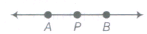
(b)\(\overleftrightarrow {XY}\) and \(\overleftrightarrow {PO}\) intersect at M.
(c) Line I contains E and F but not D.
(d) \(\overleftrightarrow {OP}\) and \(\overleftrightarrow {OQ}\) meet at O.
22.
Given digits are 4, 5, 6, 0, 7 and 8.
We can make many numbers by using these digits, five of them are as follows:
876540, 867540, 876450, 876045 and 867405
(a) After putting commas, numbers are as follows:
(i) 8,76,540 (ii) 8,67,540
(iii) 8,76,450 (iv) 8,76,045
(v) 8,67,405
(b) Ascending order of numbers is as follows:
867405 < 867540 < 876045 < 876450 < 876540
Descending order of numbers is as follows:
876540 > 876450 > 876045 > 867540 > 867405.
23.
(d)
12
24.
(a)
0.005 kg
25.
(d)
4
26.
(a)
5
27.
(b)
commutativity of addition
28.
(a)
5/13
29.
(d)
30.
(c)
3
31.
()
Yes.
32.
()
Yes! the required rule is as follows:
Number of matchsticks required = 4n where n is a variable which can take any value 1,2, 3, 4, ..., etc.
33.
()
The arcs drawn with B and C as centres will not intersect each other.
34.
()
Yes
35.
()
Ten lakhs make a million.
36.
()
Yes

6th Standard CBSE Syllabus & Materials
6th Standard CBSE
CBSE 6th Social Science Locating Places on the Earth - New Sample Question Papers Study Material - QB365 Set A
NEW6th Standard CBSE
CBSE 6th Science A Journey Through States of Water - New Sample Question Papers Study Material - QB365 Set A
NEW6th Standard CBSE
CBSE 6th Science Temperature and its Measurement - New Sample Question Papers Study Material - QB365 Set A
NEW6th Standard CBSE
CBSE 6th Science Materials Around Us - New Sample Question Papers Study Material - QB365 Set A



NCERT Books

Syllabus

Exam Pattern

Sample Question Papers

Previous year Question Papers

Important Notes

MCQ Practice test

NCERT Exemplers

Case study Questions

Image Based Questions

Passage based Questions

HOT Questions

Value Based Questions

Model Questions Papers
NCERT ( Book Back ) Questions

Assertion and Reason
Important Questions And Answers

CBSE 6th Standard CBSE Subjects
CBSE Standards


