
 100% FREE ACCESS
6th Standard CBSE Syllabus & Materials
6th Standard CBSE
CBSE 6th Social Science The Value of Work - New Sample Question Papers Study Material - QB365 Set A
NEW6th Standard CBSE
CBSE 6th Social Science Family and Community - New Sample Question Papers Study Material - QB365 Set A
NEW6th Standard CBSE
CBSE 6th Social Science India's Cultural Roots - New Sample Question Papers Study Material - QB365 Set A
NEW6th Standard CBSE
CBSE 6th Social Science India,That is Bharat - New Sample Question Papers Study Material - QB365 Set A
NEW6th Standard CBSE
CBSE 6th Social Science Timeline and sources of history - New Sample Question Papers Study Material - QB365 Set A
NEW6th Standard CBSE
CBSE 6th Social Science Oceans and Continents - New Sample Question Papers Study Material - QB365 Set A

Published on: 24/10/2025
Download CBSE Class 6th Standard CBSE Mathematics question papers, sample papers, important questions, and previous year solved papers in PDF format. Get free study materials, NCERT solutions, and exam preparation resources for Class 6th Standard CBSE Mathematics
Questions + Answers key
Take MCQ Mathematics Test
1.
Solve \(\frac { 4 }{ 9 } +\frac { 2 }{ 7 } \)
2.
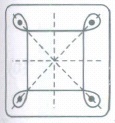
How many lines of symmetry are there for the following figures?
3.
Insert the commas at appropriate places according to International system of numeration 7869420
4.
Write four negative integers greater than -20 .
5.
Find using distributive property 4275 x 125.
6.
Write all the factors of the following number: 36
7.
Find the product by suitable rearrangement 4 x 166 x 25.
8.
4.56 + 9.25 = _______________
9.
\(\frac{5}{17}+\frac{11}{17}\)is equal to ______ .
10.
The number of lines of symmetry in a rectangle and a square are ______. (equal / unequal).
11.
An equilateral triangle has _____ lines of symmetry.
12.
Area of a rectangle with length 5 cm and breadth 3 cm is------
13.
The tally marks  represent __________.
14.
The additive inverse of 14 is _________
15.
10005 x 0 = ___________.
16.
A number which has more than two factors is called a ________________
17.
1 million = ____ lakhs
18.
Add the following 270.24 + 12.52 + 1.5
19.
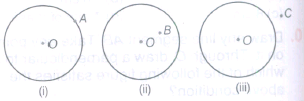
Given, a circle of radius 3.1 cm, mark points A Band C such that
(i) A is on the circle.
(ii) B is in the interior of the circle.
(iii) C is in the exterior of the circle.
20.
The pocket money of A B and C are Rs 600, Rs 500 and Rs 550, respectively. Find the
(a) ratio of pocket money of A to that of B.
(b) ratio of pocket money of A to that of C.
21.
Write the letters of the word' MATHEMATICS' which have no line of symmetry.
22.
The following pictograph depicts the information about the areas in sq km (to nearest hundred) of some districts of Chhattisgarh State.
.png)
(a) What is the area of Karia district?
(b) Which two districts have the same area?
(c) How many districts have area more than 5000 square kilometres?
23.
The area of a rectangular garden 50 m long is 300sq m. Find the width of the garden.
24.
Use number line and add the following integers
9+ (-6)
25.
Find the value of 968 x 73 + 968 x 27?
26.
Find the difference between the greatest and the least numbers that can be written using the digits 6, 2, 7, 4, 3 each only once.
27.
A Book exhibition was held for four days in a school. The number of tickets sold at the counter on the first, second, third arid final days was respectively 1094, 1812, 2050 and 2751. Find the total number of tickets sold on all the four days.
28.
See the figure and find the ratio of
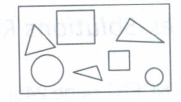
(a) number of triangles to the number of circles inside n the rectangle.
(b) number of squares to all the figures inside the rectangle.
(c) number of circles to all the figures inside the rectangle.
29.
In a Mathematics test, the following marks were obtained by 40 students. Arrange these marks in a table using tally marks.
| 8 | 1 | 3 | 7 | 6 | 5 | 5 | 4 | 4 | 2 |
| 4 | 9 | 5 | 3 | 7 | 1 | 6 | 5 | 2 | 7 |
| 7 | 3 | 8 | 4 | 2 | 8 | 9 | 5 | 8 | 6 |
| 7 | 4 | 5 | 6 | 9 | 6 | 4 | 4 | 6 | 6 |
(a) Find how many students obtained marks equal to or more than 7.
(b) How many students obtained marks below 4?
30.
Write the following decimals in the place value table.
(a) 0.29 (b) 2.08 (c) 19.60 (d) 148.32 (e) 200.812
31.
There are 30 boys and 20 girls in a class. The ratio of the number of girls to the number of boys is
2:3
3:2
2:5
3:5
32.
The prime number which is even is
2
3
5
13
33.
Perimeter of a square=
4 x Length of a side
2 x Length of a side
3 x Length of a side
6 x Length of a side
34.
Express \(\frac { 9 }{ 4 } \) as a mixed fraction.
\(2\frac { 1 }{ 4 } \)
\(3\frac { 1 }{ 4 } \)
\(4\frac { 1 }{ 4 } \)
\(5\frac { 1 }{ 4 } \)
35.
(-2)+(+3)=?
-2
+3
+1
-1
36.
The successor of 99 is
99
98
100
none of these.
37.
In the given figure, point B lies
.png)
interior
exterior
both (a) and (b)
None of these
38.
\(19+\frac { 5 }{ 10 } +\frac { 7 }{ 100 } \) in decimal form is written as
19.75
19.057
19.705
19.57
39.
If \(\frac{3}{4}\) is equivalent to , then \(\frac{x}{24}\)the value of x is
15
20
16
18
40.
In Indian system of numeration, the number 58695376 is written as
58,69,53,76
58,695,376
5,86,95,376
586,95,376
1.
\(\frac { 4 }{ 9 } +\frac { 2 }{ 7 } =\frac { 46 }{ 63 } \)
2.
This figure has four lines of symmetry.
3.
According to International system of numeration 7,869,420
4.
Negative integers greater than -20 on the number line are shown as below:

When we move on the number line to the right, then the value of integer increases.
So, it is clear that from the figure that when we move right of -20, we will get integers greater than -20. So, four negative integers greater than -20 are -19, -18, -17 and -16.
5.
We have, 4275 x 125 = 4275 x (100 + 20 + 5)
= 4275 x 100 + 4275 x 20 + 4275 x 5 [by distributive property of multiplication over addition]
= 427500 + 85500 + 21375
= 513000 + 21375 = 534375.
6.
We have, 36
36 = 1x 36; 36 = 2 x 18; 36 = 3 x 12;
36=4x9;36=6x6
\(\therefore\)Factors of 36 are 1, 2, 3, 4, 6, 9,12,18 and 36.
7.
We have, 4 x 166 x 25 = (4 x 25) x 166
= 100 x 166 = 16600.
8.
()
13.81
9.
()
We have, \(\frac{5}{17}+\frac{11}{17}=\frac{5+11}{17}=\frac{16}{17}\)
10.
()
unequal.
11.
()
three
12.
Area = 5 x 3 = 15 sq cm
13.
()
13
14.
The additive inverse of 14 is -14.
15.
()
0
16.
()
composite number.
17.
We know that,
1 million = 1000000 (in digits)
= 10 \(\times\)100000 = ten \(\times\) one lakhs (in number name)
∴1 million = ten lakhs
18.
Here, 270.24 + 12.52+ 1.5 can be written as
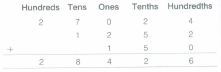
270.24 + 12.52 + 1.50 = 284.26
19.
The required circles, are given below.
20.
(a) 6 : 5
(b) 12 : 11
21.
Here, the letter S has no line of symmetry.
22.
(a) Area of Karia district = 6000 sq km
(b) Raigarh and Jashpur have the same area.
(c) Four districts have area more than 5000 sq km.
23.
Given, area of the rectangular garden = 300 sq m
and length of the rectangular garden = 50 m
We know that,
Area of the rectangular garden = Length \(\times\) Breadth
⇒ 300 sq m = 50 m \(\times\) Breadth
∴ Breadth =\(\frac { 300\quad sqm }{ 50m } =6m\)
Hence, the breadth or width of the garden is 6 m.
24.
We have, 9 + (- 6)

Firstly,draw a number line, then, wemove 9 steps to the right of 0 and reach at 9. Now,wemove6 steps to thelen of9 [∴ -6 is a negative integer] and reach at 3, as shown in the above figure. Hence, 9 + (-6) = 3
25.
We have, 968 x 73 + 968 x 27
= 968 (73 + 27) [taking 968 as common term]
= 968 x 100 = 96800.
26.
Using the digits 6, 2, 7, 4 and 3, we get
Greatest number = 76,432 and least number = 23,467
∴ Difference = Greatest number - Least number
=76,432 - 23,467 = 52,965.
27.
Given, number of tickets sold on the first day = 1094
Number of tickets sold on the second day = 1812
Number of tickets sold on the third day = 2050
Number of tickets sold on the fourth day = 2751
∴ Total number of tickets sold on all the four days
= 1094 + 1812 + 2050 + 2751 = 7707
Hence, there are 7707 tickets sold on all the four days.
28.
In the given figure,
Number of triangles = 3; Number of squares = 2
Number of circles = 2
\(\therefore\) Total number of figures = 3 + 2 + 2 = 7
(a) Required ratio of number of triangles to the number of circles \(=\frac{Number\ of\ triangles}{Number\ of\ circles}=\frac{3}{2}=3:2\)
(b) Required ratio of number of squares to all the figure \(=\frac{Number\ of\ squares}{Total\ number\ of\ figures}=\frac{2}{7}=2:7\)
(c) Required ratio of number of circles to all the figure \(=\frac{Number\ of\ circles}{Total\ number\ of\ figures}=\frac{2}{7}=2:7\)
29.
The table with tally marks is shown below:
| Marks | Tally marks | Number of students |
| 1 | II | 2 |
| 2 | III | 3 |
| 3 | III | 3 |
| 4 | .png) |
7 |
| 5 | .png) |
6 |
| 6 | |
7 |
| 7 | .png) |
5 |
| 8 | IIII | 4 |
| 9 | III | 3 |
| Total | 40 |
(a) Here, we have to find out the students, who obtained marks equal to 7 or more than 7. So, we have to add the number of students who obtained marks equal to 7 or more than 7 i.e. 7, 8 and 9.
\(\therefore\) Number of those students = 5 + 4 + 3 = 12
Hence, 12 students obtained marks equal to 7 or more than 7.
(b) Here, we have to find out the students who obtained marks below 4.
So, we have to add the number of students who obtained marks below 4 i.e. 1, 2 and 3.
\(\therefore\) Number of those students = 3 + 3 + 2 = 8
Hence, 8 students obtained marks below 4.
30.
The given decimals can be written as
(a) 0.29=\(0+\frac { 2 }{ 10 } +\frac { 9 }{ 100 } \)
(b) 2.08=\(2+\frac { 0 }{ 10 } +\frac { 8 }{ 100 } \)
(c) 19.60=10+9+\(\frac { 6 }{ 10 } +\frac { 0 }{ 100 } \)
(d) 14832=100+40+8+\(\frac { 3 }{ 10 } +\frac { 2 }{ 100 } \)
(e) 200.812=200+00+0+\(\frac { 8 }{ 10 } +\frac { 1 }{ 100 } +\frac { 2 }{ 1000 } \)
Now, the place value table is given below:
| Decimal number | Hundreds (100) |
Tens (10) |
Ones (1) |
Tenths (1/10) |
Hundredths (1/100) |
Thousandths (1/1000) |
|
|---|---|---|---|---|---|---|---|
| (a) | 0.29 | 0 | 0 | 0 | 2 | 9 | 0 |
| (b) | 2.08 | 0 | 0 | 2 | 0 | 8 | 0 |
| (c) | 19.60 | 0 | 1 | 9 | 6 | 0 | 0 |
| (d) | 148.32 | 1 | 4 | 8 | 3 | 2 | 0 |
| (e) | 200.812 | 2 | 0 | 0 | 8 | 1 | 2 |
31.
\(\frac { 20 }{ 30 } =\frac { 2 }{ 3 } \)= 2:3
32.
(a)
2
33.
(a)
4 x Length of a side
34.
(a)
\(2\frac { 1 }{ 4 } \)
35.
(c)
+1
36.
(c)
100
37.
(a)
interior
38.
(d)
19.57
39.
(d)
18
40.
(b)
58,695,376

6th Standard CBSE Syllabus & Materials
6th Standard CBSE
CBSE 6th Social Science Locating Places on the Earth - New Sample Question Papers Study Material - QB365 Set A
NEW6th Standard CBSE
CBSE 6th Science A Journey Through States of Water - New Sample Question Papers Study Material - QB365 Set A
NEW6th Standard CBSE
CBSE 6th Science Temperature and its Measurement - New Sample Question Papers Study Material - QB365 Set A
NEW6th Standard CBSE
CBSE 6th Science Materials Around Us - New Sample Question Papers Study Material - QB365 Set A



NCERT Books

Syllabus

Exam Pattern

Sample Question Papers

Previous year Question Papers

Important Notes

MCQ Practice test

NCERT Exemplers

Case study Questions

Image Based Questions

Passage based Questions

HOT Questions

Value Based Questions

Model Questions Papers
NCERT ( Book Back ) Questions

Assertion and Reason
Important Questions And Answers

CBSE 6th Standard CBSE Subjects
CBSE Standards


