
 100% FREE ACCESS
6th Standard CBSE Syllabus & Materials
6th Standard CBSE
CBSE 6th Social Science The Value of Work - New Sample Question Papers Study Material - QB365 Set A
NEW6th Standard CBSE
CBSE 6th Social Science Family and Community - New Sample Question Papers Study Material - QB365 Set A
NEW6th Standard CBSE
CBSE 6th Social Science India's Cultural Roots - New Sample Question Papers Study Material - QB365 Set A
NEW6th Standard CBSE
CBSE 6th Social Science India,That is Bharat - New Sample Question Papers Study Material - QB365 Set A
NEW6th Standard CBSE
CBSE 6th Social Science Timeline and sources of history - New Sample Question Papers Study Material - QB365 Set A
NEW6th Standard CBSE
CBSE 6th Social Science Oceans and Continents - New Sample Question Papers Study Material - QB365 Set A

Published on: 24/10/2025
Download CBSE Class 6th Standard CBSE Mathematics question papers, sample papers, important questions, and previous year solved papers in PDF format. Get free study materials, NCERT solutions, and exam preparation resources for Class 6th Standard CBSE Mathematics
Questions + Answers key
Take MCQ Mathematics Test
1.
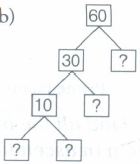
Here is a factor tree for 60. Write the missing number.
2.
A number is divisible by 6, 5 and 7. By which other number will that number be always divisible?
3.
Write the number 114 in roman numeral.
4.
A dealer purchased 139 VCR. If the cost of each set is Rs 24350. Find the cost of all the sets together.
5.
Estimate each difference to the nearest thousand (35863 - 27677)
6.
A milk dairy produced 75,678 L of milk in a day. It supplied 67,689 L of milk to milk depot. Find the milk left in the dairy.
7.
Write the number of expanded form 3\(\times\)10000 + 6 \(\times\)1000 + 4 \(\times\)100 + 3\(\times\)10 + 6 \(\times\)1.
8.
A taxi driver filled his car petrol tank with 40 L of petrol on Monday. The next day, he filled the tank with 50 L of petrol. If the petrol cost Rs 44 per litre, how much did he spend in all on petrol?
9.
Find the product by suitable rearrangement 625 x 279 x 16.
10.
Use the given digits without repetition and make the greatest and smallest 4-digit numbers. 1, 7, 6, 2.
11.
Solve the following using Brackets.
54 \(\times\) 105
12.
In a school, there are four sections of class VI. Each section has 50 students. Money collected for picnic from each student is Rs 125. Find the r total amount collected.
13.
Using divisibility tests, determine the following number is divisible by 6? 639210.
14.
Kirti bookstore sold books worth Rs. 2,85,891 in the first week of June and book worth Rs. 4,00,768 in the second week of the month. How much was the sale for the two weeks together? In which week was the sale greater and by how much?
15.
Study the pattern.
1 x 8 + 1 = 9
1234 x 8 + 4 = 9876
12 x 8 + 2 = 98
12345 x 8 + 5 = 98765
123 x 8 + 3 = 987
Write the next two steps.Can you say how the pattern works?
16.
Take two digits, say 2 and 3. Make 4-digit numbers using both the digits equal number of times.
(i) Which is the greatest number?
(ii) Which is the smallest number?
(iii} How many different numbers can you make in all?
17.
A box contains 50 packets of biscuits, each weighing 120 g. How many such boxes can be loaded in a van, which cannot carry beyond 900 kg?
18.
An auto driver filled his CNG cylinder with 30 kg of CNG. If the cost of CNG is Rs 38/kg, find the amount spent by the auto driver.
19.
| Raman's shop | The sales during the last year | |
| Things | Price | Apples 2457 kg |
| Apples | Rs.40 per kg | Oranges 3004 kg |
| Oranges | Rs.30 per kg | Combs 22760 |
| Combs | Rs.3 for one | Toothbrushes 25367 |
| Toothbrushes | Rs.10 for one | Pencils 38530 |
| Pencils | Rs.1 for one | Notebooks 40002 |
| Notebooks | Rs.6 for one | Soapcakes 20005 |
| Soapcakes | Rs.8 for one | |
(a) Can you find the total weight of apples and oranges Raman sold last year?
Weight of apples = ________kg
Weight of oranges = _______kg
Therefore, total weight = __ kg +__ kg = __ kg
(b) Can you find the total money Raman got by selling apples?
(c) Can you find the total money Raman got by selling apples and oranges together?
(d) Make a table showing how much money Raman received from selling each item? Arrange the entries of amount of money received in descending order. Find the item which brought him the highest amount. How much is this amount?
20.
Find the possible factors of 45, 30, 36.
21.
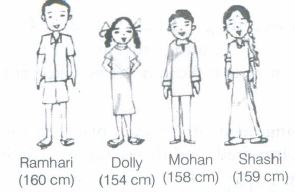
Who is the tallest? Who is the shortest?
(a) Can you arrange them in the increasing order of their heights?
(b) Can you arrange them in the decreasing order of their heights?
22.
24 x 25 = 24 x \(\frac{\Box}{4}\) = 600.
23.
10005 x 0 = ___________.
24.
450 is the successor of __________.
25.
The smallest prime number is___________
26.
1 million = ____ lakhs
27.
Which of the following statements is false?
All even numbers are composite numbers.
If an even number is divided by 2, the quotient may be odd or even
The sum of two odd numbers and one even number is even.
Sum of two prime numbers is not always even.
28.
The prime number which is even is
2
3
5
13
29.
Which of the following number is not a multiple of 6?
12
21
24
36
30.
In Roman numerals C stands for
10
100
1000
1
31.
Arrange the following numbers in descending order: 4000, 8500,50600, 7235.
50600, 8500, 7235, 4000
50600, 8500, 4000, 7235
50600,7235, 8500, 4000
50600,7235, 4000, 8500
32.
First triangular number is
3
6
10
15
33.
Which of the following will not represent zero?
0 +1
0 x 0
\(\frac { 0 }{ 2 } \)
\(\frac { 2-2 }{ 0 } \)
34.
Which of the following statements is true?
1is the smallest natural number.
50 is the predecessor of 49.
1 is the smallest whole number.
599 is the successor of 600.
35.
If the number 7254 *98 is divisible by 22, the digit at * is
1
2
6
0
36.
The number of distinct prime factors of the largest 4-digit number is
2
3
5
11
37.
The number formed by interchanging the digits 6 and 2 in 465271 is
467521
425671
165274
None of these
38.
Which of the following numbers is divisible by 11?
7249
250
1250
39.
The greatest number which always divides the product of the predecessor and successor of an odd natural number other than 1, is
6
4
16
32
40.
77 + 23 = 23 + 77 is an example of
closure property
associative property
commutative property
distributive property
41.
A number with 4 or more digits is divisible by 8 if the number formed by the last three digits is divisible by 8.
42.
The numbers 4578,4587,5478,5487 are in ascending order.
43.
Sum of two whole numbers is always less than their product.
44.
4.716 x 3 + 716 x 7 = 7160.
1.
\(\because\) 60 =30 x 2
30 = 10 x 3 and 10 = 5 x 2
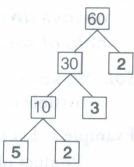
\(\therefore\)Hence, missing numbers are 2, 3, 5 and 2.
2.
210
3.
CXIV
4.
Rs 3384650
5.
8000
6.
Production of milk in one day = 75678 L 75678
Supply to milk depot in one day = 67689 L -67689
So, the milk left in the dairy = (75678 - 67689) = 7989 L 7989
7.
36436
8.
Given, quantity of petrol filled on Monday = 40 L
Quantity of petrol filled on the next day i.e. Tuesday = 50 L
Total quantity of petrol = 40 + 50 = 90 L
Cost of petrol = Rs 44 per litre
Total cost of petrol = Cost per litre x Total quantity of petrol
= 44 x 90 = Rs 3960
Hence, total cost of petrol is Rs 3960.
9.
We have, 625 x 279 x 16 = (625 x 16) x 279
= 10000 x 279 = 2790000.
10.
Here, descending order of the given digits is 7, 6, 2, 1
∴ Greatest number = 7621
and ascending order of the given digits is 1,2,6, 7.
∴ Smallest number = 1267.
11.
54 \(\times\) 105 = 54 \(\times\) (100 + 5)
= 5400 + 54 \(\times\) 5 = 5400 + 270 = 5670
12.
25000
13.
639210 is divisible by 6.
14.
Given, sale of books in Ist week = Rs. 2,85,891
Sale of books in IInd week = Rs. 4,00,768
Total sales of two weeks =Sale of Ist week + Sale of IInd week
= 2,85,891 + 4,00,768 = Rs. 6,86,659
Since, 4,00,768 > 2,85,891
Thus, sale in the second week is greater.
∴ Difference in the sales amount = 4,00,768 - 2,85,891
= Rs. 1,14,877
Hence, sale in the second week was greater by Rs. 1,14,877.
15.
It is clear that the next two steps will be
123456 x 8 + 6 = 987654
and 1234567 x 8 + 7 = 9876543
Pattern of the working is given below:
11 + 1 = 12
111 + 11 + 1 = 123
1111 + 111 + 11 + 1 = 1234
11111 + 1111 + 111 + 11 + 1 = 12345
\(\therefore\) 1 x 8 + 1 = 9 = 1+ 8 x 1
12 x 8 + 2 = 98 = (11 + 1) x 8 + 2
123 x 8 + 3 = 987 = (111 + 11 + 1) x 8 + 3
1234 x 8 + 4 = 9876
= (1111 + 111 + 11 + 1) x 8 + 4
12345 x 8 + 5 = 98765
= (11111 + 1111 + 111 + 11 + 1) x 8 + 5
and the next two steps will be work as
123456 x 8 + 6 = 987654
= (111111 + 11111 + 1111 + 111 + 11 + 1) x 8 + 6
1234567 x 8 + 7 = 9876543
= (1111111 + 111111 + 11111 + 1111 + 111 + 11 + 1) x 8 + 7.
16.
Two given digits are 2 and 3. We want to make 4-digit numbers using both the digit equal number of times.
The possible 4-digit numbers are 2233, 3322, 2332, 3223, 2323 and 3232.
(i) The greatest number is 3322.
(ii) The smallest number is 2233.
(iii) We can make 6 different numbers in all.
17.
Given, total number of packets = 50
Weight of each packet = 120 g
Weight of a box = 50 \(\times\) 120 g = 6000 g= 6 kg [∵ 1000 g = 1 kg]
∴ Required number of boxes = \(\frac{900}{6}=150\)
18.
Rs 1140
19.
(a) Weight of apples sold during the last year = 2457 kg
Weight of oranges sold during the last year = 3004 kg
∴ Total weight of apples and oranges Raman sold, during the last year = 2457 + 3004= 5461 kg
(b) Total money Raman got by selling apples
=Total number of apples \(\times\) Cost per kg
= 2457 \(\times\) 40 = Rs. 98280
(c) Total money Raman got by selling oranges
=Total number of oranges \(\times\) Cost per kg
=3004 \(\times\) 30 = Rs. 90120
∴ Total money Raman got by selling apples and oranges together =98280 + 90120 = Rs. 188400
(d) Following table shows the money received from selling items:
| Items | Sales | Rate | Money received |
| Apples | 2457 | Rs.40 per kg | 2457 \(\times\) 40 =Rs. 98280 |
| Oranges | 3004 | Rs.30 per kg | 3004 \(\times\) 30 = Rs. 90120 |
| Combs | 22760 | Rs.3 for one | 22760 \(\times\) 3 = Rs. 68280 |
| Toothbrushes | 25367 | Rs.10 for one | 25367\(\times\) 10 =Rs. 253670 |
| Pencils | 38350 | Rs.1 for one | 38350 \(\times\) 1= Rs. 38350 |
| Notebooks | 40002 | Rs.6 for one | 40002 \(\times\) 6 = Rs. 240012 |
| Soapcakes | 20005 | Rs.8 for one | 20005 \(\times\) 8 = Rs. 160040 |
The entries of amount of money received in descending order are as follows:
Rs. 253670 >Rs. 240012 >Rs. 160040 > Rs. 98280 > Rs. 90120 >Rs. 68280 > Rs. 38350
The item, which brought him the highest amount is tooth brushes. This amount is Rs. 253670.
20.
(i) We have, 45
On dividing 45 by 1,
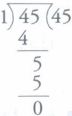
We get, divisor = 1 and quotient = 45
i.e. 1 x 45 = 45
So, 1 and 45 are factors of 45.
Now, on dividing 45 by 3,
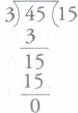
We get. divisor = 3 and quotient = 15
i.e. 3x15=45
so, 3 and 15 are factors of 45.
Again, on dividing 45 by 5,

We get, divisor = 5 and quotient = 9
i.e. 5 x 9 = 45
so, 5 and 9 are factors of 45.
Again, on dividing 45 by 9, we get quotient 5
i.e. 9 x 5 = 45
But it is repetition of the above step, so we will stop this process here.
Hence. factors of 45 are 1, 3. 5. 9. 15 and 45.
Note Here, on dividing 45 by 2, 4, 6, 7, ... , we get remainder. So, we will not consider these cases.
(ii) We have, 30
On dividing 30 by 1.
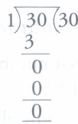
We get. divisor = 1 and quotient = 30
i.e. 1 x 30 = 30
So, 1 and 30 are factors of 30.
Now, on dividing 30 by 2.
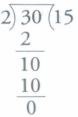
We get, divisor = 2 and quotient = 15
i.e. 2 x 15 = 30
So, 2 and 15 are factors of 30.
Again. on dividing 30 by 3,
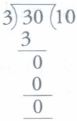
We get, divisor = 3 and quotient = 10
i.e. 3 x 10 = 30
so, 3 and 10 are factors of 30.
Again on dividing 30 by 5,

We get, divisor = 5 and quotient = 6
i.e. 5 x 6=30
So, 5 and 6 are factors of 30.
Again, on dividing 30 by 6, we get quotient 5.
But it is repetition of the above step, so we will stop this process here.
Hence, the factors of 30 are 1, 2, 3, 5, 6. 10, 15 and 30.
(iii) We have, 36
On dividing 36 by 1,
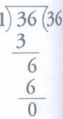
We get. divisor = 1 and quotient = 36
i.e. 1 x 36 = 36
So, 1 and 36 are factors of 36.
Now, on dividing 36 by 2.
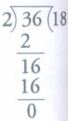
We get. divisor = 2 and quotient = 18
i.e. 2 x 18 =36
So, 2 and 18 are factors of 36.
Again, on dividing 36 by 3,
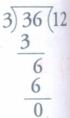
We get. divisor = 3 and quotient = 12
i.e. 3 x 12 = 36
So. 3 and 12 are factors of 36.
Again, on dividing 36 by 4,

We get, divisor = 4 and quotient = 9
i.e. 4 x 9 =36
So. 4 and 9 are factors of 36.
Again. on dividing 36 by 6,

We get, divisor = 6 and quotient = 6
i.e. 6 x 6 = 36
So. 6 and 6 are factors of 36.
Again, on dividing 36 by 9, we get quotient 4.
But it is repetition of the above second last step, so we will stop this process here.
Hence, factors of 36 are 1,2,3,4,6,9, 12, 18 and 36.
21.
(i) From the given figure, it is clear that,
160> 159> 158> 154
∴ Ramhari is the tallest, because he has the height of 160 cm.
(ii) From the given figure, it is clear that,
154 < 158 < 159 < 160
∴ Dolly is the shortest, because she has the height of 154 cm.
We can arrange height from two types:
(a) Yes, we can arrange their heights in increasing order as follows: Dolly (154 cm) < Mohan (158 cm) < Shashi (159 cm) < Ramhari (160 cm).
(b) Yes, we can arrange their heights in decreasing order as follows: Ramhari (160 cm) > Shashi (159 cm) > Mohan (158 cm) > Dolly (154 cm).
22.
()
100
23.
()
0
24.
Here, we will find predecessor of 450 = 450 - 1 = 449
So, 450 is the successor of 449.
25.
()
2
26.
We know that,
1 million = 1000000 (in digits)
= 10 \(\times\)100000 = ten \(\times\) one lakhs (in number name)
∴1 million = ten lakhs
27.
(a)
All even numbers are composite numbers.
28.
(a)
2
29.
(b)
21
30.
(b)
100
31.
(a)
50600, 8500, 7235, 4000
32.
(a)
3
33.
(a)
0 +1
34.
(a)
1is the smallest natural number.
35.
(c)
6
36.
(b)
3
37.
(b)
425671
38.
(a)
7249
39.
Let an odd natural number other than 1 be 3.
Predecessor of 3 = 3 - 1 = 2
Successor of 3 = 3 + 1 = 4
\(\therefore\) Product = 2 x 4 = 8
Now, LCM of predecessor and successor = 2 x 2 = 4
\(\therefore\) The greatest number which always divides the product of predecessor and successor of an odd natural number other than 1 is 4.
40.
If a and b are any two whole numbers, then a + b = b + a. This is commutative property.
41.
(a)
42.
(a)
43.
(b)
44.
(a)

6th Standard CBSE Syllabus & Materials
6th Standard CBSE
CBSE 6th Social Science Locating Places on the Earth - New Sample Question Papers Study Material - QB365 Set A
NEW6th Standard CBSE
CBSE 6th Science A Journey Through States of Water - New Sample Question Papers Study Material - QB365 Set A
NEW6th Standard CBSE
CBSE 6th Science Temperature and its Measurement - New Sample Question Papers Study Material - QB365 Set A
NEW6th Standard CBSE
CBSE 6th Science Materials Around Us - New Sample Question Papers Study Material - QB365 Set A



NCERT Books

Syllabus

Exam Pattern

Sample Question Papers

Previous year Question Papers

Important Notes

MCQ Practice test

NCERT Exemplers

Case study Questions

Image Based Questions

Passage based Questions

HOT Questions

Value Based Questions

Model Questions Papers
NCERT ( Book Back ) Questions

Assertion and Reason
Important Questions And Answers

CBSE 6th Standard CBSE Subjects
CBSE Standards


