
 100% FREE ACCESS
6th Standard CBSE Syllabus & Materials
6th Standard CBSE
CBSE 6th Social Science The Value of Work - New Sample Question Papers Study Material - QB365 Set A
NEW6th Standard CBSE
CBSE 6th Social Science Family and Community - New Sample Question Papers Study Material - QB365 Set A
NEW6th Standard CBSE
CBSE 6th Social Science India's Cultural Roots - New Sample Question Papers Study Material - QB365 Set A
NEW6th Standard CBSE
CBSE 6th Social Science India,That is Bharat - New Sample Question Papers Study Material - QB365 Set A
NEW6th Standard CBSE
CBSE 6th Social Science Timeline and sources of history - New Sample Question Papers Study Material - QB365 Set A
NEW6th Standard CBSE
CBSE 6th Social Science Oceans and Continents - New Sample Question Papers Study Material - QB365 Set A

Published on: 24/10/2025
Download CBSE Class 6th Standard CBSE Mathematics question papers, sample papers, important questions, and previous year solved papers in PDF format. Get free study materials, NCERT solutions, and exam preparation resources for Class 6th Standard CBSE Mathematics
Questions + Answers key
Take MCQ Mathematics Test
1.
The peculiar number:
There is a number which is very peculiar. This number is three times the sum of its digits. Can you find the number?
2.
Going up and down
In Mohan's house there are stairs for going up to the terrace and for going down to the godown.
Let us consider the number of stairs going up to the terrace as positive integer, the number of stairs going down to the godown as negative integer, and the number representing ground level as zero.
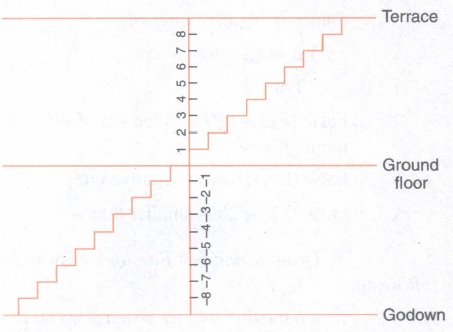
Do the following exercise and write down the answer as integer:
(a) Go 6 steps up from the ground floor.
(b) Go 4 steps down from the ground floor.
(c) Go 5 steps up from the ground floor and then go 3 steps up further from there.
(d) Go 6 steps down from the ground floor and then go down further 2 steps from there.
(e) Go down 5 steps from the ground floor and then move up 12·steps from there.
(f) Go 8 steps down from the ground floor and then go up 5 steps from there.
(g) Go 7 steps up from the ground floor and then 10 steps down from there.
Ameena wrote them as follows:
(a)+6
(b)-4
(c) (+ 5) + (+ 3) = + 8
(d) (-6) + (-2) =-4
(e)(-5)+(+12)=+7
(f)(-8) +(+5)=-3
(g) (+ 7) + (-10) = 17
She has made some mistakes. Can you check her answers and correct those that are wrong?
3.
Try arranging 18 marbles in rows and find the factors of 18
4.
In the word 'IMAGE', which letter has identical mirror image?
5.
Is this possible to draw a rough sketch of two triangles having two sides are common?
6.
India's population has been steadily increasing from 439 millions in 1961 to 1028 millions in 2001. Find the total increase in population from 1961 to 2001. Write the increase in population in Indian system of numeration, using commas suitably.
7.
Find the product of the smallest whole number with the largest three-digit whole number.
8.
Try to form a polygon with
(i) five matchsticks.
(ii) four matchsticks.
(iii) three matchsticks.
(iv) two matchsticks.
In which case was it not possible? Why?
9.
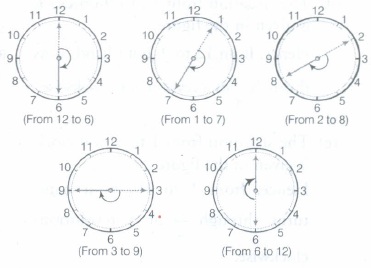
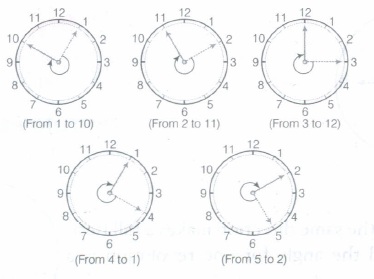
Draw five other situations of one-fourth, half and three-fourth revolution on a clock.
10.
Find the greatest and the smallest numbers. 6895, 23787, 24569, 24659.
1.
Let in the number,
unit's digit = x
and ten's digit = Y
Then, the number = 10y + x
Sum of the digits = x + y
According to the question,
10y + x = 3(x + y)
⇒ 10y + x = 3x + 3y
⇒ 2x=7y
⇒ x =\(\frac{7}{2}\)y
When y =0, x =0, which is impossible. When y = 1, x =\(\frac{7}{2}\), which is impossible. When y= 2, x= 7.
Hence, the required number is 27
2.
(a) correct
(b)correct
(c)correct
(d)Incorrect; the correct is (- 6) + (- 2) = - 8
(e)correct
(f)correct
(g)ncorrect; the correct is (+ 7) + (- 10) = - 3
3.
(i) 1 marble in each row

Number ofrows = 18
Total number of marbles = 1 x 18 = 18
(ii) 2 marbles in each row

Number of rows = 9
Total number of marbles = 2 x 9 = 18
(iii) 3 marbles in each row

Number of rows = 6
Total number of marbles = 3 x 6 = 18
(iv) 6 marbles in each row

Number of rows = 3
Total number of marbles = 6 x 3 = 18
(v) 9 marbles in each row

Number of rows = 2
Total number of marbles = 9 x 2 = 18
(vi) All 18 marbles in one row

Number of rows = 1
Total number of marbles = 18 x 1 = 18
Hence, 18 can be written as a product of two
numbers in different ways as:
18=1x18
18 = 2 x 9
18 = 3 x 6
18 = 6 x 3
18 = 9 x 2
18 = 18 x 1
Thus, 1,2,3,6,9 and 18 are exact divisors of 18.
4.
I, M, A
5.
No, cannot be possible.
6.
Given, population of India in 1961 = 439 millions
= 439 \(\times\)1000000 = 439000000 [∵ 1million = 1000000]
and population of India in 2001 = 1028 millions
= 1028\(\times\) 1000000 = 1028000000 [∵ 1 million = 1000000]
∴ Total increase in population from 1961 to 2001
= Population in 2001 - Population in 1961
= 1028000000 - 439000000 = 589000000
= 589 \(\times\) 1000000 = 589 millions
So, the increase population in Indian system of numeration = 58,90,00,000
7.
0
8.
We know that, if a closed simple figure is made up entirely of line segments, then it is called a polygon.
(i) Polygon with five matchsticks.
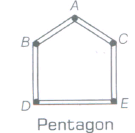
(ii) Polygon with four matchstick
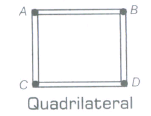
(iii) Polygon with three matchsticks
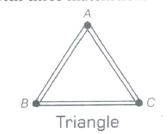
(iv) We know that, a polygon is a closed plane figure, bounded by line segments. So, with the help of two matchsticks, it is not possible to make a closed plane figure. Hence, no polygon is formed by two matchsticks.
9.
(i) One-fourth revolution For one-fourth revolution, the clock hand moves in many individual routes. Some of these situations on a clock are as follows:
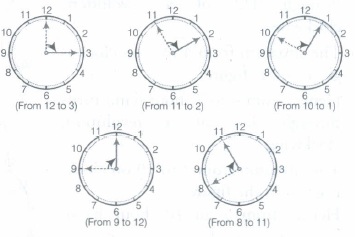
(ii) Half revolution For half revolution, the clock hand moves in many individual routes. Some of these situations on a clock are as follows:
(iii) Three-fourth revolution For three-fourth revolution, the clock hand moves in many individual routes. Some of these situations on a clock are as follows:
10.
We have, 6895, 23787, 24569, 24659
Here, 6895 is a 4-digit number and other numbers are 5 digits, so it is clear that 6895 is the smallest number. Now, in remaining three numbers, the digit at ten thousands place is same in each number. So, we compare the thousands place digit.
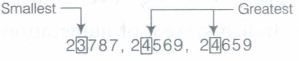
∵ 4>3
Again, in two numbers, digit at thousands place is same. So, we compare the hundreds place digit.

∵ 6>5
∴ The greatest number is 24659 and smallest number is 6895.

6th Standard CBSE Syllabus & Materials
6th Standard CBSE
CBSE 6th Social Science Locating Places on the Earth - New Sample Question Papers Study Material - QB365 Set A
NEW6th Standard CBSE
CBSE 6th Science A Journey Through States of Water - New Sample Question Papers Study Material - QB365 Set A
NEW6th Standard CBSE
CBSE 6th Science Temperature and its Measurement - New Sample Question Papers Study Material - QB365 Set A
NEW6th Standard CBSE
CBSE 6th Science Materials Around Us - New Sample Question Papers Study Material - QB365 Set A



NCERT Books

Syllabus

Exam Pattern

Sample Question Papers

Previous year Question Papers

Important Notes

MCQ Practice test

NCERT Exemplers

Case study Questions

Image Based Questions

Passage based Questions

HOT Questions

Value Based Questions

Model Questions Papers
NCERT ( Book Back ) Questions

Assertion and Reason
Important Questions And Answers

CBSE 6th Standard CBSE Subjects
CBSE Standards


