
 100% FREE ACCESS
6th Standard CBSE Syllabus & Materials
6th Standard CBSE
CBSE 6th Social Science The Value of Work - New Sample Question Papers Study Material - QB365 Set A
NEW6th Standard CBSE
CBSE 6th Social Science Family and Community - New Sample Question Papers Study Material - QB365 Set A
NEW6th Standard CBSE
CBSE 6th Social Science India's Cultural Roots - New Sample Question Papers Study Material - QB365 Set A
NEW6th Standard CBSE
CBSE 6th Social Science India,That is Bharat - New Sample Question Papers Study Material - QB365 Set A
NEW6th Standard CBSE
CBSE 6th Social Science Timeline and sources of history - New Sample Question Papers Study Material - QB365 Set A
NEW6th Standard CBSE
CBSE 6th Social Science Oceans and Continents - New Sample Question Papers Study Material - QB365 Set A

Published on: 29/11/2018
In this questions paper, the questions are covered from the entire syllabus. And the questions are prepared from NCERT and HOTs questions.
CBSE Class 6 is a crucial grade in your secondary school education. So learning with effective preparation is a must. Our study materials for CBSE Class 6 follow the latest CBSE syllabus and are prepared by subject experts who have much experience in the academic industry. By referring to our solutions, students get a clear understanding of each concept in detail. Students who have referred to our solutions have seen a significant increase in overall marks and ease in understanding the subjects. Our study materials are not only used by students but also by educational institutes in India.
You should know answers to these questions in all likelihood to score good marks in Class 6 Mathematics exam.
In this question paper, the questions are cover from the NCERT guidelines by the help of expert teachers.
The latest sample papers have been designed as per the latest blueprints, syllabus and examination trends. Sample papers should be practiced in examination condition at home or school and also show it to your teachers for checking or compare with the answers provided.
Download CBSE Class 6th Standard CBSE Mathematics question papers, sample papers, important questions, and previous year solved papers in PDF format. Get free study materials, NCERT solutions, and exam preparation resources for Class 6th Standard CBSE Mathematics
Questions + Answers key
Take MCQ Mathematics Test
1.
What will be the next number in the sequence?
1, 3, 6, 10, 15, ....
2.
Subtract 1.85 from 5.46.
3.
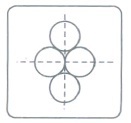
How many lines of symmetry are there for the following figures?
4.
The area of a rectangular piece of cardboard is 48 cm 2 and its breadth is 6 cm. What is the length of the cardboard?
5.
Find the place and face values of 7 in number 97621.
6.
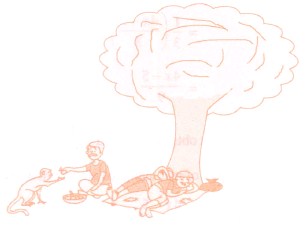
Three friends plucked some mangoes from a mango grove and collected them together in a pile and took nap after that. After some time one of the friends woke up and divided the mangoes into three equal numbers. There was one mango extra. He gave it to a monkey nearby, took one part for himself and slept again. Next the secondfriend got up unaware of what has happened, divided the rest of the mangoes into three equal shares. There was an extra mango. He gave it to the monkey, took one share for himself and slept again. Next the thirdfriend got up not knowing what happened and divided mangoes into three equal shares. There was an extra mango. He gave it to the monkey, took one share for himself and went to sleep again. After some time all of them got up together to find 30 mangoes. How many mangoes did the friends pluck initially?
7.
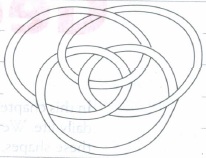
How many lines of symmetry does the given figure have?
8.
Cost of 3 dozen bananas is Rs 54. Rehman has Rs 18 with him. He wants to give bananas to the poor people on the street.
(a) How many bananas he can buy?
(b) Mention the value depict from Rehman?
9.
Find the greatest and the smallest numbers. 6895, 23787, 24569, 24659.
10.
The ratio of income to expenditure of Mr. Natarajan is 7: 5. if he saves Rs 2000 a month, what could be his income?
11.
Find the line of symmetry of English letter

12.
Using divisibility tests, determine the following number is divisible by 6? 1258
13.
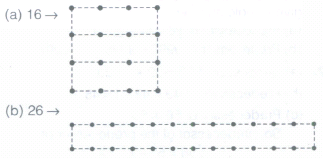
Write the following numbers as directed using dots.
(a) 16 as a square
(b) 26 as a rectangle.
14.
Where do you come across mixed fractions? Give some examples.
15.
State which of the following are equations (with a variable). Give reason for your answer. Identify the variable from the equations with a variable
2m < 30
16.
Take any post card. Use the above technique to measure its two adjacent sides.
17.
What is the greatest number, you can get?
1.
The given numbers are:
1, 3, 6, 10, 15, .
1, (1 + 2), (3 + 3), (6 + 4), (10 + 5), .....
∴ Next number in the sequence
= 15 + 6 = 21.
2.
We have, 5.46 - 1.85
Now,
\(Ones\quad Tenths\quad Hundreaths\\\quad5\quad\quad\quad\quad4\quad\quad\quad\quad\quad6\\-1\quad\quad\quad\quad8\quad\quad\quad\quad\quad5\\\_\_\_\_\_\_\_\_\_\_\_\_\_\_\_\_\_\_\_\_\_\_\_\_\_\_\\\quad3\quad\quad\quad\quad6\quad\quad\quad\quad\quad1\\\_\_\_\_\_\_\_\_\_\_\_\_\_\_\_\_\_\_\_\_\_\_\_\_\_\_\)
\(\therefore\) 5.46 - 1.85 = 3.61
3.
This figure has two lines of symmetry.
4.
Given, area = 48 cm2 and breadth (b) = 6 cm
We know that, Area = Length \(\times\)Breadth\(\Rightarrow Length=\frac { Area }{ Breadth } =\frac { 48 }{ 6 } =8cm\)
Hence, length of the cardboard is 8 cm.
5.
Given, number is 97621.
Hence, place value of 7 is 7000 and face value of 7 is 7.
6.
Suppose that initially (3x + 1) mangoes were pluck. [because when the collected mangoes were divided into three equal numbers, then there was one mango extra.]
Each equal part = x
Part got by first = x
Number of mangoes given to monkey = 1
∴ Number of rest mangoes after first division
=(3x+ 1)-(x+ 1)=2x
In second distribution
Number of mangoes given to monkey = 1
Rest mangoes = 2x - 1
On dividing into three equal parts, each part
= \(\frac { 2x-1 }{ 3 } \)
∴ Part obtained by second = \(\frac { 2x-1 }{ 3 } \)
Number of rest mangoes after second division
= \(\frac { 2x-1 }{ 3 } +\frac { 2x-1 }{ 3 } \)
= \(\frac { 2x-1+2x-1 }{ 3 } =\frac { 4x-2 }{ 3 } \)
In third distribution
Number of mangoes given to monkey = 1
∴ Rest mangoes = \(\frac { 4x-2 }{ 3 } -1=\frac { 4x-5 }{ 3 } \)
On dividing into three equal part, each part
=\(\frac { 1 }{ 3 } \left( \frac { 4x-1 }{ 3 } \right) \)
= \(\frac { 4x-5 }{ 9 } \)
∴ Part obtained by third =\(\frac { 4x-5 }{ 9 } \)
Number of rest mangoes afte r third division
= \(\frac { 4x-5 }{ 9 } +\frac { 4x-5 }{ 9 } \)
= \(\frac { 4x-5+4x-5 }{ 9 } =\frac { 8x-10 }{ 9 } \)
According to the question,
\(\frac { 8x-10 }{ 9 } \) =30
⇒ 8x-10 = 270
⇒ 8x= 280
⇒ x =\(\frac { 280 }{ 8 } \)
⇒ x= 35
∴ 3x + 1 = 3 x 35 + 1 = 105 + 1 = 106
Hence, 106 mangoes were plucked initially.
7.
Three
8.
Let the cost of 1 dozen be Rs x.
Then, cost of 3 dozen = Rs 3x
According to the question,
\(3x=54 \Rightarrow x=\frac{54}{3}=18\)
∴ The cost of one dozen = Rs 18
Hence, Rehman can buy 1 dozen of bananas.
(b) Humanity, Helpfulness, caring for others.
9.
We have, 6895, 23787, 24569, 24659
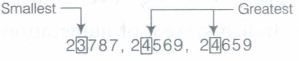
Here, 6895 is a 4-digit number and other numbers are 5 digits, so it is clear that 6895 is the smallest number. Now, in remaining three numbers, the digit at ten thousands place is same in each number. So, we compare the thousands place digit.
∵ 4>3
Again, in two numbers, digit at thousands place is same. So, we compare the hundreds place digit.
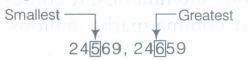
∵ 6>5
∴ The greatest number is 24659 and smallest number is 6895.
10.
Ratio of income to expenditure = 7 : 5
Let the income and expenditure per month be Rs 7x and 5x respectively.
Then, saving per month = Rs 7x - Rs 5x = Rs 2x
According to the question,
2x= 2000
⇒ x =\(\frac{2000}{2}\) =1000
⇒ 7x = 7 x 1000 = 7000
Hence, his income is Rs 7000 per month.
11.
Vertical
12.
We have, 1258
(i) Divisibility by 2
\(\because\)Unit digit of number = 8, so 1258 is divisible by 2.
(ii) Divisibility by 3
Sum of digits of given number = 1+ 2 + 5 + 8 = 16 is not divisible by 3, so 1258 is not divisible by 3. Now, we see that 1258 is divisible by 2 but not divisible by 3.
Hence, it is not divisible by 6.
13.
According to the patterns of whole number,
14.
()
Marks obtained in a test, price, weight, height, etc.
15.
()
Is not an equation LHS ≠ RHS : It has no sign of equality (=)
16.
()
The measures of its two adjacent sides are 11.7 cm and 9.7 cm
17.
()
The greatest number we can get is 8753.

6th Standard CBSE Syllabus & Materials
6th Standard CBSE
CBSE 6th Social Science Locating Places on the Earth - New Sample Question Papers Study Material - QB365 Set A
NEW6th Standard CBSE
CBSE 6th Science A Journey Through States of Water - New Sample Question Papers Study Material - QB365 Set A
NEW6th Standard CBSE
CBSE 6th Science Temperature and its Measurement - New Sample Question Papers Study Material - QB365 Set A
NEW6th Standard CBSE
CBSE 6th Science Materials Around Us - New Sample Question Papers Study Material - QB365 Set A



CBSE 6th Standard CBSE Subjects
CBSE Standards




