
 100% FREE ACCESS
6th Standard Syllabus & Materials
6th Standard
TN 6th Tamil பருவம் 1 - இயல் 1 - மொழி -தமிழ்த்தேன் - இன்பத்தமிழ் Sample Question Papers Study Material - QB365 Set A
NEW6th Standard
TN 6th English T1 - Supplementary - The Apple Tree and The Farmer Sample Question Papers Study Material - QB365 Set A
NEW6th Standard
TN 6th English T1 - Prose - When The Trees Walked Sample Question Papers Study Material - QB365 Set A
NEW6th Standard
TN 6th Social Science T3 - CIV - Road Safety Sample Question Papers Study Material - QB365 Set A
NEW6th Standard
TN 6th Social Science T3 - CIV - Local Bodies - Rural and Urban Sample Question Papers Study Material - QB365 Set A
NEW6th Standard
TN 6th Social Science T3 - CIV - Democracy Sample Question Papers Study Material - QB365 Set A

Published on: 03/12/2019
Geometry
Download Tamil Nadu 6th Standard Maths question papers, model tests, one-mark questions, important questions, and public exam papers in PDF format. Free study materials and answer keys for TN State Board students.
Questions + Answers key
Take MCQ Maths Test1.
What is the supplementary and complementary angles of 60°
2.
Draw the diagram of two angles having only one common point.
3.
In the following Figure, name the angles.
4.
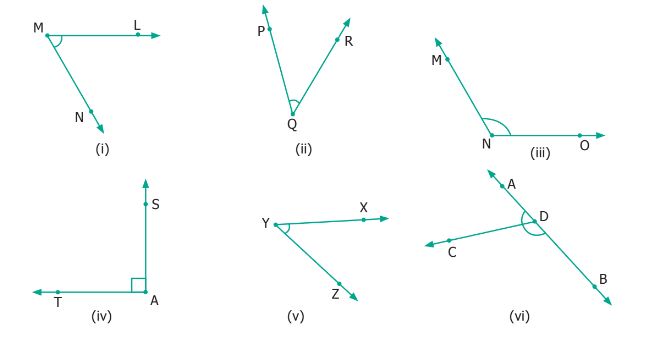
Pick out the Right angles from the given figures.
.png)
5.
How many line segments are there in the given line? Name them.

6.
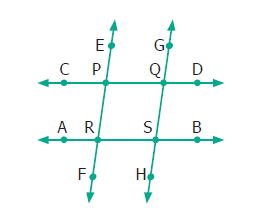
From the given figure
(i) identify the parallel lines
(ii) identify the intersecting lines
(iii) name the points of intersection.
7.
Construct a line segment using ruler and compass QR = 10 cm
8.
Construct a line segment using ruler and compass CD = 3.6 cm
9.
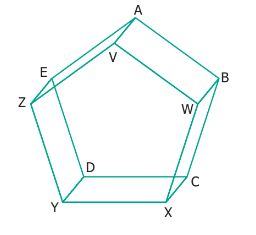
Find the parallel and intersecting line segments in the picture given below.
10.
Pick out the Obtuse angles from the given figures.
11.
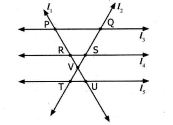
From the given figure, name
(i) all pairs of parallel lines.
(ii) all pairs of intersecting lines.
(iii) pair of lines whose point of intersection is ‘V’.
(iv) point of intersection of the lines ‘ l2’ and ‘l3’.
(v) point of intersection of the lines ‘l1’ and ‘l5’.
12.
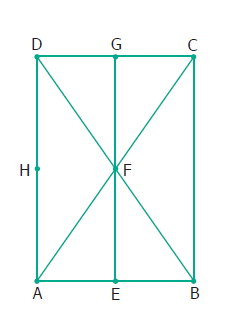
A point of concurrency in the figure is _________.
E
F
G
H
13.
A set of non-collinear points in the figure are _________.
A, F, C
B, F, D
E, F, G
A, D, C
14.
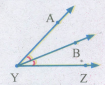
In this Figure, ∠AYZ = 45°. If point ‘A’ is shifted to point ‘B’ along the ray, then the measure of ∠BYZ is ___________
.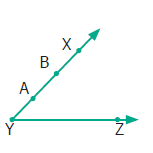
more than 45°
45°
Less than 45°
90°
15.
In this Figure, which is not the correct way of naming an angle?
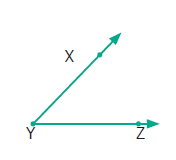
∠Y
∠ZXY
∠ZYX
∠XYZ
16.
A line is denoted as
AB
\(\overrightarrow { AB } \)
\(\overleftrightarrow { AB } \)
\(\overline{\mathrm{AB}}\)
17.
The number of line segments in  is
is
1
2
3
4
1.
Supplementary angle is 120°
Complementary angle is 30°
2.

3.
4.
i), iii), v) are right angles
5.
There are 10 \(\overline { PQ },\overline {PA},\overline {PB},\overline {PC},\overline {AB},\overline {BC},\overline {CQ},\overline {AQ},\overline {BQ},\overline {AC}\)
6.
(i) \(\overline{EF}and\overline{GH},\overline{CD}and\overline{AB}\)
(ii) \(\overline{CD}and\overline{EF},\overline{AB}and\overline{EF},\overline{CD}and\overline{GH},\overline{AB}and\overline{GH}\)
(iii) P, Q, R and S
7.
QR = 10 cm

Construction:
Step 1: Drawn a line 'l' and marked the point Q on it
Step 2: Measured 10 cm using compass by placing pointer at 'O' and pencil pointer at 10 cm.
Step 3: Placing pointer at Q drawn the arc on 'l' with pencil pointer and named the point R
Step 4: QR is the required line segments of 10 cm.
8.
CD = 3.6 cm

Construction:
Step 1: Drawn a line l and marked the point C on it
Step 2: Measured 3.6 cm using compass by placing pointer at 0 and pencil at 3.6 cm
Step 3: Place the pointer of the compass at C then draw a small arc on the line l with the pencil pointer. It cuts the line l at a point and name that point as D.
Step 4: Now, CD is the required line of length 3.6 cm.
9.
Paralell line:
\( \overline{\mathrm{AB}} \ \text{and}\) \( \overline{\mathrm{DC}},\)
\( \overline{\mathrm{AD}} \ \text{and}\) \(\overline{\mathrm{BC}},\)
\(\overline{\mathrm{DC}} \text { and } \overline{\mathrm{HG}}, \)
\(\overline{\mathrm{AD}} \text { and } \overline{\mathrm{EH}},\)
\( \overline{\mathrm{AE}} \text { and } \overline{\mathrm{DH}}, \)
\( \overline{\mathrm{DH}} \text { and } \overline{\mathrm{GG}}\)
Intersecting lines:
\(i) \ \overline{\mathrm{AB}}, \overline{\mathrm{AE}}, \overline{\mathrm{AD}}\\ ii) \ \overline{\mathrm{DA}}, \overline{\mathrm{DH}}, \overline{\mathrm{DC}}\\ iii) \ \overline{\mathrm{CB}}, \overline{\mathrm{CG}}, \overline{\mathrm{CD}}\\ iv)\ \overline{\mathrm{HD}}, \overline{\mathrm{HG}}, \overline{\mathrm{HE}}\\ v) \ \overline{\mathrm{EA}}, \overline{\mathrm{EH}}_{, . .}\)
10.
i), iii) are obtuse angles
11.
(i) all pairs of parallel lines.
l3 and l4 ,l4 and l5 ,l3 and l5
(ii) all pairs of intersecting lines.
l1 and l2, l1 and l3 , l1 and l4 , l1 and l5 , l2 and l3 , l2 and l4, l2 and l5
(iii) pair of lines whose point of intersection is ‘V’.
l1 and l2
(iv) point of intersection of the lines ‘ l2’ and ‘l3’. l1 and l2
Q
(v) point of intersection of the lines ‘l1’ and ‘l5’.
U
12.
(b)
F
13.
(d)
A, D, C
14.
(b)
45°
15.
(b)
∠ZXY
16.
(d)
\(\overline{\mathrm{AB}}\)
17.
(c)
3

6th Standard Syllabus & Materials
6th Standard
TN 6th Social Science T3 - GEO - Understanding Disaster Sample Question Papers Study Material - QB365 Set A
NEW6th Standard
TN 6th Social Science T3 - GEO - Globe Sample Question Papers Study Material - QB365 Set A
NEW6th Standard
TN 6th Social Science T3 - GEO - Asia and Europe Sample Question Papers Study Material - QB365 Set A
NEW6th Standard
TN 6th Social Science T3 - HIS - South Indian Kingdoms Sample Question Papers Study Material - QB365 Set A



Tamilnadu Stateboard 6th Standard Subjects
Tamilnadu Stateboard Standards




