
 100% FREE ACCESS
6th Standard Syllabus & Materials
6th Standard
TN 6th Tamil பருவம் 1 - இயல் 1 - மொழி -தமிழ்த்தேன் - இன்பத்தமிழ் Sample Question Papers Study Material - QB365 Set A
NEW6th Standard
TN 6th English T1 - Supplementary - The Apple Tree and The Farmer Sample Question Papers Study Material - QB365 Set A
NEW6th Standard
TN 6th English T1 - Prose - When The Trees Walked Sample Question Papers Study Material - QB365 Set A
NEW6th Standard
TN 6th Social Science T3 - CIV - Road Safety Sample Question Papers Study Material - QB365 Set A
NEW6th Standard
TN 6th Social Science T3 - CIV - Local Bodies - Rural and Urban Sample Question Papers Study Material - QB365 Set A
NEW6th Standard
TN 6th Social Science T3 - CIV - Democracy Sample Question Papers Study Material - QB365 Set A

Published on: 27/07/2018
Some of the model question paper is prepared from the entire chapter of this syllabus. In this question paper, covers the questions based on the book back and creative questions.
Download Tamil Nadu 6th Standard Maths question papers, model tests, one-mark questions, important questions, and public exam papers in PDF format. Free study materials and answer keys for TN State Board students.
Questions + Answers key
Take MCQ Maths Test1.
When __________ is added to a number, it remains the same.
2.
The difference between the smallest natural number and the smallest whole number is __________
3.
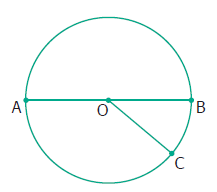
Observe the diagram and fill in the blanks.
‘A’, ‘O’ and ‘B’ are _________ points.
4.
The tally marks for number 7 in standard form is________________.
5.
If Karkuzhali earns Rs. 1800 in 15 days, then she earns Rs. 3000 in __________days.
6.
_____: 24 : : 3 : 8
7.
The algebraic statement of ‘f’ decreased by 5 is_________.
8.
3 : 5 = 9 : ___
9.
A quantity that takes____________values is called a variable.
10.
Ratio of 3 m to 200 c.m = __________.
11.
Both addition and multiplication are associative for whole numbers
12.
8567 is rounded off as 8600 to the nearest 10.
13.
0° and 180° are supplementary.
14.
80° and 180° are supplementary.
15.
2 : 7 : : 14 : 4
16.
7 less to 7 times ‘y’ is '7 − 7y'.
17.
In the Indian System of Numeration the number 67999037 is written as 6,79,99,037.
18.
If the cost of an  is ‘x’ and the cost of a
  is Rs. 5, then the total cost of fruits is Rs. 'x+5'.
19.
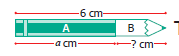 The length of part B in the pencil shown is ‘a − 6’.
20.
The ratio of 130 c.m to 1 m is 13: 10.
21.
The pictorial representation for a phrase is a__________.
Picto
Tally mark
Frequency
Data
22.
A set of non-collinear points in the figure are _________.
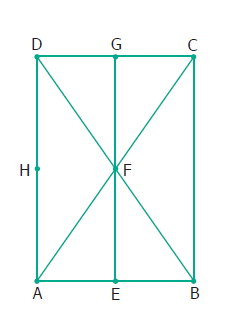
A, F, C
B, F, D
E, F, G
A, D, C
23.
The tally marks  represents the number count
5
8
9
10
24.
If 7 : 5 is in proportion to x : 25, then ‘x’ is
27
49
35
14
25.
The chart below shows the number of newspapers sold as per Indian Readership Survey in 2018. Which could be the missing number in the table?
| Name of the Newspaper | Ranking | Sold (in Lakh) |
|---|---|---|
| A | 1 | 70 |
| B | 2 | 50 |
| C | 3 | ? |
| D | 4 | 10 |
8
52
77
26
26.
The successor of 10 million is
1000001
10000001
9999999
100001
27.
1 billion is equal to ___________
100 crore
100 million
100 lakh
10000 lakh
28.
‘6y’ means
6 + y
6 − y
6 × y
\(\frac{6}{y}\)
29.
Variable means that it
can take only a few values
has a fixed value
can take different values
can take only 8 values
30.
The ratio of Rs. 1 to 20 paise is __________.
1: 5
1: 2
2: 1
5: 1
31.
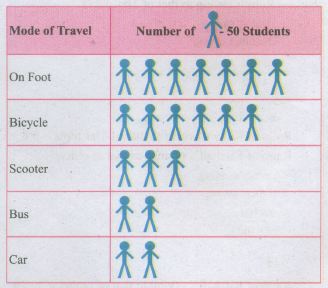
There are 1000 students in a school. Data regarding the mode of transport of the students is given below. Draw a pictograph to represent the data.
| Mode of Travel | On Foot | Bicycle | Scooter | Bus | Car |
| Number of Students | 350 | 300 | 150 | 100 | 100 |
32.
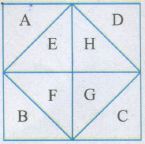
How many Triangles are there in each of the following figures?

33.
Round off the seven digit number 29,75,842 to the nearest lakhs and ten lakhs. Are they the same?
34.
Draw any line and mark any 3 points that are collinear.
35.
Express the following verbal statement to algebraic statement.
4 times ‘q’.
36.
Find the simplified form of the following ratios 75: 100
37.
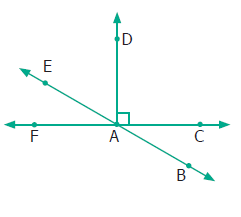
From the figure name a pair of
(i) name a pair of complementary angles
(ii) name a pair of supplementary angles
38.
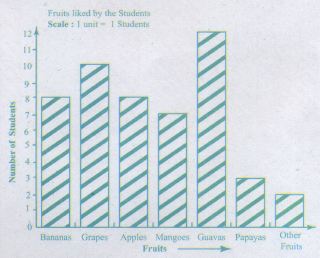
The fruits liked by the students of a class are as follows. Draw a Bar Graph for this data.
| Fruits | Bananas | Grapes | Apples | Mangoes | Guavas | Papayas | Other fruits |
| Number of students | 8 | 10 | 8 | 7 | 12 | 3 | 2 |
39.
Use the properties of whole numbers and simplify. 50 \(\times\) 102
40.
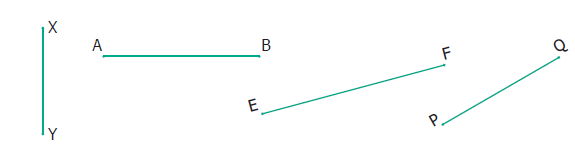
Measure the following line segments.
41.
Arivazhagan is 30 years younger to his father. Write Arivazhagan's age in terms of his father's age.
42.
Out of 50 students in a class, 30 are boys. Find the ratio of
(i) number of boys to the number of girls.
(ii) number of girls to the total number of students.
(iii) number of boys to the total number of students.
43.
Count the number of squares in each of the following figures?

44.
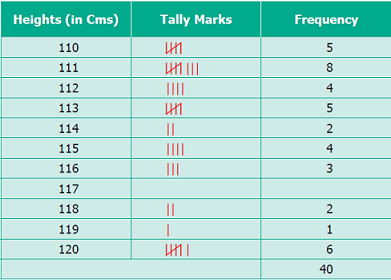
The heights (in centimeters) of 40 children are.
110 112 112 116 119 111 113 115 118 120
110 113 114 111 114 113 110 120 118 115
112 110 116 111 115 120 113 111 113 120
115 111 116 112 110 111 120 111 120 111
Prepare a tally mark table.
45.
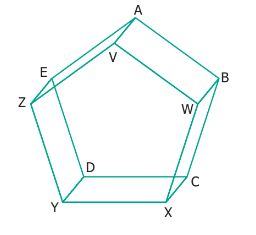
Find the parallel and intersecting line segments in the picture given below.
46.
Study the following table and answer the questions.
| Year | No. of Tigers |
|---|---|
| 1990 | 3500 |
| 2008 | 1400 |
| 2011 | 1706 |
| 2014 | 2226 |
(i) How many tigers were there in 2011?
(ii) How many tigers were less in 2008 than in 1990?
(iii) Did the number of tigers increase or decrease between 2011 and 2014? If yes, by how much?
47.
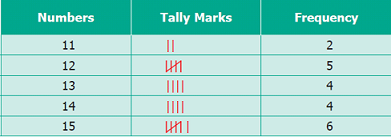
The following are the marks obtained by 30 students in a class test out of 20 in Mathematics subject.
11 12 13 12 12 15 16 17 18 12
20 13 13 14 14 14 15 15 15 15
16 16 16 15 14 13 12 11 19 17
Prepare a table using Tally Marks.
48.
Karmegan made 54 runs in 9 overs and Asif made 77 runs in 11 overs. Whose run rate is better? (run rate = ratio of runs to overs)
49.
The table given below shows the results of the matches played by 8 teams in a Kabaddi championship tournament.
| Teams | A | B | C | D | E | F | G | H |
| Total Matches played | 8 | 7 | n | a | 9 | 10 | 8 | y |
| Matches won | 5 | 6 | 4 | 7 | b | 6 | x | 3 |
| Matches lost | k | m | 6 | 2 | 3 | c | 4 | 6 |
Find the value of all the variables in the table given above.
50.
Tamil Nadu has about twenty six thousand three hundred forty five square kilometre of Forest land. Write the number mentioned in the statement in the Indian System and International System.
1.
()
0
2.
()
1
3.
()
Collinear
4.
()

5.
()
25 days
6.
()
9
7.
()
f - 5
8.
()
15
9.
()
Different
10.
()
3 : 2
11.
(a)
12.
(b)
13.
(a)
14.
(b)
15.
(b)
16.
(b)
17.
(a)
18.
(a)
19.
(b)
20.
(a)
21.
(a)
Picto
22.
(d)
A, D, C
23.
(c)
9
24.
(c)
35
25.
(d)
26
26.
(b)
10000001
27.
(a)
100 crore
28.
(c)
6 × y
29.
(c)
can take different values
30.
(d)
5: 1
31.
The pictograph for the mode of transport of students
32.
The single portions A, B, C, D, E, F, G and H are 8 triangles.
Taking the combination of 2 E & F, F & G, & H and E & H are 4 triangles.
There are 8 + 4 = 12 triangles.
33.
| TL | L | TTH | TH | H | T | O |
| 2 | 9 | 7 | 5 | 8 | 4 | 2 |
To the nearest lakhs \(\Rightarrow\) 30,00,000
To the nearest ten lakhs \(\Rightarrow\) 30,00,000
Yes, they are the same.
34.

35.
4q
36.
75 : 100
Fraction = \(\frac{75}{100} \div \frac{25}{25}=\frac{3}{4}\)
Simplest form = 3 : 4
37.
(i) name a pair of complementary angles:
∠FAE;∠EAD
(ii) name a pair of supplementary angles:
∠FAD;∠DAC
∠BAC;∠CAE
∠FAB;∠BAC
∠FAB;∠FAE
∠EAD;∠DAB
38.
39.
Using distributive property of multiplication over addition.
50 \(\times\) 102 = 50 \(\times\) 10 + 50 \(\times\) 2
= 5000 + 100
= 5100
50 \(\times\)102 = 5100.
40.
\((i) \ \overline{XY}=2.4 \ cm\)
\((ii) \ \overline{ AB}=3.4 \ cm\)
\((iii) \ \overline{EF}=4 \ cm\)
\((iv) \ \overline{ PQ}=3 \ cm\)
41.
Age ofArivazhagan's father = n
Arivazhagan’s age = ‘n - 30’
42.
Total number of students = 50.
Number of boys = 30.
Then number of girls = 50 - 30 = 20.
(i) Ratio of number of boys to no. of girls = \(\frac { 30 }{ 20 } \)
\(=\frac { 30\div 10 }{ 20\div 10 } =\frac { 3 }{ 2 } =3:2\)
(ii) \(\frac { Number\ of\ girls }{ Total\ number\ of\ students } =\frac { 20 }{ 50 } =\frac { 20\div 10 }{ 50\div 10 } =\frac { 2 }{ 5 } =2:5\)
(iii) \(\frac { Number\ of\ boys }{ Total\ number\ of\ students } =\frac { 30 }{ 50 } =\frac { 30\div 10 }{ 50\div 10 } =\frac { 3 }{ 5 } =3\ :\ 5\)
43.
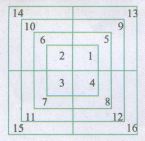
Smaller squares 4 \(\times\) 4 = 16 (As numbered).
As a whole bigger = 4.
Total squares = 20.
44.
45.
Paralell line:
\( \overline{\mathrm{AB}} \ \text{and}\) \( \overline{\mathrm{DC}},\)
\( \overline{\mathrm{AD}} \ \text{and}\) \(\overline{\mathrm{BC}},\)
\(\overline{\mathrm{DC}} \text { and } \overline{\mathrm{HG}}, \)
\(\overline{\mathrm{AD}} \text { and } \overline{\mathrm{EH}},\)
\( \overline{\mathrm{AE}} \text { and } \overline{\mathrm{DH}}, \)
\( \overline{\mathrm{DH}} \text { and } \overline{\mathrm{GG}}\)
Intersecting lines:
\(i) \ \overline{\mathrm{AB}}, \overline{\mathrm{AE}}, \overline{\mathrm{AD}}\\ ii) \ \overline{\mathrm{DA}}, \overline{\mathrm{DH}}, \overline{\mathrm{DC}}\\ iii) \ \overline{\mathrm{CB}}, \overline{\mathrm{CG}}, \overline{\mathrm{CD}}\\ iv)\ \overline{\mathrm{HD}}, \overline{\mathrm{HG}}, \overline{\mathrm{HE}}\\ v) \ \overline{\mathrm{EA}}, \overline{\mathrm{EH}}_{, . .}\)
46.
(i) There are 1706 tigers in 2011
(ii) No. of tigers in 2008 = 1400
No. of tigers in 1990 = 3500
There were 2100 lesser tigers
(iii) No. of tigers in 2014 = 2226
No. of tigers in 2011 = 1706
= 520
\(\therefore\) 2226 > 1706
\(\therefore\) The number of tigers increased from 2011 to 2014.
Yes, the number of tigers increased, 520 more tigers are there in 2014.
47.
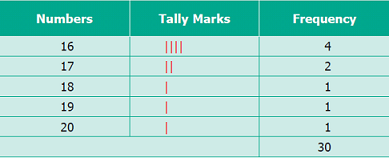
48.
Run rate = Ratio of runs to overs
Run rate of Karmegam = \(\frac { 54 }{ 9 } \) = \(\frac { 6 }{ 1 } \) = 6 :1
Run rate of Asif = \(\frac { 77 }{ 11 } \) = \(\frac { 7 }{ 1 } \) = 7 :1
∴ Asif's run rate is better.
49.
i) 5k = 8
k = 8 - 5 =
k = 3
ii) 6 + m = 7
m = 7 - 6
m = 1
iii) 4 + 6 = n
n = 10
iv) 7 + 2 = a
a = 9
v) b + 3 = 9
= 9 - 3
b = 6
vi) 6 + c = 10
c = 10 - 6 = 4
c = 4
vii) x +4 = 8
x = 8 - 4
x = 4
viii) y = 3 + 6
y = 9
50.
Forest land of Tamilnadu : 26,345 sq. km.

6th Standard Syllabus & Materials
6th Standard
TN 6th Social Science T3 - GEO - Understanding Disaster Sample Question Papers Study Material - QB365 Set A
NEW6th Standard
TN 6th Social Science T3 - GEO - Globe Sample Question Papers Study Material - QB365 Set A
NEW6th Standard
TN 6th Social Science T3 - GEO - Asia and Europe Sample Question Papers Study Material - QB365 Set A
NEW6th Standard
TN 6th Social Science T3 - HIS - South Indian Kingdoms Sample Question Papers Study Material - QB365 Set A



Tamilnadu Stateboard 6th Standard Subjects
Tamilnadu Stateboard Standards




