
 100% FREE ACCESS
6th Standard CBSE Syllabus & Materials
6th Standard CBSE
CBSE 6th Social Science The Value of Work - New Sample Question Papers Study Material - QB365 Set A
NEW6th Standard CBSE
CBSE 6th Social Science Family and Community - New Sample Question Papers Study Material - QB365 Set A
NEW6th Standard CBSE
CBSE 6th Social Science India's Cultural Roots - New Sample Question Papers Study Material - QB365 Set A
NEW6th Standard CBSE
CBSE 6th Social Science India,That is Bharat - New Sample Question Papers Study Material - QB365 Set A
NEW6th Standard CBSE
CBSE 6th Social Science Timeline and sources of history - New Sample Question Papers Study Material - QB365 Set A
NEW6th Standard CBSE
CBSE 6th Social Science Oceans and Continents - New Sample Question Papers Study Material - QB365 Set A

Published on: 27/07/2018
Some of the important questions are prepared from this chapter Knowing our Numbers.
Teachers can prepared question paper with answer key within five minutes. Please Click Here for subscribe.
Download CBSE Class 6th Standard CBSE Mathematics question papers, sample papers, important questions, and previous year solved papers in PDF format. Get free study materials, NCERT solutions, and exam preparation resources for Class 6th Standard CBSE Mathematics
Questions + Answers key
Take MCQ Mathematics Test
1.
Estimate (21397 + 27807 + 42505)
2.
Write the expressions for the following using brackets:
Four multiplied by the sum of nine and two
3.
Can you instantly find the greatest and the smallest numbers in the row?
1473,89423, 100,5000,310
4.
Can you instantly find the greatest and the smallest numbers in the row? 382, 4972, 18, 59785, 750.
5.
Use the following digits without repetition and make the greatest and smallest 4-digit numbers
2,8,7,4
6.
Arrange the numbers 819, 5240, 890, 6249 in descending order.
7.
Compare the following number: 67454 and 78465
8.
Compare the following number: 97632 and 96543
9.
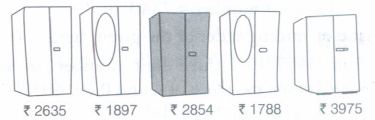
Sohan and Rita went to buy an almirah. There were many almirahs available with their price tags.
(a) Can you arrange their prices in increasing order?
(b) Can you arrange their prices in decreasing order?
10.
Make the greatest and the smallest 4-digit numbers using any four different digits with conditions given below.
Digit 1 is always at thousands place.
11.
Make the greatest and the smallest 4-digit numbers by using anyone digit twice. 8, 5, 1.
12.
Make the greatest and the smallest 4-digit numbers by using anyone digit twice. 3, 8, 7.
13.
You have the digits 4, 5, 6, 0, 7 and 8. Using them, make five numbers each with 6-digits.
(a) Put commas for easy reading.
(b) Arrange them in ascending and descending orders.
14.
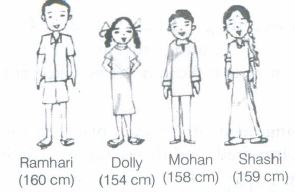
Who is the tallest? Who is the shortest?
(a) Can you arrange them in the increasing order of their heights?
(b) Can you arrange them in the decreasing order of their heights?
15.
The smallest 4-digit number with different digits is ------
16.
In Indian system of numeration, the number 61711682 is written, using commas, as -------
17.
1 million = ____ lakhs
18.
1 million = _______ hundred thousands
19.
Which of the following roman symbol is never repeated?
I
V
X
C
20.
The greatest natural number is
1 crore
10 crores
10 lakhs
undefine
21.
Which of the following is true?
1 million = 1000000
1 lakh = 10000
1crore=100000000
22.
The numbers 4578,4587,5478,5487 are in ascending order.
23.
LXXV is greater than LXXIV.
24.
The number 58663 rounded off to nearest hundred is 58600.
1.
90000
2.
According to the question, sum of 9 and 2 = 9 + 2
Now, mutiplying it by 4, we have 4 \(\times\) (9 + 2)
which is the required expression.
3.
89423 is the greatest number, because it has highest number of digits i.e. 5 and 100 is the smallest number, because it has least number of digits i.e. 3.
4.
59785 is the greatest and 18 is the smallest.
5.
For getting the smallest number, firstly we convert the numbers into ascending order.
The smallest 4-digit number is 2478.
For getting greatest number, firstly we convert the numbers into descending order.
The greatest 4-digit number is 8742.
6.
Given, numbers are 819, 5240, 890 and 6249.
To convert numbers into descending order, we arrange numbers greatest to the smallest.
Now, descending order is 6249 > 5240> 890> 819.
7.
Both 67454 and 78465 are five-digit numbers. So, we compare them by comparing the digits at ten thousand places. Since, 7> 6. So, 78465> 67454.
8.
Both 97632 and 96543 have same number of digits i.e. five. Now, compare them by looking at the digits at ten thousand place, which is 9 for both the numbers.
Next, compare the second digit from the left. Here, it is 7 in 97632 and 6 in 96543.
Since, 7> 6
So, 97632> 96543
9.
(a) Yes, prices can be arranged in increasing order as follows:
Rs.1788 < Rs.1897 < Rs. 2635 < Rs. 2854 < Rs. 3975
(b) Yes, prices can be arranged in decreasing order as follows:
Rs.3975 > Rs. 2854 > Rs. 2635 > Rs. 1897 > Rs. 1788.
10.
Digits in ascending order are 0,1,2,3,4,5,6,7,8,9 and digits in descending order are 9,8,7,6,5,4,3,2,1, 0. Also, we know that 0 can never be taken at the leftmost place.
Keeping the digit 1 at thousands place, we can fill hundreds, tens and ones place digit by remaining digits.
Greatest number
| 1 | 9 | 8 | 7 |
[Keeping the greatest digit i.e, 9, 8 and 7 at hundreds, tens and ones place]
Smallest number
| 1 | 0 | 2 | 3 |
[Keeping the smallest digit i.e. 0, 2 and 3 at hundreds, tens and ones place]
11.
Given digits are 8, 5 and 1.
Here, descending order of the given digits is 8, 8, 5, 1. [∴ greatest digit 8 is taken twice]
∴ Greatest 4-digit number = 8851
and ascending order of the given digits is 1, 1, 5, 8. [∴ smallest digit 1 is taken twice]
∴ Smallest 4-digit number = 1158.
12.
Given digits are 3, 8 and 7.
Here, descending order of the given digits is 8, 8, 7, 3. [∵ greatest digit 8 is taken twice]
∴ Greatest 4-digit number = 8873
and ascending order of the given digits is 3, 3, 7, 8. [∵ smallest digit 3 is taken twice]
∴ Smallest 4-digit number = 3378
13.
Given digits are 4, 5, 6, 0, 7 and 8.
We can make many numbers by using these digits, five of them are as follows:
876540, 867540, 876450, 876045 and 867405
(a) After putting commas, numbers are as follows:
(i) 8,76,540 (ii) 8,67,540
(iii) 8,76,450 (iv) 8,76,045
(v) 8,67,405
(b) Ascending order of numbers is as follows:
867405 < 867540 < 876045 < 876450 < 876540
Descending order of numbers is as follows:
876540 > 876450 > 876045 > 867540 > 867405.
14.
(i) From the given figure, it is clear that,
160> 159> 158> 154
∴ Ramhari is the tallest, because he has the height of 160 cm.
(ii) From the given figure, it is clear that,
154 < 158 < 159 < 160
∴ Dolly is the shortest, because she has the height of 154 cm.
We can arrange height from two types:
(a) Yes, we can arrange their heights in increasing order as follows: Dolly (154 cm) < Mohan (158 cm) < Shashi (159 cm) < Ramhari (160 cm).
(b) Yes, we can arrange their heights in decreasing order as follows: Ramhari (160 cm) > Shashi (159 cm) > Mohan (158 cm) > Dolly (154 cm).
15.
1023 is required smallest four-digit number.
16.
According to Indian system of numeration, 6,17,11,682.
17.
We know that,
1 million = 1000000 (in digits)
= 10 \(\times\)100000 = ten \(\times\) one lakhs (in number name)
∴1 million = ten lakhs
18.
We know that,
1 million = 1000000 (in digits) = 10 \(\times\) 100000
= ten\(\times\) hundred thousands
(in number name)
∴ 1 million = ten hundred thousands
19.
(b)
V
20.
(d)
undefine
21.
(a)
1 million = 1000000
22.
(a)
23.
(a)
24.
(b)

6th Standard CBSE Syllabus & Materials
6th Standard CBSE
CBSE 6th Social Science Locating Places on the Earth - New Sample Question Papers Study Material - QB365 Set A
NEW6th Standard CBSE
CBSE 6th Science A Journey Through States of Water - New Sample Question Papers Study Material - QB365 Set A
NEW6th Standard CBSE
CBSE 6th Science Temperature and its Measurement - New Sample Question Papers Study Material - QB365 Set A
NEW6th Standard CBSE
CBSE 6th Science Materials Around Us - New Sample Question Papers Study Material - QB365 Set A



CBSE 6th Standard CBSE Subjects
CBSE Standards




