
 100% FREE ACCESS
6th Standard CBSE Syllabus & Materials
6th Standard CBSE
CBSE 6th Social Science The Value of Work - New Sample Question Papers Study Material - QB365 Set A
NEW6th Standard CBSE
CBSE 6th Social Science Family and Community - New Sample Question Papers Study Material - QB365 Set A
NEW6th Standard CBSE
CBSE 6th Social Science India's Cultural Roots - New Sample Question Papers Study Material - QB365 Set A
NEW6th Standard CBSE
CBSE 6th Social Science India,That is Bharat - New Sample Question Papers Study Material - QB365 Set A
NEW6th Standard CBSE
CBSE 6th Social Science Timeline and sources of history - New Sample Question Papers Study Material - QB365 Set A
NEW6th Standard CBSE
CBSE 6th Social Science Oceans and Continents - New Sample Question Papers Study Material - QB365 Set A

Published on: 22/09/2018
Monthly Test
Download CBSE Class 6th Standard CBSE Mathematics question papers, sample papers, important questions, and previous year solved papers in PDF format. Get free study materials, NCERT solutions, and exam preparation resources for Class 6th Standard CBSE Mathematics
Questions + Answers key
Take MCQ Mathematics Test
1.
A number is divisible by 8. By what other numbers will that number be divisible?
2.
Write these numbers in roman numerals 341
3.
Using divisibility tests, determine the following number are divisible by 4 and 8?
6000
4.
What is the additive identity of 498?
5.
Round off these numbers to the nearest thousands 4235
6.
Is 29 a factor of 743067?
7.
Place commas correctly and write the numerals:
Nine crores five lakhs forty one
8.
Verify the commutative law under addition for the following whole numbers. Does it hold under subtraction?
(i) 402, 113
(ii) 54, 45.
9.
Find the sum, using the number line 2 + 6.
10.
Arrange the numbers 847, 9754, 8320, 571 in ascending order
11.
Name five large cities in India. Find their population. Also, find the distance (in km) between each pair of these cities.
12.
You have the digits 4, 5, 6, 0, 7 and 8. Using them, make five numbers each with 6-digits.
(a) Put commas for easy reading.
(b) Arrange them in ascending and descending orders.
13.
The smallest even number is
1
2
3
4
14.
?-4=-2
1
2
3
4
15.
Which of the following is false?
-1 <-2
79< 89
-1 < 1
1> 0.
16.
The succeeding number of the number - 1 is.
-1
1
0
-11
17.
How many angles are there in a triangle?
1
2
3
4
18.
The number of common prime factors of 75, 60, 105 is
2
3
4
5
19.
Number of vertices in cylinder are
2
0
3
4
20.
Which of the following has two end points?
Ray
Line
Line segment
None of the above
21.
Which of the following is divisible by both 8 and 12?
1312
1626
1612
1926
None of the given number is divisible by 8 and 12
22.
The greatest number which always divides the product of the predecessor and successor of an odd natural number other than 1, is
6
4
16
32
23.
A number for which the sum of all its factors is equal to twice the number is called a ________________number.
24.
Numbers having more than two factors are called _____________numbers.
25.
In a scalene triangle, all sides are _______
26.
The number of vertices of a cuboid are _______
27.
Number of faces in a triangular pyramid are _______
28.
The angle formed in half-revolution is _______
29.
The hour hand of a clock stops at _____ if it starts at 12 and makes \(\frac { 1 }{ 2 } \) revolution clockwise.
30.
A triangle has_______vertices.
31.
A quadrilateral has______sides.
32.
____________ is the successor of the largest 3-digit number.
1.
1, 2, 4
2.
CCCXLI
3.
6000 is divisible by 4.
6000 is divisible by 8.
4.
We know that additive identity of any whole number is 0. So, additive identity of 498 is 0.
i.e. 0 + 498 = 498.
5.
In 4235, hundred digit is 2 < 5.
∴ The required rounded number 4235 = 4000
6.
Yes
7.
Numbers after commas are as follows: 9, 05, 00, 041.
8.
No, the commutative property does not hold under subtraction of whole numbers.
9.
To find 2 + 6
Let us start from 2. Since, we have to add 6 to this number, we make 6 jumps to the right of 2. Each jump being equal to 1 unit. After six jumps, we reach at 8.
.png)
\(\therefore\) 2 + 6 = 8.
10.
Given, numbers are 847, 9754, 8320 and 571.
To convert numbers into ascending numbers, we arrange numbers smallest to the greatest.
Now, ascending order is 571 < 847 < 8320 < 9754.
11.
The names of five large cities in India are Delhi, Bengaluru, Kolkata, Hyderabad and Chennai.
Process of making the pair of cities are given below:
We have, Delhi, Bengaluru, Kolkata, Hyderabad and Chennai
First, we take Delhi as base city
So,
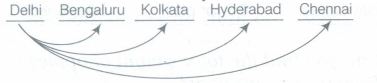
Now, we take Bengaluru as base city.
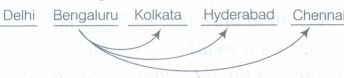
Now, we take Kolkata as base city.
So,

Now, we take Hyderabad as base city.
So,

Their respective population can be taken from a book of general awareness. However, the distance (in kilometres) between each pair of these cities is given below:
| Cities in pair | Distance between two cities (in km) |
| Delhi - Bengaluru | 2019 |
| Delhi - Kolkata | 1442 |
| Delhi - Hyderabad | 1453 |
| Delhi - Chennai | 2157 |
| Bengaluru - Kolkata | 1883 |
| Bengaluru - Hyderabad | 566 |
| Bengaluru- Chennai | 334 |
| Kolkata - Hyderabad | 1516 |
| Kolkata - Chennai | 1678 |
| Hyderabad - Chennai | 704 |
These are the national distances between the cities.
12.
Given digits are 4, 5, 6, 0, 7 and 8.
We can make many numbers by using these digits, five of them are as follows:
876540, 867540, 876450, 876045 and 867405
(a) After putting commas, numbers are as follows:
(i) 8,76,540 (ii) 8,67,540
(iii) 8,76,450 (iv) 8,76,045
(v) 8,67,405
(b) Ascending order of numbers is as follows:
867405 < 867540 < 876045 < 876450 < 876540
Descending order of numbers is as follows:
876540 > 876450 > 876045 > 867540 > 867405.
13.
(b)
2
14.
(b)
2
15.
(a)
-1 <-2
16.
(c)
0
17.
(c)
3
18.
(a)
2
19.
(b)
0
20.
(c)
Line segment
21.
(e)
None of the given number is divisible by 8 and 12
22.
Let an odd natural number other than 1 be 3.
Predecessor of 3 = 3 - 1 = 2
Successor of 3 = 3 + 1 = 4
\(\therefore\) Product = 2 x 4 = 8
Now, LCM of predecessor and successor = 2 x 2 = 4
\(\therefore\) The greatest number which always divides the product of predecessor and successor of an odd natural number other than 1 is 4.
23.
()
Perfect Number
24.
()
Composite Numbers
25.
()
unequal
26.
()
8
27.
()
3
28.
()
1800
29.
()
6
30.
()
three
31.
()
four
32.
that, the largest 3-digit is 999.
\(\therefore\) Successor of 999 = 999 + 1 = 1000
So, 1000 is the successor of largest 3-digit number.

6th Standard CBSE Syllabus & Materials
6th Standard CBSE
CBSE 6th Social Science Locating Places on the Earth - New Sample Question Papers Study Material - QB365 Set A
NEW6th Standard CBSE
CBSE 6th Science A Journey Through States of Water - New Sample Question Papers Study Material - QB365 Set A
NEW6th Standard CBSE
CBSE 6th Science Temperature and its Measurement - New Sample Question Papers Study Material - QB365 Set A
NEW6th Standard CBSE
CBSE 6th Science Materials Around Us - New Sample Question Papers Study Material - QB365 Set A



CBSE 6th Standard CBSE Subjects
CBSE Standards




