
 100% FREE ACCESS
6th Standard Syllabus & Materials
6th Standard
TN 6th Tamil பருவம் 1 - இயல் 1 - மொழி -தமிழ்த்தேன் - இன்பத்தமிழ் Sample Question Papers Study Material - QB365 Set A
NEW6th Standard
TN 6th English T1 - Supplementary - The Apple Tree and The Farmer Sample Question Papers Study Material - QB365 Set A
NEW6th Standard
TN 6th English T1 - Prose - When The Trees Walked Sample Question Papers Study Material - QB365 Set A
NEW6th Standard
TN 6th Social Science T3 - CIV - Road Safety Sample Question Papers Study Material - QB365 Set A
NEW6th Standard
TN 6th Social Science T3 - CIV - Local Bodies - Rural and Urban Sample Question Papers Study Material - QB365 Set A
NEW6th Standard
TN 6th Social Science T3 - CIV - Democracy Sample Question Papers Study Material - QB365 Set A

Published on: 08/12/2018
Everyone has the same aim that is to reach the top rank list. We are paving the way for you to reach your goal. Practice with important questions from all chapters and get set ready to crack your exams with confidence. It's nearing the examination and right time to grab the model question papers and practice for the board exams.
Here is the most important question paper for samacheer 6th Maths for the chapter Ratio and Proportion. The question paper is prepared based on the new samacheer syllabus. Get thorough knowledge in individual chapters helps you to score more. The question paper is created with value-added questions.
It's the right time to grab chapter wise model question papers and practice for the exams. By practicing repeatedly you will get the idea of answering the questions and this improves the speed of answering. This will save the time and you can complete all the questions without any last our tension. Get more model question papers and practice for state board Class 6 Maths examination.
In this question paper, all the important questions from 6th Maths for the chapter Ratio and Proportion are included. Not only with book back questions, but also included creative questions as well. By practicing with this important model question paper student can gain more knowledge and confidence to crack the exams.
Download Tamil Nadu 6th Standard Maths question papers, model tests, one-mark questions, important questions, and public exam papers in PDF format. Free study materials and answer keys for TN State Board students.
Questions + Answers key
Take MCQ Maths Test1.
If Karkuzhali earns Rs. 1800 in 15 days, then she earns Rs. 3000 in __________days.
2.
5 :____ : : 10 : 8 : : 15 :_____
3.
6 : ___ = 1 : 2
4.
Ratio of 5 k.m 400 m to 6 k.m = __________.
5.
Ratio of Rs. 3 to Rs. 5 = __________.
6.
A car travels 90 k.m in 3 hours with constant speed. It will travel 140 k.m in 5 hours at the same speed.
7.
10 books is to 15 books as 3 books is to 15 books
8.
2 : 7 : : 14 : 4
9.
5 : 7 is equivalent to 21 : 15
10.
The ratio of 130 c.m to 1 m is 13: 10.
11.
Which of the following fractions is not a proper fraction?
\(\frac { 1 }{ 3 } \)
\(\frac { 2 }{ 3 } \)
\(\frac { 5 }{ 10 } \)
\(\frac { 10 }{ 5 } \)
12.
If 8 oranges cost Rs. 56, then the cost of 5 oranges is Rs. ___________.
42
48
35
24
13.
If the ratios formed using the numbers 2, 5, x, 20 in the same order are in proportion, then ‘x’ is
50
4
10
8
14.
The ratio of the number of sides of a triangle to the number of sides of a rectangle is
4 : 3
3 : 4
3 : 5
3 : 2
15.
The ratio of 1m to 50 cm is __________.
1 : 5
1 : 20
20 : 1
5 : 1
16.
Anban says the \(\frac { 2 }{ 6 } \) th of the group of triangles given below are blue. Is he correct?

17.
Fill the boxes using any set of suitable numbers 6 :_____ : :____ : 15.
18.
Complete the table.
| Feet | 1 | 2 | 3 | ? |
| Inch | 12 | 24 | ? | 72 |
19.
Simplify the ratio 20 : 5
20.
Find the simplified form of the following ratios 7 : 15
21.
In a school excursion, 6 teachers and 12 students from 6th standard and 9 teachers and 27 students from 7th standard, 4 teachers and 16 students from 8th standard took part. Which class has the least teacher to student ratio?
22.
The maximum speed of some of the animals are given below :
the Elephant = 20 k.m/h; the Lion = 80 k.m./h; the Cheetah = 100 k.m./h. Find the following ratios of their speeds in simplified form and find which ratio is the least?
(i) the Elephant and the Lion
(ii) the Lion and the Cheetah
(iii) the Elephant and the Cheetah
23.
Write the mean and extreme terms in the following ratios and check whether they are in proportion.
(i) 78 litres is to 130 litre and 12 bottles is to 20 bottles
(ii) 400 gm is to 50 gm and 25 rupees is to 625 rupees
24.
Which of the two ratios is larger? 3 : 4 or 7 : 8
25.
The cost of parking a bicycle is Rs. 5 and the cost of parking a scooter is Rs. 15. Find the simplest ratio of the parking cost of a bicycle to that of a scooter.
26.
If the ratio of Green, Yellow and Black balls in a bag is 4 : 3 : 5, then
(a) Which is the most likely ball that you can choose from the bag?
(b) How many balls in total are there in the bag if you have 40 black balls in it?
(c) Find the number of green and yellow balls in the bag.
27.
A picture is resized in a computer as shown below.
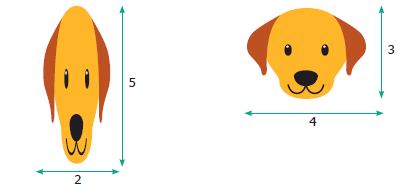
Do you observe any change in the shape and size of the picture? Check whether the ratios formed by its length and breadth are in proportion by cross product method.
1.
()
25 days
2.
()
4, 12
3.
()
12
4.
()
9 : 10
5.
()
3 : 5
6.
(b)
7.
(b)
8.
(b)
9.
(b)
10.
(a)
11.
(d)
\(\frac { 10 }{ 5 } \)
12.
(c)
35
13.
(d)
8
14.
(b)
3 : 4
15.
(c)
20 : 1
16.
No, he is not correct because of the total of 6 triangles 4 are blue.
ie \(\frac { 4 }{ 6 } \)th triangles are blue.
17.
Product of extremes = 6 \(\times\) 15 = 90
\(\therefore\) Product of means = 90 = 1 \(\times\) 90
The required sets are 1 and 30, 2 and 45, 3 and 30, 5 and 18, 6 and 15, 9 and 10
= 1 \(\times\) 90
= 2 \(\times\)45
= 3 \(\times\) 30
= 5 \(\times\) 18
= 6 \(\times\) 15
= 9 \(\times\) 10
So, 6 : 1 : : 90 : 15.
18.
| Feet | 1 | 2 | 3 | 6 |
| Inch | 12 | 24 | 36 | 72 |
36 inches, 6 Feet
19.
Step 1: Write the ratio in fraction form as\(20\over 5\).
Step 2: Divide each quantity by 5. That is, \({20\div 5\over 5\div 5}={4\over1}=4:1\)
This is the ratio in the simplest form.
20.
7 : 15
Fraction = \(\frac {7 \div 1}{15 \div 1}=\frac{7}{15}\)
Simplest form = 7 : 15
21.
Teacher to Student ratio of 6th Std = 6 : 12 = \(\frac{6}{12}=\frac{1}{2}\) = 1 : 2
Teacher to Student ratio of 7th Std = 9 : 27 = \(\frac{9}{27}=\frac{1}{3}\) = 1 : 3
Teacher to Student ratio of 8th Std = 4 : 16 = \(\frac{4}{16}=\frac{1}{4}\) = 1 : 4
In standard 8th the ratio of teacher to Student is 1 : 4 and which is the least.
22.
(i) \(\frac { Speed\quad of\quad the\quad Elephant }{ Speed\quad of\quad the\quad Lion } =\frac { 20 }{ 80 } =\frac { 1 }{ 4 } \) ⇒ 1:4
(ii) \(\frac { Speed\quad of\quad the\quad Lion }{ Speed\quad of\quad the\quad Cheetah } =\frac { 80 }{ 100 } =\frac { 4 }{ 5 } \)⇒ 4:5
(iii) \(\frac { Speed\quad of\quad the\quad Elephant }{ Speed\quad of\quad the\quad Cheetah } =\frac { 20 }{ 100 } =\frac { 1 }{ 5 } \)⇒ 1:5
(iv) Ratio of Elephant to Cheetah is the least.
23.
(i) 78 :130 : : 12:20
Extreme terms are 78 and 20. Mean terms are 130 and 12.
Product of Extremes = 78 \(\times\) 20 = 1560
Product of Means = 130 \(\times\) 12 = 1560
Product of Extremes = Product of means
∴ It is in proportion.
(ii) 400 : 50 : : 25 : 625
Product of extremes = 400 \(\times\) 625 = 250,000
Product of means = 50 \(\times\) 25 = 1250
Here product of extremes ≠ product of means
∴ 400 : 50 and 25 : 625 are not in proportion
24.
\(3:4=\frac{3}{4}\times\frac{2}{2}=\frac{6}{8}\)
\(7:8=\frac{7}{8}\)
Here \(\frac{7}{8}\) larger than \(\frac{6}{8}\)
\(\therefore\) 7 : 8 larger than 3 : 4
25.
Parking cost of bicycle = Rs. 5
Parking cost of Scooter = Rs. 15
\(\frac { Parking\ cost\ of\ bicycle }{ Parking\ cost\ of\ scooter } =\frac { 5 }{ 15 } =\frac { 1 }{ 3 } \)
Parking cost of bicycle : scooter = 1 : 3
26.
(a) green balls = 4, Yellow balls = 3, black balls = 5.
so, Black balls
(b) 5 parts of Black balls = 40 balls
\(\therefore \) 1 part of Black balls = \(\frac{40}{5}=8 \text { balls }\)
4part of Green balls = 4 \(\times\) 8 = 32
3 part of yellow balls = 3 \(\times\) 8 = 24
If there are 40 black balls, then total number of balls = 32 + 24 + 40 = 96 balls
(c) Number of green balls = 32
Number of Yellow balls = 24
27.
The given pictures are in the ratio 2 : 5 and 4 : 3 respectively.
Here the extremes are 2 and 3 and the means are 5 and 4.
Product of extremes, ad = 2 \(\times\)3 = 6.
Product of means, bc = 5 \(\times\) 4 = 20.
Thus, we find ad\(\neq\) bc and hence 2 : 5 and 4 : 3 are not in proportion.

6th Standard Syllabus & Materials
6th Standard
TN 6th Social Science T3 - GEO - Understanding Disaster Sample Question Papers Study Material - QB365 Set A
NEW6th Standard
TN 6th Social Science T3 - GEO - Globe Sample Question Papers Study Material - QB365 Set A
NEW6th Standard
TN 6th Social Science T3 - GEO - Asia and Europe Sample Question Papers Study Material - QB365 Set A
NEW6th Standard
TN 6th Social Science T3 - HIS - South Indian Kingdoms Sample Question Papers Study Material - QB365 Set A



Tamilnadu Stateboard 6th Standard Subjects
Tamilnadu Stateboard Standards




