
 100% FREE ACCESS
6th Standard Syllabus & Materials
6th Standard
TN 6th Tamil பருவம் 1 - இயல் 1 - மொழி -தமிழ்த்தேன் - இன்பத்தமிழ் Sample Question Papers Study Material - QB365 Set A
NEW6th Standard
TN 6th English T1 - Supplementary - The Apple Tree and The Farmer Sample Question Papers Study Material - QB365 Set A
NEW6th Standard
TN 6th English T1 - Prose - When The Trees Walked Sample Question Papers Study Material - QB365 Set A
NEW6th Standard
TN 6th Social Science T3 - CIV - Road Safety Sample Question Papers Study Material - QB365 Set A
NEW6th Standard
TN 6th Social Science T3 - CIV - Local Bodies - Rural and Urban Sample Question Papers Study Material - QB365 Set A
NEW6th Standard
TN 6th Social Science T3 - CIV - Democracy Sample Question Papers Study Material - QB365 Set A

Published on: 13/12/2019
Term 2 Geometry
Download Tamil Nadu 6th Standard Maths question papers, model tests, one-mark questions, important questions, and public exam papers in PDF format. Free study materials and answer keys for TN State Board students.
Questions + Answers key
Take MCQ Maths Test1.
Draw a line and mark a point R below it at a distance of 5.4 cm Through R draw a line parallel to the given line.
2.
Draw a line segment measuring 7.8 cm. Mark a point B above it at a distance of 5 cm. Through B draw a line parallel to the given line segment.
3.
Can a triangle be formed with the angles 80°, 30°, 40°?
4.
Can a triangle be formed with 8 cm, 3 cm and 4 cm as its sides?
5.
Can a triangle be formed with 7 cm, 10 cm and 5 cm as its sides?
6.
If one angle of an isosceles triangle is 70°, then find the possibilities for the other two angles.
7.
Is a triangle possible with the angles 90°, 90° and 0°? Why?
8.
If one angle of an isosceles triangle is 124°, then find the other angles.
9.
Classify the following triangles based on its sides and angles.

10.
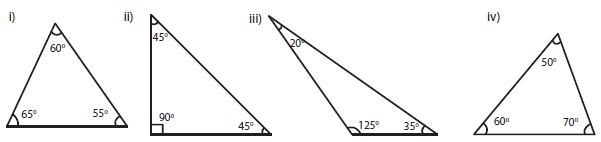
Classify the given triangles based on its angles as acute angled, right angled or obtuse angled.
11.
Draw a line segment PQ = 12 cm. Mark two points M, N at a distance of 5 cm above the line segment PQ. Through M and N draw a line parallel to PQ.
12.
Draw a line and mark a point R at a distance of 4.8 cm above the line. Through R draw a line parallel to the given line.
13.
Two angles of the triangles are given. Find the third angle.
(i) 80°, 60°
(ii) 75°, 35°
(iii) 52°, 68°
(iv) 50°, 90°
(v) 120°, 30°
(vi) 55°, 85°
14.
Can a triangle be formed with the following angles? If yes, name the type of triangle.
(i) 60°, 60°, 60°
(ii) 90°, 55°, 35°
(iii) 60°, 40°, 42°
(iv) 60°, 90°, 90°
(v) 70°, 60°, 50°
(vi) 100°, 50°, 30°
15.
Which of the following can be the sides of an isosceles triangle?
6cm, 3cm, 3cm
5cm, 2cm, 2cm
6cm, 6cm,7cm
4cm, 4cm, 8cm
16.
An equilateral triangle is
an obtuse angled triangle
a right angled triangle
an acute angled triangle
a scalene triangle
17.
The angles of a right angled triangle are
acute, acute, obtuse
acute, right, right
right, obtuse, acute
acute, acute, right
18.
If two sides of a triangle are 5 cm and 9 cm, then the third side is ______________
5 cm
3 cm
4 cm
14 cm
19.
If all angles of a triangle are less than a right angle, then it is called ______________.
an obtuse angled triangle
a right angled triangle
an isosceles right angled triangle
an acute angled triangle
1.
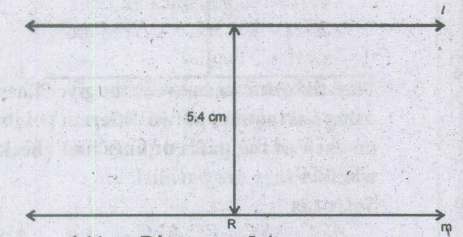
l || m, Distance = 5.4 cm
2.
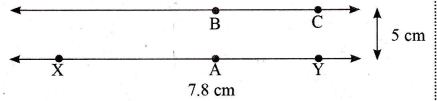
Construction:
1. Draw a line segment XY = 7.8 cm. Mark a point A on the line.
2. Place the set square on XY. Mark a point B above XY such that AB = 5 cm.
3. Using a scale and set square draw a line BC through B.
4. The line BC is parallel to XY. That is BC || XY.
3.
The sum of three angles = 80°+ 30°+ 40° = 150° (not equal to 180°)
In a triangle, the sum of three angles is 180°.
So, a triangle cannot be formed with the given angles.
4.
The sum of two smaller sides = 3 + 4 = 7 cm <8 cm, the third side.
It is less than the third side.
So, a triangle cannot be formed with the given sides.
5.
Instead of checking triangle inequality by all the sides in the triangle, check only with two smaller sides.
Sum of two smaller sides of the triangle = 5+7=12 cm > 10 cm, the third side. It is greater than the third side. So, a triangle can be formed with the given sides.
6.
Given
One angle of an isoceles triangle is 70.
Two angles are same.
Therefore the possibilities for the other two angles are 70, 40 (or) 55, 55.
7.
No, It is not possible with angles 90°, 90°, 0°.
Because there cannot be two right angles in a triangle
8.
Given
One angle of an isoceles triangle = 124°
The sum of three angles of a triangle is = 180°
= 180° - 124° = 56°
Sum of other two angles are = 56°
Two angles are same = 56°/ 2 = 28°
Other angles are 28°, 28°.
9.
i)
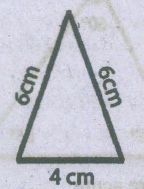
3 angles are acute and 2 sides are equal.
Type: Isoceles acute angled triangle.
ii)
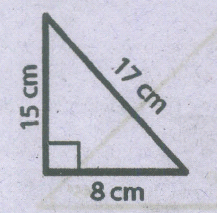
Three sides are different and one angle is right angle.
Type: Scalene right angled triangle.
iii)
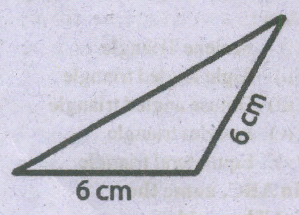
Two sides are equal and one angle is obtuse.
Type: Isoceles obtuse angled triangle.
iv)
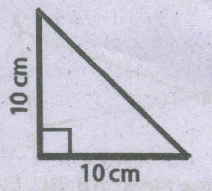
Two sides are equal and one angle is right angle.
Type: Isoceles acute angled triangle.
v)
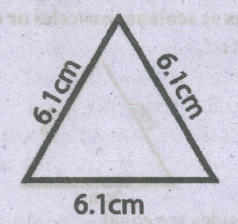
Three sides are equal and Three angles are acute.
Type: Equilateral right angled triangle.
vi)
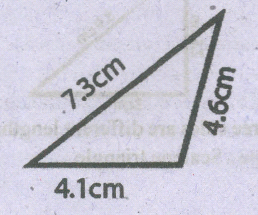
All sides are different and one angle is obtuse.
Type: Scalene obtuse angled triangle.
10.
i)
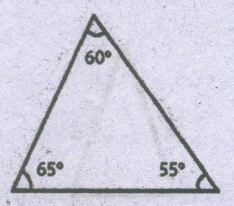
3 angles are acute.
Type: Acute angled triangle.
ii)
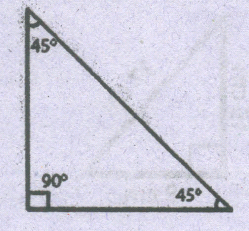
One angle is right angle.
Type: Right angled triangle.
iii)
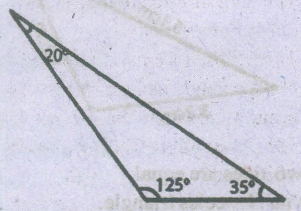
One angle is obtuse.
Type: Obtuse angled triangle.
iv)
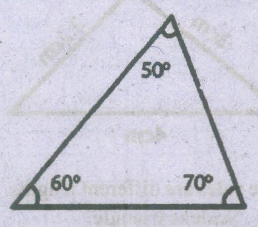
All angles are acute.
Type: Acute angled triangle.
11.
| Step 1: Using a scale, draw a line segment PQ = 12 cm. Mark two points A and B on the line segment. | 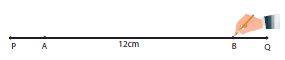 |
| Step 2: Using the set square as shown, mark points M and N such that AM = BN = 5 cm. | 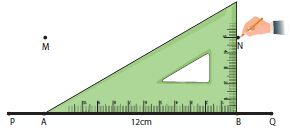 |
| Step 3: Using the scale, join M and N. MN is parallel to PQ. That is, MN ║ PQ. | 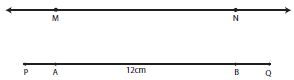 |
12.
| Step 1: Using a scale draw a line AB and mark a point Q on the line. |  |
| Step 2: Place the set square in such a way that the vertex of the right angle coincides with Q and one of the edges of right angle lies along AB. Mark the point R such that QR = 4.8 cm. | 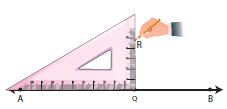 |
| Step 3: Place the scale and the set square as shown in the figure. | 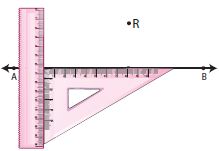 |
| Step 4: Hold the scale firmly and slide the set square along the edge of the scale until the other edge touches the point R. Draw a line RS through R. | 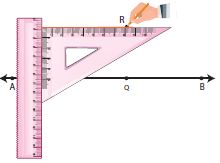 |
| Step 5: The line RS is parallel to AB. That is, RS ║AB. | 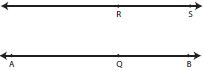 |
13.
(i) 80°, 60°
The sum of 3 angles of triangle = 180°
Let A = 80° , B = 60° , C = ?
A + B + C = 180°
80° + 60° + C = 180°
= 180° - (80° + 60°)
C = 180° - 140° = 40°
Therefore third angle = 40°
(ii) 75°, 35°
The sum of 3 angles of triangle = 180°
Let A = 75°, B = 35°, C = ?
A + B + C = 180°
75° + 35° + C = 180°
= 180° - (75° + 35°)
C = 180° - 110° = 70°
Therefore third angle = 70°
(iii) 52°, 68°
The sum of 3 angles of triangle = 180°
Let A = 52°, B = 68°, C = ?
A + B + C = 180°
52 + 68 + C = 180°
= 180° - (52° + 68°)
C = 180° - 120° = 60°
Therefore third angle = 60°
(iv) 50°, 90°
The sum of 3 angles of triangle = 180°
Let A = 50°, B = 90°, C = ?
A + B + C = 180°
50° + 90° + C = 180°
= 180° - (50° + 90°)
C = 180° - 140° = 40°
Therefore third angle = 40°
(v) 120°, 30°
The sum of 3 angles of triangle = 180°
Let A = 120°, B = 30°, C = ?
A + B + C = 180°
75° + 35° + C = 180°
= 180° - (120°+ 30°)
C = 180° - 150 = 30°
Therefore third angle = 30°
(vi) 55°, 85°
The sum of 3 angles of triangle = 180°
Let A = 55°, B = 85°, C = ?
A + B + C = 180°
55° + 85° + C = 180°
= 180° - (55° + 85°)
C = 180° - 140°= 40°
Therefore third angle = 40°
14.
(i) 60°, 60°, 60°
The sum of the three angles of a triangle = 180°
Sum of three angles = 60° + 60° + 60° = 180° degrees
Yes, a triangle can be formed.
Type: Acute angled triangle.
(ii) 90°, 55°, 35°
The sum of three angles of a triangle = 90° + 55° + 35° = 180°
Yes, a triangle can be formed.
Type: Right angled triangle.
(iii) 60°, 40°, 42°
The sum of three angles of a triangle = 180°
Sum of the angles = 60° + 40° + 42° = 142°
No a triangle cannot be formed.
(iv) 60°, 90°, 90°
The sum of three angles of a triangle = 180°
Sum of the angles = 60° + 90° + 90°
= 240° \(\neq\) 180°
No a triangle cannot be formed.
(v) 70°, 60°, 50°
The sum of three angles of a triangle = 180°
Sum of the angles = 70° + 60° + 50° = 180° = 180° .
Yes, a triangle can be formed.
Type: Acute angled triangle.
(vi) 100°, 50°, 30°
The sum of three angles of a triangle = 180°
Sum of the angles = 100° + 50° + 30°
= 180° = 180°
Yes, a triangle cannot be formed.
Type: Obtuse angled triangle
15.
(c)
6cm, 6cm,7cm
16.
(c)
an acute angled triangle
17.
(d)
acute, acute, right
18.
(a)
5 cm
19.
(d)
an acute angled triangle

6th Standard Syllabus & Materials
6th Standard
TN 6th Social Science T3 - GEO - Understanding Disaster Sample Question Papers Study Material - QB365 Set A
NEW6th Standard
TN 6th Social Science T3 - GEO - Globe Sample Question Papers Study Material - QB365 Set A
NEW6th Standard
TN 6th Social Science T3 - GEO - Asia and Europe Sample Question Papers Study Material - QB365 Set A
NEW6th Standard
TN 6th Social Science T3 - HIS - South Indian Kingdoms Sample Question Papers Study Material - QB365 Set A



Tamilnadu Stateboard 6th Standard Subjects
Tamilnadu Stateboard Standards




