
 100% FREE ACCESS
6th Standard CBSE Syllabus & Materials
6th Standard CBSE
CBSE 6th Social Science The Value of Work - New Sample Question Papers Study Material - QB365 Set A
NEW6th Standard CBSE
CBSE 6th Social Science Family and Community - New Sample Question Papers Study Material - QB365 Set A
NEW6th Standard CBSE
CBSE 6th Social Science India's Cultural Roots - New Sample Question Papers Study Material - QB365 Set A
NEW6th Standard CBSE
CBSE 6th Social Science India,That is Bharat - New Sample Question Papers Study Material - QB365 Set A
NEW6th Standard CBSE
CBSE 6th Social Science Timeline and sources of history - New Sample Question Papers Study Material - QB365 Set A
NEW6th Standard CBSE
CBSE 6th Social Science Oceans and Continents - New Sample Question Papers Study Material - QB365 Set A

Published on: 24/10/2025
Download CBSE Class 6th Standard CBSE Science question papers, sample papers, important questions, and previous year solved papers in PDF format. Get free study materials, NCERT solutions, and exam preparation resources for Class 6th Standard CBSE Science
Questions + Answers key
Take MCQ Science Test
1.
Elbow joint is a ________ joint.
2.
Hinge joint is present in __________________ .
3.
__________ is strongest and longest bone of the body.
4.
The bones at the elbow are joined by a _____________ joint.
5.
Joints of the bones help in the ____________ of the body.
6.
The human skeletal system is made up of 206 bones.
7.
Palm consists of 5 long metacarpal bones.
8.
Cockroaches cannot walk.
9.
The forearm has two bones.
10.
The movement and locomotion of all animals is exactly the same.
11.
Leech
12.
Insects
13.
Fish
14.
Cow
15.
Snail
16.
Mention the number of bones present in human skeletal system. Give its functions.
17.
Skeleton is made of bones but it has some cartilage too. Do you agree?
18.
There are 12 pairs of curved bones called X in our chest region. One end of bones X is joined to backbone and their other end is joined to bone Y in the front to form a box-like structure Z. This strong, box-like structure protects the delicate organs P, Q and R our body.
(a) What are (i) X, (ii) Y and (iii) Z?
(b) Name the organs.
(i) P (ii) Q (iii) R
19.
(a) What is ball and socket joints?
(b) Which of the skull bones are movable?
(c) Why can our elbow not move backwards?
20.
Rishi was playing football with his friends. While playing football he fell down and started crying. On seeing him crying, his friends rushed to him and found that he was unable to move his right leg. His friends took him to his house. His father immediately rushed him to a doctor. Doctor diagnosed that his leg was fractured.
(a) Can you suggest, how did doctor diagnose in Rishi's leg?
(b) What do X-rays show us?
(c) What are the values shown by Rishi's friends?
21.
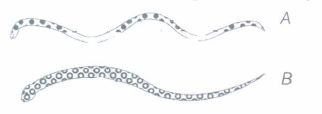
In the figure given below, there are two snakes of the same size slithering on sand. Can you identify which of them would move faster and why?
22.
The joint at the elbow is the _______joint.
Pivot
Hinge
Balland socket
Gliding
23.
Which of the following joints is immovable?
Shoulder and arm
Knee and joint
Upper jaw and skull
Lower jaw and upper jaw
24.
Skeleton of human body is made up of
bones
cartilage
Both (a) and (b)
None of these
25.
How many muscles work together to move a bone?
One
Two
Three
Four
26.
Which of the following parts of our body help us in movement?
(i) Bones
(ii) Skin
(iii) Muscles
(iv) Organs
Choose the correct answer from the option below.
(i) and (iii)
(ii) and (iv)
(i) and (iv)
(ii) and (iii)
27.
Some animals like fishes, birds and snakes move due to streamlined body. What do you mean by streamlined?
28.
Name two animals which move without bones.
29.
Name the type of joints of your hand which helps you to grasp a badminton racquet.
30.
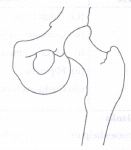
Identify the type of joint in the figure given below:
31.
Which bones enclose. The portion of our body below the stomach.
32.
Which part of the skull encloses the brain?
33.
What modifications do birds have for flying?
34.
What type of skeleton does a snail have?
1.
()
hinge
2.
()
elbow
3.
()
Thigh bone
4.
()
hinge
5.
()
movement
6.
(a)
7.
(a)
8.
(b)
9.
(a)
10.
(b)
11.
()
Swims with the help of muscles.
12.
()
Breast is connected with 3 pairs of legs and 2 pairs of wings.
13.
()
Fins
14.
()
Limbs
15.
()
shows very slow movement or has an outer skeleton
16.
The human skeletal system is made up of 206 bones.
The functions of skeleton system are
(i) Giving shape and support to the body
(ii) Protecting internal organs
(iii) Making movement possible
17.
Yes, cartilages are the additional parts of the skeleton that are not as hard as the bones and which can bent. So, we can say that though most of the skeleton is made of bones but it has some cartilages too.
18.
(a) (i) Ribs X (ii) Breast bone Y (iii) Ribcage Z
(b) (i) Heart P (ii) Lungs Q (iii) Liver R
19.
(a) A joint in which the rounded end of one bone fits into the hollow space of other bone is called ball and socket joint. It allows movements in all the directions. Joints between upper arm and shoulder, thigh and hip are examples of ball and socket joints.
(b) In skull, only the lower jaw is movable. All the other bones of skull are immovable.
(c) Our elbow cannot move backwards because the elbow has a hinge joint that allows movement in only one direction.
20.
(a) The doctor has diagnosed the fracture by taking photographs of bones, i.e. X-ray images.
(b) X-rays show us the images and shapes of different bones in our body.
(c) Friendly behaviour, sense of responsibility and kind nature are the values shown by Rishi's friends.
21.
A snake form loops in its body while slithering. Each loop of the snake gives it a forward push by pressing against the ground. The snake with a larger number of loops will move much faster than the snake with lesser number of loops. Thus, the snake A will move faster than snake B as we can see that loops in snake A are more than in snake B.
22.
23.
(c)
Upper jaw and skull
24.
(c)
Both (a) and (b)
25.
(b)
Two
26.
(a)
(i) and (iii)
27.
If the body tapers at both the ends, then such shape of the body is said to be streamlined.
28.
Earthworm and snail move without the bones.
29.
Hinge joint of our hand helps us to grasp a badminton racquet.
30.
()
Ball and Socket joint.
31.
()
Pelvic bones enclose the portion of our body below the stomach.
32.
()
Cranium encloses brain.
33.
()
Forelimbs of birds are modified to wings which help them in flying.
34.
()
Snail has exoskeleton.

6th Standard CBSE Syllabus & Materials
6th Standard CBSE
CBSE 6th Social Science Locating Places on the Earth - New Sample Question Papers Study Material - QB365 Set A
NEW6th Standard CBSE
CBSE 6th Science A Journey Through States of Water - New Sample Question Papers Study Material - QB365 Set A
NEW6th Standard CBSE
CBSE 6th Science Temperature and its Measurement - New Sample Question Papers Study Material - QB365 Set A
NEW6th Standard CBSE
CBSE 6th Science Materials Around Us - New Sample Question Papers Study Material - QB365 Set A



NCERT Books

Syllabus

Exam Pattern

Sample Question Papers

Previous year Question Papers

Important Notes

MCQ Practice test

NCERT Exemplers

Case study Questions

Image Based Questions

Passage based Questions

HOT Questions

Value Based Questions

Model Questions Papers
NCERT ( Book Back ) Questions

Assertion and Reason
Important Questions And Answers

CBSE 6th Standard CBSE Subjects
CBSE Standards


