
 100% FREE ACCESS
6th Standard CBSE Syllabus & Materials
6th Standard CBSE
CBSE 6th Social Science The Value of Work - New Sample Question Papers Study Material - QB365 Set A
NEW6th Standard CBSE
CBSE 6th Social Science Family and Community - New Sample Question Papers Study Material - QB365 Set A
NEW6th Standard CBSE
CBSE 6th Social Science India's Cultural Roots - New Sample Question Papers Study Material - QB365 Set A
NEW6th Standard CBSE
CBSE 6th Social Science India,That is Bharat - New Sample Question Papers Study Material - QB365 Set A
NEW6th Standard CBSE
CBSE 6th Social Science Timeline and sources of history - New Sample Question Papers Study Material - QB365 Set A
NEW6th Standard CBSE
CBSE 6th Social Science Oceans and Continents - New Sample Question Papers Study Material - QB365 Set A

Published on: 24/10/2025
Download CBSE Class 6th Standard CBSE Science question papers, sample papers, important questions, and previous year solved papers in PDF format. Get free study materials, NCERT solutions, and exam preparation resources for Class 6th Standard CBSE Science
Questions + Answers key
Take MCQ Science Test
1.
Name two translucent objects.
2.
Is a mango sapling a herb? Give reason to support your answer.
3.
How much time does adaptation take to occur?
4.
Write a short note on the water cycle
5.
Out of all identified parts, name the part of the plants that we eat generally.
6.
Correct the definitions of certain terms given below by changing only one word.
(a) Compost Substances converted into manure for use in industries.
(b) Landfill Garbage buried under water in an area.
(c) Recycling Reuse of unused material in the same or another form.
7.
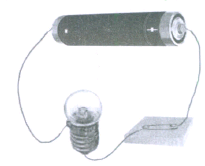
An electric bulb is connected to a cell through a switch as shown in figure. When the switch is brought in ON position, the bulb does not glow. What could be the possible reasons for it? Mention any two of them.
8.
Give an example of a non-living thing which shows any two characteristics of living things.
9.
Give three common characteristics of materials.
10.
If a plant has fibrous root, what type of venation do its leaves likely to have?
11.
Invention of ______________ changed the mode of transport significantly.
12.
Liquids that are soluble in one another are called ............. liquids.
13.
The habitats of plants and animals that live in water are called____________ habitat.
14.
A device that is used to break an electric circuit is called_____________
15.
Milk provides ____________ vitamin-D and _________ (mineral).
16.
Which of the following can be recycled?
Waste paper
Kitchen waste
Leather
Animal waste
17.
Flood means:
Excess of water
Scarcity of water
Food and milk
Spilling of milk
18.
Which of the following are characteristics of living beings?
(i) Respiration
(ii) Reproduction
(iii) Adaptation
(iv) Excretion
Choose the correct answer from the options below.
(i), (ii) and (iv)
(i) and (ii)
(ii) and (iv)
(i), (ii) (iii) and (iv)
19.
Bouncing back of ray of light from shining surface on which it was incident is known as
refraction
bending
reflection
dispersion
20.
Salt can be separated from its solution (salt dissolved in water) because
mixing of salt in water is a change that can be reversed by heating and melting of salt
mixing of salt in water is a change that cannot be reversed
mixing of salt-in water is a permanent change
mixing of salt in water is a change that can be reversed by evaporation
21.
The north pole of a freely suspended magnet points towards the magnetic south pole of earth.
22.
The image of a yellow rose is black in colour.
23.
Arrangement of leaf on plant is called venation.
24.
Cotton yarn on burning gives an odour similar to that of a burning paper.
25.
The boiling of rice is a physical change.
26.
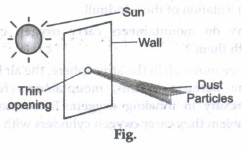
How can you say that air contains dust particles?
27.
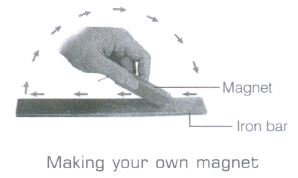
Describe the steps involved in the magnetising of an iron strip with the help of a magnet.
28.
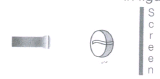
A student had a ball, a screen and a torch in working condition. He tried to form a shadow of the ball on the screen by placing them at different positions. Sometimes,1he shadow was not obtained. Explain.
29.
Sugar, salt, mustard oil, sand, sawdust, honey, chalk powder, petals of flower, soil, copper sulphate crystals, glucose, wheat flour are some substances given to Paheli. She wants to know whether these substances are soluble in water or not. Help her in identifying soluble and insoluble substances in water.
30.
One day, students were asked to perform an activity. They were told to identify the root system in some given plant samples by analysing the venation in leaves. Archana at the same time failed to do so. She got sad and asked her teacher to guide her after the test.
(a) How will you identify the root system by analysing the leaves?
(b) Distinguish two types of venation in leaves.
(c) What are the values shown by Archana?
31.
Tendon
32.
Earthworm
33.
Cow
34.
Ribs
35.
Upper jaw
36.
Name two synthetic fibres.
37.
Cartilage provides the shape to our body and also lubrication in movement. Is it true?
38.
Name two changes in yourself that you face every day.
39.
Why do we write in laterally inverted letters on ambulance?
40.
Who are non-vegetarians?
1.
Butter paper and oiled paper are two examples of translucent objects
2.
No, it is not a herb because sapling is a stage in the growth of the plant. A mango sapling would grow into a tree.
3.
Adaptation does not take place in a short time. The abiotic factors of a region change over thousands of years. The animals and plants which cannot change themselves and do not adapt to these changes die out and those who adapt are able to survive.
4.
Water from the oceans and surface of the earth goes into air as vapours and returns as rain, hail or snow and finally goes back to the oceans. The circulation of water in this manner is known as water cycle. The circulation of water between ocean and land is a continuous process. It maintains the supply of water on land.
5.
We generally eat fruit of many plants.
6.
(a) Compost is a substance converted into manure for use in agricultural fields.
(b) Landfill is the place where garbage is buried under soil in an area.
(c) Recycling is a process of using used material in the same or another form.
7.
The possible reasons so that the even at switch ON position bulb is not glowing are
(i) The cell may be discharged.
(ii) The bulb may be fused.
(iii) The wire may be broken from inside.
8.
Cloud is an example of non-living thing which shows following two characteristics of living things:
(i) It increases or decreases in size
(ii) It shows movements.
(Another example can be a car move from one place to another and also requires energy, i.e. petrol).
9.
The three common characteristics of materials are.
(i) All materials occupy space.
(ii) All materials possess mass.
(iii) All materials can be felt by one or more of our sense organs.
10.
If a plant has fibrous root, its leaves have parallel venation.
11.
()
wheel
12.
()
miscible
13.
()
aquatic
14.
()
switch
15.
()
protein, calcium
16.
(a)
Waste paper
17.
(a)
Excess of water
18.
(d)
(i), (ii) (iii) and (iv)
19.
(c)
reflection
20.
(d)
mixing of salt in water is a change that can be reversed by evaporation
21.
(a)
22.
(a)
23.
(a)
24.
(a)
25.
(b)
26.
On a sunny day, go to a room which is a little bit dark. In this room, choose a thin opening through which light can enter the room. If, there is no opening in the room, then make one. From this opening we will see that a sharp beam of sunlight enters the room. In this beam, we will observe that there are some tiny solid-like particles moving freely. These particles are the dust particles, and this shows the presence of dust particles in air.
27.
Steps involved in the magnetising of an iron strip are
(i) Take an iron strip which is to be magnetised.
(ii) Keep it in a wooden table.
(iii) Hold one end of bar magnet in your hand and keep the other end of bar magnet at one end of iron bar.
(iv) Without lifting, move the lower end of bar magnet to the end of iron bar.
(v) After reaching end of iron bar, lift the bar magnet and bring it to the same position and repeat the process again and again.
28.
Sometimes, the shadow of the object (ball) may not be formed because of improper arrangement. It may be that the direction of the torchlight is not towards the screen. The shadow will be formed only if screen, torch and ball are in the same straight line (as shown in figure).
29.
Substances soluble in water are sugar, salt, honey, copper sulphate crystals, glucose. Substances insoluble in water are mustard oil, sand, sawdust, chalk powder, petals of flower, soil, wheat flour.
30.
(a) The leaves with reticulate venation have tap roots. Whereas leaves with parallel venation have fibrous roots. We can identify the roots by keeping these points in mind.
(b) There are two types of venations seen in different plants.
(i) Reticulate venation In such type, the veins make a network of veins around the main midrib, e.g.sunflower, mustard, etc.
(ii) Parallel venation In such type, the veins run parallel along the main midrib, e.g. maize, wheat, etc.
(c) Archana is a responsible, student. She is attentive towards her studies and has scientific attitude.
31.
()
Joins bones to muscles.
32.
()
Move by alternate extension and contraction of the body.
33.
()
Limbs
34.
()
protect the heart
35.
()
is an immovable joint
36.
()
Rayon and Nylon
37.
()
Yes, it is true.
38.
()
(a) Daily hair growth.
(b) Daily nail growth
39.
()
So that we can see it right in rearview mirror.
40.
()
People who eat meat, egg, fish and other foods of animal origin are non-vegetarians.

6th Standard CBSE Syllabus & Materials
6th Standard CBSE
CBSE 6th Social Science Locating Places on the Earth - New Sample Question Papers Study Material - QB365 Set A
NEW6th Standard CBSE
CBSE 6th Science A Journey Through States of Water - New Sample Question Papers Study Material - QB365 Set A
NEW6th Standard CBSE
CBSE 6th Science Temperature and its Measurement - New Sample Question Papers Study Material - QB365 Set A
NEW6th Standard CBSE
CBSE 6th Science Materials Around Us - New Sample Question Papers Study Material - QB365 Set A



NCERT Books

Syllabus

Exam Pattern

Sample Question Papers

Previous year Question Papers

Important Notes

MCQ Practice test

NCERT Exemplers

Case study Questions

Image Based Questions

Passage based Questions

HOT Questions

Value Based Questions

Model Questions Papers
NCERT ( Book Back ) Questions

Assertion and Reason
Important Questions And Answers

CBSE 6th Standard CBSE Subjects
CBSE Standards


