
 100% FREE ACCESS
6th Standard CBSE Syllabus & Materials
6th Standard CBSE
CBSE 6th Social Science The Value of Work - New Sample Question Papers Study Material - QB365 Set A
NEW6th Standard CBSE
CBSE 6th Social Science Family and Community - New Sample Question Papers Study Material - QB365 Set A
NEW6th Standard CBSE
CBSE 6th Social Science India's Cultural Roots - New Sample Question Papers Study Material - QB365 Set A
NEW6th Standard CBSE
CBSE 6th Social Science India,That is Bharat - New Sample Question Papers Study Material - QB365 Set A
NEW6th Standard CBSE
CBSE 6th Social Science Timeline and sources of history - New Sample Question Papers Study Material - QB365 Set A
NEW6th Standard CBSE
CBSE 6th Social Science Oceans and Continents - New Sample Question Papers Study Material - QB365 Set A

Published on: 24/10/2025
Download CBSE Class 6th Standard CBSE Science question papers, sample papers, important questions, and previous year solved papers in PDF format. Get free study materials, NCERT solutions, and exam preparation resources for Class 6th Standard CBSE Science
Questions + Answers key
Take MCQ Science Test
1.
Some bags of cement lying on the floor get wet due to the leakage of tap water in the room. The next day, they are kept in the sunshine. Do you think the changes, that have occurred in the cement could be reversed?
2.
Sometimes the rail tracks become curved. Explain why this happens.
3.
Rohit puts a few drops of alcohol on the back of his hand. The alcohol disappears and his hand feels cool. Why does this happen?
4.
Differentiate between physical and chemical changes. Give two examples.
5.
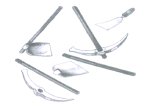
How the iron blade in these tools is fixed to the wooden handle?
6.
Name the cause of change which takes place during the
(a) conversion of ice into water.
(b) conversion of water into hydrogen and oxygen.
(c) formation of image of a person on a photographic film.
(d) bending of iron rods to make an iron grille.
7.
What is charring of sugar? State whether it is a physical change or chemical change.
8.
Can we say that ironing of a cloth is a reversible change? Give reasons.
9.
A potter working on his wheel-shaped a lump of clay into a pot. He then baked the pot in an oven. Do these two acts lead to the same kind of changes or different? Give your opinion and justify your
10.
Boojho's sister broke a white dove, a symbol of peace, made of Plaster of Paris (POP). Boojho tried to reconstruct the toy by making a powder of the broken pieces and then making a paste by mixing water. Will he be successful in his effort? Justify your answer.
11.
Tearing of paper is said to be a change that cannot be reversed. What about paper recycling?
12.
Can we reverse the following changes? If yes, suggest the name of the method.
(a) Water into water vapour
(b) Water vapour into water
(c) Ice into water
(d) Curd into milk
13.
A thick coating of a paste of Plaster of Paris (POP) is applied over the bandage on a fractured bone. It becomes hard on drying to keep the fractured bone immobilised. Can the change in POP be reversed?
14.
You accidently dropped your favourite toy and broke it. This is a change you did not want. Can this change be reversed?
15.
To walk through a waterlogged area, you usually shorten the length of your dress by folding it. Can this change be reversed?
1.
Cement bags are converted into a hard mass due to the chemical reaction with water. Anew product is formed, which has entirely different properties. So it being a chemical changes cannot be reversed.
2.
We know that the heating of any metal causes it to expand. In the same way, the sun heat causes the rail tracks made up of metal to expand. So, these tracks become curved.
3.
It happens because, the heat energy required for the change is provided by the body
4.
| S.No | Physical change | Chemical change |
|---|---|---|
| 1 | Only physical properties like colour volume, etc change. | The chemical composition and chemical properties of the reacting substances undergo a chang |
| 2 | No new substance is formed. Examples: (i) Conversion of water into ice. (ii)Tearing of paper. |
One or more new substances are formed Examples: (i) Burning of cooking gas, (ii)Ripening of fruits. |
5.
To fix the handle, the ring is heated and it becomes slightly large in size. Then, the handle easily fits into the ring. When the ring cools down contracts and fits tightly onto the handle.
6.
(a) Heat
(b) Electricity
(c) Light
(d) Force
7.
When sugar is continuously heated in the porcelain dish, it becomes foggy due to water vapour. A black powdery substance is left behind which is charcoal. This process is called charring of sugar.
This is a chemical change.
8.
Ironing removes the wrinkles of the clothes which can be get back in the same condition. Hence, ironing of a cloth is a reversible change.
9.
These two acts are of different kinds. Making a lump of clay into a pot is a reversible change, while baking the pot in an oven is an irreversible change.
10.
Boojho will not be successful because making of toy from Plaster of Paris (POP) is a Change that cannot be reversed.
11.
We can get the paper on paper recycling but it is not the same original paper that we get. The colour and texture of the paper change.
12.
(a) Yes, the name of method is condensation.
(b) Yes, the name of method is evaporation.
(c) Yes, the name of method is freezing.
(d) Not possible.
13.
No, the change in POP cannot be reversed because it is a irreversible chemical change.
14.
No, this change cannot be reversed. Because breaking of a toy is an irreversible change, we cannot regain the same toy.
15.
Yes, we can reverse this change by unfolding the dress.

6th Standard CBSE Syllabus & Materials
6th Standard CBSE
CBSE 6th Social Science Locating Places on the Earth - New Sample Question Papers Study Material - QB365 Set A
NEW6th Standard CBSE
CBSE 6th Science A Journey Through States of Water - New Sample Question Papers Study Material - QB365 Set A
NEW6th Standard CBSE
CBSE 6th Science Temperature and its Measurement - New Sample Question Papers Study Material - QB365 Set A
NEW6th Standard CBSE
CBSE 6th Science Materials Around Us - New Sample Question Papers Study Material - QB365 Set A



NCERT Books

Syllabus

Exam Pattern

Sample Question Papers

Previous year Question Papers

Important Notes

MCQ Practice test

NCERT Exemplers

Case study Questions

Image Based Questions

Passage based Questions

HOT Questions

Value Based Questions

Model Questions Papers
NCERT ( Book Back ) Questions

Assertion and Reason
Important Questions And Answers

CBSE 6th Standard CBSE Subjects
CBSE Standards


