
 100% FREE ACCESS
6th Standard CBSE Syllabus & Materials
6th Standard CBSE
CBSE 6th Social Science The Value of Work - New Sample Question Papers Study Material - QB365 Set A
NEW6th Standard CBSE
CBSE 6th Social Science Family and Community - New Sample Question Papers Study Material - QB365 Set A
NEW6th Standard CBSE
CBSE 6th Social Science India's Cultural Roots - New Sample Question Papers Study Material - QB365 Set A
NEW6th Standard CBSE
CBSE 6th Social Science India,That is Bharat - New Sample Question Papers Study Material - QB365 Set A
NEW6th Standard CBSE
CBSE 6th Social Science Timeline and sources of history - New Sample Question Papers Study Material - QB365 Set A
NEW6th Standard CBSE
CBSE 6th Social Science Oceans and Continents - New Sample Question Papers Study Material - QB365 Set A

Published on: 24/10/2025
Download CBSE Class 6th Standard CBSE Science question papers, sample papers, important questions, and previous year solved papers in PDF format. Get free study materials, NCERT solutions, and exam preparation resources for Class 6th Standard CBSE Science
Questions + Answers key
Take MCQ Science Test
1.
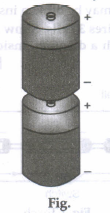
What is a battery? Explain it with a figure.
2.
Explain why all the light bulbs and fans go off if the main switch is turned off in your house.
3.
Briefly explain about the components present inside the cell.
4.
Discuss briefly that how switch works.
5.
What is an electric switch? What is the purpose of using it ? Give some examples of electrical appliances where electric switches are used.
6.
Describe an electric cell with the help of a labelled diagram.
7.
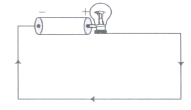
Boojho has a cell and a single piece of connecting wire. Without cutting the wire in two, will he be able to make the bulb glow? Explain with the help of a circuit diagram.
8.
If we touch a base wire and we are in contact with earth, then we can get an electric shock and if we are standing above a plastic or drywood chair, then even on touching the base wire, we will not get any electric shock. Explain why.
9.
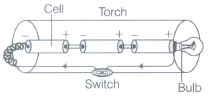
A torch requires 3 cells. Show the arrangement of the cells with a diagram inside the torch so that the bulb glows.
10.
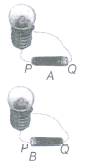
In figures A and B, show a bulb connected to a cell in two different ways.
(a) Mention the direction of the current through the bulb in both the cases (Q to P or P to Q)?
(b) Will the bulb glow in both the cases?
(c) Does the brightness of the glowing bulb depend on the direction of current through it?
1.
When two or more than two electric cells are connected together in such a way that the positive terminal of one cell is connected to the negative terminal of the other, then we call it a battery. A simple connection showing the combination of two electric cells to form a battery is shown below:
2.
Current flows in our house appliances through the main switch. When it is turned off, flow of current stops and our lights and fans go off.
3.
The cell consists of a carbon rod present of the centre of the zinc container. By the side, metal cup present is positive terminal and opposite to that is a metal disc which is of negative terminal.
4.
A device which is used to close or open a circuit is known as-switch, so when we open the switch, there exists an air gap which does not allow the current to pass through it. On the other hand, when it is closed, then there is not any existence of air gap between the wires and therefore in this way, it conducts electricity.
5.
An electric switch is a device used to complete or break an electric circuit. Usually, it is manually operated.
Purpose of using electric switch: In 'ON' position, the switch allows the current to flow through the circuit. Thus, the circuit becomes a closed circuit. In 'OFF' position, the switch does not allow current to flow through the circuit. Thus, the circuit becomes an open circuit.
Examples: Electrical appliances such as fans, electric lamps, washing machines, juicer and mixer, TV radio, etc, have switches.
6.
An electric cell consists of a cylindrical pot which is covered by a thick paper sheet.
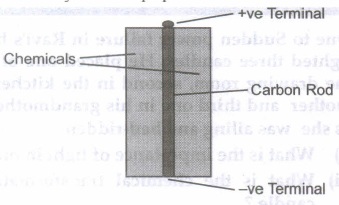
It consists of two terminals. One is called positive terminal and the other is called negative terminal. The metal cap is the positive terminal and the metal disc is the negative terminal of the electric cell.
The production of electric current takes place due to the chemical reactions inside the cell. The chemicals are present between the outermost covering of the cell and carbon rod.
7.
This can be done by arranging the circuit as the given diagram.
One terminal should be connected to the terminal of the cell directly and other terminal can be connected using the given wire.
8.
Current can only flow through a body if it gets the way to pass through it. In case of the earth, it gets the way from base wire to your body to the earth. In case of plastic chair or dry wood chair, it doesn't get the way to flow. So, you don't get any electric shock.
9.
The arrangement of bulb should be such that positive terminal of a battery touches the base of the bulb. When switch ON, bulb will glow.
10.
(a) The direction of current will be from Q to P in A and direction of current will be from P to Q in B. Because direction of current is always from positive terminal to negative terminal of the cell or battery.
(b) Yes, the bulb will glow in both the cases because to glow the bulb, we just need to complete the circuit.
(c) No, the brightness of the bulb never depend upon the direction of current passing through it.

6th Standard CBSE Syllabus & Materials
6th Standard CBSE
CBSE 6th Social Science Locating Places on the Earth - New Sample Question Papers Study Material - QB365 Set A
NEW6th Standard CBSE
CBSE 6th Science A Journey Through States of Water - New Sample Question Papers Study Material - QB365 Set A
NEW6th Standard CBSE
CBSE 6th Science Temperature and its Measurement - New Sample Question Papers Study Material - QB365 Set A
NEW6th Standard CBSE
CBSE 6th Science Materials Around Us - New Sample Question Papers Study Material - QB365 Set A



NCERT Books

Syllabus

Exam Pattern

Sample Question Papers

Previous year Question Papers

Important Notes

MCQ Practice test

NCERT Exemplers

Case study Questions

Image Based Questions

Passage based Questions

HOT Questions

Value Based Questions

Model Questions Papers
NCERT ( Book Back ) Questions

Assertion and Reason
Important Questions And Answers

CBSE 6th Standard CBSE Subjects
CBSE Standards


