
 100% FREE ACCESS
6th Standard CBSE Syllabus & Materials
6th Standard CBSE
CBSE 6th Social Science The Value of Work - New Sample Question Papers Study Material - QB365 Set A
NEW6th Standard CBSE
CBSE 6th Social Science Family and Community - New Sample Question Papers Study Material - QB365 Set A
NEW6th Standard CBSE
CBSE 6th Social Science India's Cultural Roots - New Sample Question Papers Study Material - QB365 Set A
NEW6th Standard CBSE
CBSE 6th Social Science India,That is Bharat - New Sample Question Papers Study Material - QB365 Set A
NEW6th Standard CBSE
CBSE 6th Social Science Timeline and sources of history - New Sample Question Papers Study Material - QB365 Set A
NEW6th Standard CBSE
CBSE 6th Social Science Oceans and Continents - New Sample Question Papers Study Material - QB365 Set A

Published on: 24/10/2025
Download CBSE Class 6th Standard CBSE Science question papers, sample papers, important questions, and previous year solved papers in PDF format. Get free study materials, NCERT solutions, and exam preparation resources for Class 6th Standard CBSE Science
Questions + Answers key
Take MCQ Science Test
1.
Silk is a plant fibre.
2.
Jute fibres are obtained from the stem of jute plant.
3.
Polyester is a natural fibre.
4.
The process of removing seeds from cotton is called ginning.
5.
Spinning is a process of making fibres.
6.
Yarn is made from fibres.
7.
What are synthetic fibres? Give examples.
8.
What is weaving? Name the device that is used for weaving.
9.
Why coconut fibres are used in making ropes?
10.
Which type of soil is best suited for jute crop?
11.
Give the name of two simple devices used for spinning.
12.
Name two fibres which are obtained from the stems of plants.
13.
Out of cotton, nylon, flax and wool which is not a natural fibre?
14.
In which states of India cotton is grown?
15.
Are the cotton and jute obtained from animals?
16.
What is Ginning?
17.
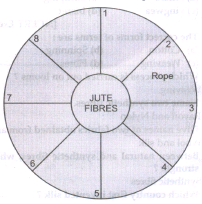
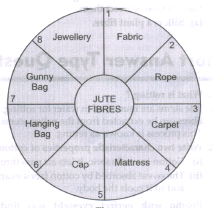
Fill in the names of useful items made from jute fibres in Fig. One such example is given.
18.
Which part of these plants have fibres?
(a) Cotton
(b) Coconut
(c) Jute
19.
This is the only natural fibre obtained from an insect:
Nylon
Silk
Wool
Jute
20.
Takli is a device used for:
Ginning
Weaving
Knitting
Spinning
21.
Cotton bolls are which part of the plant?
Flower
Fruit
Stem
Root
22.
A synthetic fibre is:
Cotton
Rayon
Wool
Fur
23.
Beera is a farmer. His field has black soil and the climate is warm. Which fibre yielding plant should he grow in his field?
Jute
Cotton
Coconut
Wool
24.
Which part of the jute plant is used for getting jute fibre?
Flower
Stem
Fruit
Leaf
25.
Boojho went to a cloth shop. There he found a fabric which was smooth to touch, had vibrant colour and shine. The fabric could be
cotton
wool
silk
jute
26.
Which set of substances is not used for making fibres?
Silk, chemicals
Yak hair, camel hair
Husk, bones
Flax, wool
27.
Which of the following is not a natural fibre?
Cotton
Jute
Nylon
Flax
28.
Yarn is woven to get fabric using
charkha
spinning machines
looms
knitting needles
29.
Weaving is done on __________.
30.
The ________ fibre absorbs sweat, thus giving cooling effect.
31.
________ soil is the best soil for growing cotton.
32.
Jute is cultivated in ____________ season.
33.
Silk is obtained from ___________ of silkworm.
34.
For cultivation of cotton crop,___________ soil is excellent.
35.
You are given Two kinds of fibres. How do you identify the synthetic as well as natural fibre in it?
36.
How many yarns are used for knitting?
37.
Which country first invented silk?
38.
Give names of two fabrics obtained from animals.
39.
Name two synthetic fibres.
40.
Which process is carried out on looms?
41.
Classify the following fibres as natural and synthetic: Acrylic, Wool, Jute, Polyester, Rayon. Give reason also.
42.
Mention the sources and uses of the following
fibres: cotton, jute, silk and wool.
43.
Describe the two main processes of making fabric from yarn.
1.
(b)
2.
(a)
3.
(b)
4.
(a)
5.
(b)
6.
(a)
7.
Man-made fibres are called synthetic fibres, e.g., Nylon, rayon, polyester etc.
8.
The process of arranging two sets of yarns together to make a fabric is called weaving. The device used for weaving are looms.
9.
Coconut fibres are rough and very hard, so these can only be used for making ropes.
10.
All valuable soil in the delta regions of rivers like Ganga and Brahmaputra is best for the cultivation of jute.
11.
Charkha and takli are used for spinning.
12.
Flax arid jute fibres are obtained from the stems of the plants.
13.
Nylon is not a natural fibre, it is a synthetic fibre.
14.
In Maharashtra, Karnataka, Madhya Pradesh, Gujarat, Tamilnadu, etc. cotton is grown.
15.
No, cotton and jute are obtained from plants.
16.
17.
18.
(a) Cotton - Seeds (fruits or cotton bolls)
(b) Coconut - Fruits
(c) Jute - Stems (Barks)
19.
(b)
Silk
20.
(d)
Spinning
21.
(b)
Fruit
22.
(b)
Rayon
23.
(b)
Cotton
24.
(b)
Stem
25.
(c)
silk
26.
(c)
Husk, bones
27.
(c)
Nylon
28.
(c)
looms
29.
()
looms
30.
()
Cotton
31.
()
Black
32.
()
rainy
33.
()
cocoon
34.
()
black
35.
()
36.
()
A single yarn is used for knitting.
37.
()
China
38.
()
Wool and silk
39.
()
Rayon and Nylon
40.
()
Weaving.
41.
Natural fibres: Wool and Jute.
i) Wool is an animal fibre which is obtained from sheep.
ii) Jute is a plant fibre which is obtained from plant.
Synthetic fibres: Acrylic, Polyester, Rayon.
iii) These are man-made fibres which are prepared from different chemical substances.
42.
Cotton:
Source: Fruits of cotton plants
Uses: It is used in making clothes, bed sheets, curtains, towels and quilts.
Jute:
Source: Bast or skin of jute plant stem
Uses: It is used in making curtains, chair coverings, carpets and rugs.
Silk:
Source: Cocoons of silkworms
Uses: It is used in making clothes, velvet etc.
Wool:
Source: Fleeces of sheep or other hairy animals such as yak, camel, goat etc.
Uses: It is used in making clothes, sweaters, carpets etc.
43.
The two main processes of making fabric from yarn are weaving and knitting.
Weaving: It is the arrangement of two sets of yam to make a fabric. The threads are crossed over and under each other. This is done on machines called looms.
Knitting: It is the formation of fabric from single yarn. It is done by hand as well as by machine.

6th Standard CBSE Syllabus & Materials
6th Standard CBSE
CBSE 6th Social Science Locating Places on the Earth - New Sample Question Papers Study Material - QB365 Set A
NEW6th Standard CBSE
CBSE 6th Science A Journey Through States of Water - New Sample Question Papers Study Material - QB365 Set A
NEW6th Standard CBSE
CBSE 6th Science Temperature and its Measurement - New Sample Question Papers Study Material - QB365 Set A
NEW6th Standard CBSE
CBSE 6th Science Materials Around Us - New Sample Question Papers Study Material - QB365 Set A



NCERT Books

Syllabus

Exam Pattern

Sample Question Papers

Previous year Question Papers

Important Notes

MCQ Practice test

NCERT Exemplers

Case study Questions

Image Based Questions

Passage based Questions

HOT Questions

Value Based Questions

Model Questions Papers
NCERT ( Book Back ) Questions

Assertion and Reason
Important Questions And Answers

CBSE 6th Standard CBSE Subjects
CBSE Standards


