
 100% FREE ACCESS
6th Standard CBSE Syllabus & Materials
6th Standard CBSE
CBSE 6th Social Science The Value of Work - New Sample Question Papers Study Material - QB365 Set A
NEW6th Standard CBSE
CBSE 6th Social Science Family and Community - New Sample Question Papers Study Material - QB365 Set A
NEW6th Standard CBSE
CBSE 6th Social Science India's Cultural Roots - New Sample Question Papers Study Material - QB365 Set A
NEW6th Standard CBSE
CBSE 6th Social Science India,That is Bharat - New Sample Question Papers Study Material - QB365 Set A
NEW6th Standard CBSE
CBSE 6th Social Science Timeline and sources of history - New Sample Question Papers Study Material - QB365 Set A
NEW6th Standard CBSE
CBSE 6th Social Science Oceans and Continents - New Sample Question Papers Study Material - QB365 Set A

Published on: 24/10/2025
Download CBSE Class 6th Standard CBSE Science question papers, sample papers, important questions, and previous year solved papers in PDF format. Get free study materials, NCERT solutions, and exam preparation resources for Class 6th Standard CBSE Science
Questions + Answers key
Take MCQ Science Test
1.
Can the stem of a plant be compared with a street with two-way traffic? Give reason.
2.
Give the basis of characterising different types of plants using any one of the salient features.
3.
Roots are necessary to keep the plants healthy and alive. Explain.
4.
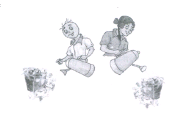
Look at figure, who do you think is watering their plant correctly, Paheli or Boojho? Why?
5.
Which of the following leaves have reticulate venation?
Wheat, tulsi, maize, grass, coriander (dhania), China rose.
6.
Life is not possible without plants. Justify.
7.
Match the parts of plant given in Column I with their functions in Column II.
| Column I | Column II |
| (a) Flower (b) Leaf (c) Stem (d) Root |
(i) Excretion
|
8.
What are weeds?
9.
Briefly describe weeds.
10.
Name various parts of pistil.
11.
Identify the wrong statements and correct them.
(a) Anther is a part of the pistil.
(b) The visible parts of a bud are the petals.
(c) Lateral roots are present in a tap root.
(d) Leaves perform the function of transpiration only.
12.
What are the characteristics of plants?
13.
Describe a leaf.
14.
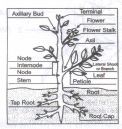
Draw a labelled diagram of a plant.
15.
Observe figure and attempt the questions that follow it.
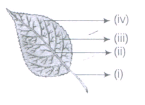
(a) Label the parts (i), (ii), (iii) and (iv) in the figure.
(b) What type of venation does the leaf has?
(c) What type of venation is seen in grass leaves?
16.
Autotrophs make food by the process of :
Respiration
Nutrition
Photosynthesis
Adaptation
17.
Identify the creeper from the following:
Pumpkin
Grape
Potato
None of these
18.
Plants spread out their branches and leaves in order to
get more sunlight
to make it more beautiful
get more rain
provide us with shade
19.
Which part of the plant grows in the soil?
Stem
Leaf
Root
Seed
20.
Sepals, ______(a stamens and ______(b) are the parts of a flower. Stamen is made up of ______ (c) and _______(d) and it represents the _______(e) parts of the flower. The female part of the flower is called the _______(f) The basal, swollen part of the pistil is called the _________(g) which contains the (h)_________
21.
Sweet potato is a modified stem.
22.
Leaves perform the function of transpiration only.
23.
Root
24.
Solve the riddles given below:
(a) I have a green tender stem and I am much shorter than you. Who am I?
(b) I come out first from the seed when it is soaked in water. I provide anchorage to plants. Who am I? Write another function that I perform.
25.
Does stem prepare food in any plant? Give an example.
1.
Yes, the stem of a plant can be compared with a street with two-way traffic because of the following reasons :
(i) It carries water and minerals from the roots to other parts in upward direction.
(ii) It carries food from the leaves to other parts of the plant.
2.
Plants are characterised into three types on the basis of several features. One of the features is "Type of stem" :
Trees: They are tall, have hard, thick and woody stems.
Shrubs: They are of medium height, have hard and woody stems.
Herbs: They are short and have tender, green and short stems.
3.
Roots absorb minerals and water from the soil. These are needed for the manufacture of food by plant leaves. So, roots are necessary to keep the plant healthy and alive.
4.
Paheli is watering the plants correctly. She is sprinkling water on the roots, from where it can travel to all other parts of the plant.
5.
From the options given in the question, leaves of tulsi, coriander and China rose have reticulate venation.
6.
Life is not possible without plants. We should save plants. Plants give us oxygen which is essential for life. They provide us raw materials for various purposes. They are the house of many birds and animals.
7.
| Column I | Column II |
| (a) Flower (b) Leaf (c) Stem (d) Root |
(iii) Reproduction (ii) Photosynthesis (iv) Bears branches (v) Anchorage |
8.
The unwanted plants growing in the fields are called weeds.
9.
Weeds are the unwanted plants, which grow in the fields, lawns or in pots. These plants are not grown by the farmers.
10.
Pistil consists of stigma, style and ovary.
11.
Wrong statements :
(a) Anther is a part of the pistil.
Correct statement: Anther is a part of the stamen.
(b) The visibleparts of a bud are the petals.
Correct statement: The visible parts of a bud are the sepals.
(d) Leaves perform the function of transpiration only.
Correct statement: Leaves perform the functions of both photosynthesis and transpiration.
12.
Characteristics of plants are :
(i) They cannot move from one place to another.
(ii) They can prepare their own food.
(iii) These are the living organisms on the earth which are responsible for the formation of food for all the living forms directly or indirectly.
(iv) All other organisms on the earth depend on the plants and their products for their survival.
(v) Plants grow in the soil from where they take nutrients for their growth and propagation.
13.
A leaf is a thin expanded outgrowth arising from the node of a stem. The part of a leaf by which it is attached to the stem is called a petiole. The broad green part of the leaf is called lamina. The lines on the leaf are called veins. The thick vein in the middle of the leaf is called the midrib. The design made by the veins on the leaf is called venation. H the design is net-like, it is termed as reticulate venation whereas if the veins are parallel to each other, it is termed as parallel venation.
14.
15.
(a) In the given figure:
(i) Petiole (ii) Midrib (iii) Lamina (iv) Vein
(b) The leaf has reticulate venation, the veins in leaf occur in an irregular way forming a net-like structure.
(c) Grass leaves have parallel type of venation. The vein run parallel to each other on both sides of midrib.
16.
17.
18.
(a)
get more sunlight
19.
(c)
Root
20.
()
(a) petals, (b) anther, (c) anther, (d) filament, (e) male, (f) pistil, (g) ovary, (h) ovules
21.
(b)
22.
(b)
23.
()
Anchorage
24.
()
(a) Herb
(b) Root
Another function of root is to absorb water and minerals from the soil.
25.
()
Yes, in cactus plant.

6th Standard CBSE Syllabus & Materials
6th Standard CBSE
CBSE 6th Social Science Locating Places on the Earth - New Sample Question Papers Study Material - QB365 Set A
NEW6th Standard CBSE
CBSE 6th Science A Journey Through States of Water - New Sample Question Papers Study Material - QB365 Set A
NEW6th Standard CBSE
CBSE 6th Science Temperature and its Measurement - New Sample Question Papers Study Material - QB365 Set A
NEW6th Standard CBSE
CBSE 6th Science Materials Around Us - New Sample Question Papers Study Material - QB365 Set A



NCERT Books

Syllabus

Exam Pattern

Sample Question Papers

Previous year Question Papers

Important Notes

MCQ Practice test

NCERT Exemplers

Case study Questions

Image Based Questions

Passage based Questions

HOT Questions

Value Based Questions

Model Questions Papers
NCERT ( Book Back ) Questions

Assertion and Reason
Important Questions And Answers

CBSE 6th Standard CBSE Subjects
CBSE Standards


